|
The most popular and widely distributed big-game animal in North America, whitetails populate almost every area of the continent. Exceptions are portions of the southwestern United States, Alaska and most of the Canadian north. Within the United States alone, over 2 million whitetails fall to successful hunter's each year. This undoubtedly makes whitetails the most sought after big game animal in North America - probably the world!
What makes this smallest of the three major deer species (whitetail, mule deer and blacktail) so much in demand? This is one big game species that has learned to cope with man and thrive. It appears if there is adequate cover, whitetails are present. Divided into 17 subspecies, this premier game animal is at hand for most hunters. Living within sight of New York's skyline, in prairie thickets and the Texas panhandle, whitetails present one of the best hunting possibilities around. If you have access, a better challenge does not exist.
1. ABOUT THE ANIMAL
A BRIEF DESCRIPTION

Whitetails evolved in the America's and have no close relatives in the old world. Always a much sought after big game animal for food and hides, the whitetail disappeared from large regions during the 1800's. By 1900 only a half million survived in North America. However, due to solid management and improved habitat conditions, populations are recently estimated at 12.5 million in the United States and 2.5 million in Canada.
The whitetail is distinguished by several characteristics. This deer's coat is a sleek reddish-brown in summer and a thick grayish-brown in winter. The belly, muzzle, eye rings, insides of the ears, neck, legs and tail are white. Fawns are reddish-brown with white spots on the back and sides. Legs and hoofs are thin and dainty, and the ears are conspicuous. Musk glands occurring along the metatarsal bones are small. The most distinguishing feature, however, is its big flaglike tail - the deer's trademark. The broad, long, bushy tail (up to 11 inches in length) is what gives the whitetail it's name.
 
Antlers branch from one main beam. Growth of these boney structures begins in April; it appears this growth is stimulated through increasing hours of daylight. Each annual set becomes larger until age 5 or 6, starting with buttons in one year old bucks. Growth is also related to diet. Developing antlers are covered by a layer of velvet that contains a network of blood vessels that nourish the bone cells. Come September, the velvet dries up and is rubbed off. The end of the rut occurs in November and decreasing hormone level's results in the annual shedding of antlers from December to March.
Males commonly weigh 190 pounds to a maximum of 425 pounds, while does weigh up to 150 pounds. Some adult subspecies can weigh as little as 40 pounds. This animal can run at speeds of up to 40 miles per hour and jump 35 feet in a single bound. Six foot fences present little problem. When alarmed, individuals snort and bound away with the large tail raised and waving from side to side. This flashes a warning to other deer.
Scientific name - Odocoileus virginianus
Subspecies - 17 subspecies are found in Canada and the United States
The 8 subspecies identified below are most common:
- Virginia
- Northern woodland
- Northwest
- Dakota
- Coues
- Kansas
- Florida
- Texas
RANGES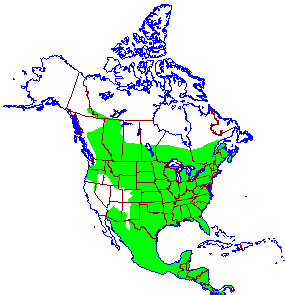
The whitetailed deer occurs across southern Canada, throughout the United States (except for the extreme southwest), Mexico, Central America and into South America to Brazil, Bolivia and Peru. Introduced to Prince Edward Island and Anticosti Island in eastern Canada and countries like Finland, Czechoslovakia and New Zealand, the whitetail deer is a study in its ability to adjust.
The Columbian, Carmen Mountains, Avery Island, Bull's Island, Hunting Island, Hilton Head Island, Blackbeard Island, Florida Coastal and the Florida Key whitetail are all distinct subspecies. They appear to survive as distinct subspecies due to their isolation from other whitetail populations.
The adaptability of this game animal is remarkable. Whitetails find suitable living conditions in humid tropical jungles, impregnable swamps, hot arid deserts, prairie thickets and the forests of cold northern and mountain regions. Body size tends to increase in colder climates and decrease when found closer to the equator. This is true with most species and is highly evident with the whitetail deer. Small bodies dissipate heat faster, while large bodies are more efficiently heated. As a general rule of thumb, the farther north you range, the larger the deer.
The range of the whitetail deer has steadily moved northward during the last century, largely due to the development of hardier cereal crops and the clearing of land that ensues. Deep snow conditions, which prevent the animals from getting to their feed, along with extreme cold are probably the only reason's whitetail deer do not expand their range further north.
The whitetail deer requires nutritious food at ground level. This deer will avoid dense and mature forests that are devoid of suitable feed, unless forced in by extreme pressure. Much of its range contains broken forest, with either broadleaf or evergreen foliage present. The edges of woodlands, stream banks, second growth forests, brushland and treed thickets are all favored. Within its range, wherever there is adequate cover, forage and water, whitetails will be found.
FEEDING HABITS

The deer's diet changes as different forage becomes available throughout the year. In the spring and summer practically hundreds of kinds of leafy plants, such as grasses, shoots, leaves, and aquatic plants are eaten. Fruit, berries, acorns, other nuts and mushrooms are favorites in the fall. Corn, soybeans, apples and alfalfa are only a few of the crops that attract whitetail deer.
During the winter months, buds and twigs of shrubs and trees, such as dogwood, raspberry, cedar, pine, birch, and aspen predominate. Digging beneath the snow with their sharp hoofs, deer search for anything edible. Winter foods are not as nutritious or abundant as the forage found in summer and deer are often weakened and lose considerable weight by spring. During prolonged, severe winter conditions, there is a high mortality rate in more northern regions.
CHARACTERISTICS

The shorter days of autumn trigger the breeding season or what is commonly known as the rut. Bucks become extremely aggressive and beat bushes with their antlers. This activity increases the size and strength of neck muscles in preparation for sparring matches with other bucks. A territory is determined and regularly patrolled. Whitetail bucks mark their territory by stripping saplings and creating scrapes in the soil. These scrapes are scented with urine and glandular secretions. In the fervor of the rut, battles often break out among the bucks, resulting in injuries from sharp hooves and antlers. Successful bucks may mate with up to four different does, staying with each up to a week.
In the northern half of the range, does come into heat several times from October to December. Each lasts 24 hours in a 28-day estrous cycle. Once bred, she must nourish herself and the developing unborn young. These can be difficult times as this must be done through winter. The number of young produced is largely dependent on the amount and quality of winter forage. Unborn young are carried for a period that ranges from 195 to 212 days. Fawns are born in May or June (rarely in April and as late as September).

Newborns weigh from 3 1/2 to 7 1/2 pounds. Having no scent, fawns are camouflaged by a short, spotted coat. Starting with a diet of milk, the doe encourages the fawn to add vegetation within a few days. Newborn fawns can stand in a few hours, running is possible at 3 weeks and weaning occurs at about 4 months. Females stay with their mother for up to 2 years. Males leave at the end of one year. Most does and bucks become sexually mature at 1.5 years of age, although it is unlikely many young bucks are strong enough to secure a mate. Healthy does as young as 6 months of age are capable of being bred.
Deer are secretive and elusive creatures. The whitetails hearing and sense of smell are far more acute than man's. When a whitetail decides to run, no man can keep up. The whitetail can outsmell, outhear and outrun any hunter. If your strategy for success is to pit yourself against this animal in any of these abilities, you're going to lose. They are wily animals; smart and full of tricks. Whitetails that feed at the open edge-country of farmlands will lie low in the presence of danger, skulk through available cover and willingly pit their skills against man's. They also have the unnerving habit of exploding from cover when danger is at close range. A big plus for the hunter is the deer's relatively poor vision. Lack of movement on the part of the hunter has been the undoing of many a whitetail. Another fact is that the whitetail is not a marathon runner like the pronghorn. It runs in short bursts of speed, does not generally leave an area and often circles about within it.

The whitetail is largely a brush country deer and spends most of its life span in or near heavily forested, brushy or swampy country. Whitetails do not migrate from summer to winter grounds but usually stay within a radius of a few miles of their home range. Moreover, the whitetail, like the pronghorn, can be cautiously curious.
Like most game animals, bucks lose much of their caution during the rut. Once a buck has located a receptive doe, he'll have to be hard pressed to leave her. Be prepared for anything in this situation and stay alert. Often, if the doe stays in the open even with danger threatening, her prospective suitor will stay by her side. This may not make sense, but with the competition a breeding buck faces, he's not likely to easily abandon his hard fought prize.
DAILY PATTERNS
Whitetail deer are largely nocturnal, although dusk and dawn are times of peak activity. The best hunting hours are during early morning and late evening when they are feeding. Whitetails usually remain bedded for less than two hours at a time. Most of that time is spent grooming or chewing their cud. Some deer have a habit of resting their heads flat on the ground or curling up with eyes closed. These periods of sleep rarely last more than a few minutes - even then the animal is easily disturbed. Whitetails bed in cover during the day and tend to bed in open areas at night, using other areas of their range.

Deer are most likely to be active during dry periods. Rain and cloud cover can reduce activity and high wind will cause whitetails to seek shelter. Deer remain inactive during extreme weather such as high wind, heavy rain and snowstorms. Whitetails may not move for a few days following a snowstorm. Distances moved by individuals vary according to sex, age, season, habitat, weather and the animal's condition. Migration patterns are almost nonexistent. The little movement that does occur is greatly reduced in winter and summer movement is generally thought to be caused to a large extent by herd dispersal. Deer spend more time feeding than on any other activity. When travelling to and from feeding areas, whitetails often move in a single file at a fairly steady walk along well-established trails. Once in a feeding area they usually separate and move about, rarely stopping long enough to deplete the food source completely. Deer are particularly cautious and alert when drinking - most deer drink during twilight hours. They may spend several minutes waiting and listening before taking a drink.
Size of the home range varies. Availability of food is a major factor. Females will use an area of 35 to 320 acres, while males cover 180 to 1200 acres. Densities of up to one and a half animals per acre have been recorded. During winter in deep snow areas, deer yards attract dozens of deer, generally though, whitetails do not form large herds. Bucks tend to be loners while a family unit can consist of a doe, yearlings, daughters, or fawns. Deer have lived to be 20 years old in captivity, but in the wild the average life span is 3 to 5 years, with few living past 10 years.
2. HUNTING THE WHITETAIL DEER
GOING IT ON YOUR OWN

This is one of the most plentiful and accessible game animal in North America. Because of the whitetail's broad range and diversified habitat requirements, hunting opportunities abound. In most areas where whitetails occur, they are reasonably abundant, with hunting success ratios of 50% or even more, and is often found sharing the same range as other desirable big game animals.
Access to whitetail hunting can be as simple as heading out to the woodlot behind the barn, or the logistics can be as complex as you want to make them. A lot of landowners will grant access if you only inquire. They may require you to hunt without your vehicle, but a dressed whitetail can normally be hauled out by a single hunter on foot. However, if you are reluctant to seek permission, crown or public land holds a tremendous population of huntable whitetails. Locate these areas through county or access maps, show up, grab your rifle and start your hunt.
This is the most accessible big game animal for the hunter going it on their own - and one of the most challenging. A lot of equipment isn't required. The family station wagon will serve just fine and most of us are close enough to whitetail country that an overnight excursion isn't necessary. In most areas, permits are readily available, even if you are out-of-state or province.
Most whitetail country is fairly open. A simple drive through the countryside at dawn and dusk can give you tremendous insight into whitetail activity. A partner double's the acreage you can scan and even allows you to watch where you're going from time to time. Watch for horizontal objects in brush - most things grow vertical in whitetail country. And remember, look for a small animal as most deer stand only 3 feet high at the shoulder.
LET'S FIND WHITETAILS
Typical methods of whitetail hunting are driving, stand hunting, still hunting and stalking. When seeking out whitetails, always look for areas that will be conducive to the type of hunt you are planning to undertake. Be prepared to change your strategy if conditions dictate. Where you find whitetails will generally determine the method you will use.
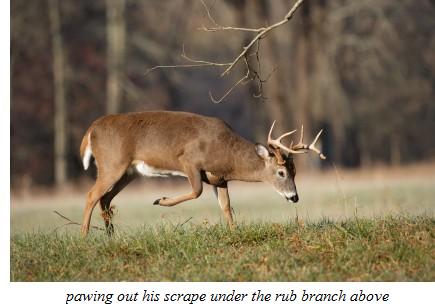 
These are forest and brush animals - look on or close to the edges. When you locate deer tracks, don't misread them. Deer wander a lot and a single animal leaves a lot of tracks. In recently wet earth that was, old track can look fresh. Can you separate buck tracks from doe tracks? It's not easy. While it's true tracks of older bucks can be more rounded and they drag their feet more as they walk, all deer wear their hoofs down. Large rounded tracks with drag marks may belong to an old doe as well.
The number of droppings in any area is more important than the number of tracks. Droppings will tell you how many deer are present, what animals are in the herd and what the animals are feeding on. Few hunters closely examine this sign. If you know what deer are feeding on in an area, you are that much closer to locating them.
For hunters seeking a buck, it is essential to locate rubs. These are on trees or bushes of moderate size where bucks have rubbed their antlers energetically. Seek out places where there are a lot of rubbed trees. A succession of rubs almost guarantees a buck is somewhere within a square mile or less of where the rubs are. If you locate rubs, along with a scrape, you've hit the jackpot.
A scrape is a pawed-out spot on the ground. Usually you'll find a bush or tree limb just over the scrape at nose height. The buck paws at the ground, urinates in the depression, and rubs the limb above with a scent gland located at his tear ducts. There may be several scrapes in a territory. Does visit scrapes and urinate in them. Other bucks identify them as warning signs. The buck that made them visits them often. A stand near one increases your chances of success.
Whitetails are unusually nervous animals. Unlike their close cousins, the mule deer, whitetails run when threatened. When jumped in a gully or ravine, a whitetail will usually run along the bottom. A whitetail jumped on a ridge will hightail over the ridge and doubtless several more.
DRIVING DEER
Driving is most popular when there are numerous hunters and deer are known to be in an area. The "drive" and all the participants are managed by one person, the Drive Master. Hunters are separated into "standers" and "drivers." These positions will alternate, usually after deer are taken or when the party moves to new territory.
Standers are posted by the Drive Master. Prime locations are along runways, crossings, deer trails, old logging roads, on high vantage points overlooking low country and similar places where deer are known to move. Once posted it is a cardinal sin to move until that particular drive is over. Patience is an absolute virtue. Any movement is apt to frighten an oncoming animal from crossing in front of the stander.
Driver's form up on a side of the area to be driven that is opposite the stander's locations. Spreading out in a tight formation, the drivers are spaced closely enough together so driven deer will not run back between them. Once in position, the signal is given and driver's still hunt toward the stander's. Normally, game will move forward and stander's get an opportunity to shoot. However, deer sometimes try to slip between the driver's, or around the outside of the line. End driver's often get a shot.
Deer drives are not the most desirable form of deer hunting as they can be extremely hazardous. But drives are often necessary to move animals that are holding tight and give more hunters an opportunity to score. This is also a good hunting strategy during midday.
STAND HUNTING
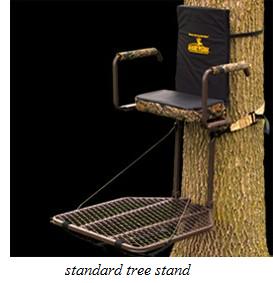
"Stand hunting" is defined as taking a fixed position, be it in a tree, on an artificial elevated stand or a concealed spot on the ground. Don't confuse this with "still hunting." A still hunter moves in a cautious, snail-like pace through deer country. While it seems remote that a deer will pass by a certain spot on a given day, the opposite is often true. Whitetails are creatures of habit. Undisturbed and when pressured, deer use favored routes. The secret is to find the magic spot - this is where to apply your understanding of deer habits.
A deer stand can be either a natural place of concealment or a constructed blind, steel tower or tree stand. Its purpose is to conceal the hunter and at the same time allow for clear vision of the surrounding area. Often overlooked, but of utmost importance, is your stand must also provide for safe and accurate shooting. Precariously perched on a limb 20 feet off the ground overlooking a deer run is asking for a dangerous fall. Whenever you choose an elevated stand ensure your platform is stable and safe. There are many commercial stands that fit the bill nicely.

When off the ground, camouflage is not critical - animals seldom look up. As well, your scent is more difficult to pick up. On the ground, make sure you are well concealed and keep movement to a minimum. Any windfall, outcropping, pile of rocks, tree stump or dense vegetation will serve your purpose. The strategy here is to break up your outline. Remember to give yourself a good view. If you must move to shoot, rethink your position. Any movement at all spooks game.
When stand hunting, most of your hunting will occur prior to the season. Scout the area; find well-used trails, feeding areas, scrapes, rubs, escape routes and crossings. Determine the direction of prevailing winds. This is the activity that will pay you dividends. When erecting a permanent stand of any kind, do so at least three months prior to the season. Allow the animals to get used to its proximity. Try not to construct an eyesore.
Don't be put out if other hunter's are in the area of your stand. A smart hunter will exploit this advantage. Activity moves animals. As well, a spooked deer is often preoccupied with what is behind him and will blunder into your position.
STILL HUNTING
The term "still hunting" has come to mean the act of hunting quietly in search of game. This is stop-and-go hunting that is attempted by many, but perfected by few. There is not a pace that is too slow. When you think you're finally moving slow enough, cut that speed in half and pause more often. Any movement forward faster than a quarter mile per hour is strolling. Still hunting is somewhere between stand hunting and stalking.
When choosing a route for still hunting, a hunter should always plan to be working into the wind. Don't allow game to pick up your scent. As in any other form of big-game hunting, the hunter sees best while moving slowly or at rest. Game sees worst while on the move. A deer's acute sense of hearing can also be defeated by a still hunter. Actually plan each step before you take it. Let other hunters that are on a forced march move game for you. They will cause game to move more than normally and increase your chances. Stay ever alert - action can and does explode from unexpected quarters.
Successful still hunting depends on a thorough knowledge of the country, an understanding of whitetail habits and weaknesses, and the sheer physical ability to move slower than thought possible for hours at a time.
STALKING THE WHITETAIL
"Stalking" whitetails is the art of outwitting an animal by stealth and superior strategy. While still hunting is almost akin to loitering, stalking is more of a determined effort to locate a cagey whitetail. One way to approach stalking is to think as a deer might. Ask yourself, "If it were me being hunted in this area and a wrong move could cause me my life, just how would I go about ensuring my survival?" You will be surprised at how close you can come to arriving at the same solution a deer does.

Whitetails utilize camouflage, lie low and remain motionless to avoid detection. On the move, they will evade danger by suddenly angling off their course, circling and crossing behind a pursuer. And of course, they will resort to flight.
If you understand all this, your odds are vastly improved. Move inside fringing timber and behind the protection of trees rather than in the open. Nullify your quarry's keen sense of smell by hunting into any breeze, even if it means you have to circle wide to hunt a particular spot where deer are thought to be. Don't let your clothing rustle. Learn to interpret the sudden snapping of a twig or clatter of a rock in still woods as the sound of moving deer. Move with determination, but employ a strategy. Don't bull through the woods without a plan or purpose.
HUNTING WITH A PARTNER
Hunting with a partner can be a very productive method of hunting whitetails. The basic technique is to hunt as if there were other hunters in the area. The difference is that one other hunter is working with you. The goal is to move game into the path of you or your partner. This requires planning and cooperation from both.
You can execute mini-drives on small patches of brush or woods by having your partner circle so as to be in a position to see the far end of the patch. Then you push through the patch of foliage, flushing the game through the opposite end. When game is thought to be in a ravine, you can work the ridge looking downward. Your partner hunts the bottom hoping either to spot the deer or have it move into a position where you, at the higher elevation, will have an opportunity at a shot.
Partner hunting is a fun way to hunt. It provides companionship and lacks the hectic pace of hunting with a large group. Two heads working toward a common goal can give you a greater chance of success and shared experiences are sweeter.
THE ART OF RATTLING

Originating many years ago in South Texas, rattling is a technique that really draws bucks in. In recent years this method of hunting has caught on and is now practiced successfully throughout North America. Equipment needed is minimal and anyone can master rattling skills in a few short sessions.
Rattling takes advantage of a buck's breeding urges. While use of this technique limits you to hunting while the rut is on, most whitetail seasons coincide. During this period a buck stakes out his territory, patrols it diligently, and defends it against intruders. The threat of competition or an opportunity to breed lowers the whitetails inherent wariness and causes him to be drawn into situations not normally fallen for. Rattling simulates two bucks fighting, presumably for an available doe. Fighting means there are other bucks in his territory. Subordinate bucks especially, will come in to see what all the fuss is all about.
So what constitutes a good set of "rattling antlers?" They should be fairly heavy and have 4 to 5 points on each antler including the brow tine. Saw them off as close to the skull as possible, file off any burrs found on the bases, drill a small hole through each base and attach a cord for carrying. A word of caution here, use "brown" antlers - white, bleached antlers have lost their resonance. The finished set should be symmetrical and mesh nicely when brought together. That's about it. Recently, artificial "rattling horns" have come onto the market. This is a good option for the hunter who doesn't have access to the real thing. Constructed to match a natural antler, they work very well.
Make yourself comfortable in a concealed spot and ensure you have a good field of view. To rattle, strike the antlers together with a loud whack, then intermesh the tines and rattle them relentlessly. Pull them back apart, whack them again and rattle. Rake the antlers hard against some bush and claw the bark of a handy tree with the tines. Clash and rattle again, a little quieter this time. Sequence is not important, the quality of the sound is. Experience will tell you when to make noise and when to keep still. Always stay alert.
CALLS AND SCENTS

Calls ordinarily are accomplished using a mouth-blown call. Even though a whitetail is mostly considered a non-vocal animal, there are sounds that will attract them. Most common is a grunt. Deer probably respond to a call more out of curiosity than any other reason. Not designed to draw an animal in, scents are primarily used to mask a hunter's odor. While there is some question as to call and scent effectiveness, try them both.
LOGISTICAL CONSIDERATIONS
There is one main logistical consideration - access! A whitetail is a small animal in comparative terms. A successful hunter on foot can haul the animal out, even in quarters if need be. Skinning and dressing is not a difficult chore. Equipment can be as basic or as extensive as desired. Vehicles, in most cases, can be as simple as the family sedan. The only logistic that is common to all is access. Get permission and don't trespass.
3. RIFLES, CARTRIDGES & OPTICS
REQUIREMENTS OF A WHITETAIL RIFLE
Since most whitetail habitat is brush or heavily wooded, this deer is shot at relatively close range, with the vast majority taken at under 100 yards. Although the first shot at a whitetail is generally the best shot, there is often the opportunity for quick subsequent shots. Once surprised and under way whitetail's will quickly put any available tree or bush between themselves and the hunter. This prevents careful follow-up shots. These conditions dictate to a large extent the type of rifle best suited for hunting this deer.
In order to get off a quick shot in brush, the rifle should be relatively compact and lightweight. Autoloaders are not recommended in any big game hunting situation. Most hunter's do not need the firepower and cannot control aiming the rapid second or third shot that is available. Lever actions, on the other hand, have killed more whitetail deer than any other rifle type. The Winchester Model 94 lever action is the most popular by far, but Marlin, Savage and Browning all make lever actions chambered for suitable whitetail cartridges. Lever actions handle and shoot "fast" with quick repeat shots.
Many whitetail hunters use bolt-action rifles, especially if they have only one rifle and must use it on other big game. In areas where heavy brush isn't a problem, or where the rifle and cartridge must be used on game at extended ranges, the bolt action is recommended.
CHOOSING THE RIGHT CARTRIDGE
The overall requirements of a bullet are dependent on the job to be done. In heavy cover, the bullet must be able to buck brush fairly well and plow through vegetation to reach the target. There must be sufficient weight to penetrate well. Often the shot at whitetails in brush will be a running shot. While it is always necessary to aim for a vital area, whitetail deer are often hit anywhere. A good bullet should do the job well on any solid body hit.
One hundred to 150 grain bullets are adequate for whitetail-sized game and there are a number of cartridges that will deliver. Our choices for availability, reliability and ability to do the job are in bold.
| CARTRIDGE |
BULLET WEIGHT |
COMMENTS |
|
|
|
| .243 Winchester |
100 gr. |
Low recoil / high accuracy |
| .25/06 Remington |
120 gr. |
Open country / long range |
| .257 Roberts |
117 gr. |
Suitable, but not common |
| .270 Winchester |
130 gr., 150 gr. |
Hits hard, excellent all-round |
| 7 mm Remington Mag. |
150 gr. |
Long range |
| 7mm-08 Remington |
140 gr. |
Similar to .308 Winchester |
| .30/30 Winchester |
170 gr. |
Maximum 150 yards |
| .30/06 Springfield |
150 gr., 180 gr. |
Heavier recoil, very versatile |
| .308 Winchester |
150 gr. |
Accurate, solid choice |
For more open country, the bullet should have a flat trajectory, penetrate well and open up fast. With these conditions in mind, the hunter might well first select a suitable cartridge and bullet, then choose a rifle that will properly handle it.
Whitetail deer are not large animals. In normal field conditions, most hunter's would have a difficult time making a solid hit at even 200 yards. Limit shots to your capabilities.
OPTICS FOR WHITETAIL HUNTING
Open sights are still used on whitetails. Although not recommended, iron sights in some hunting situations can be justified. Ideally, a well constructed, low-powered scope with a wide field of view is your best choice. The majority of your shooting opportunities will come at less than 100 yards. Carry and use binoculars. In today's crowded field conditions, it's just as likely you'll scope out another hunter as a whitetail - a dangerous and foolish practice. There are many compact, lightweight models that are suitable.
4. SHOT PLACEMENT
MAKE THAT FIRST SHOT COUNT
Generally speaking, the best spot to aim for on a whitetail is in the lung area, just behind the shoulder. Partly concealed animals often dictate where you must place your shot. The spine, anywhere along the length of the body, is a vital area. So are the heart and brain. Any head shot is not favored as jaws can be easily shot off. Although whitetails are relatively light-boned, shoulder and hip bone can deflect and even break up a lighter weight bullet. Shots at running deer will result, more often than not, in gut shots and other hits that are not immediately fatal. Avoid shooting at running deer if at all possible.
WOUNDED WHITETAILS
On occasion, an animal is wounded. It must be followed and finished off. Sign left by the animal must be interpreted step-by-step if you are to conclude the hunt successfully. Here's where your knowledge of whitetail habits and your tracking ability comes into play. A smart hunter will allow ten to thirty minutes before following a wounded animal. With no immediate pursuit, the animal will travel slower, stop more often and lie down quicker than one that is pressed.
Always clearly mark the spot where the game was last seen. Often the starting point must be referred to several times, as sign is sparse. Wounded game bleeds. Bright red blood on a trail means a lung shot, heavy dark blood comes from muscle, while green fluid or undigested vegetation indicates a gut shot. A dragging track means a leg was hit. If there are spots where an animal has lain down or paused, it usually means a hard hit. When an animal promptly heads steeply downhill or its flag dropped as it ran off, it was hard hit.
In following a wounded whitetail, go slowly, looking ahead as you watch for sign. Have your rifle ready for a finishing shot if the game jumps up again and tries to escape.
5. CONCLUSION
THE FUTURE OF WHITETAIL HUNTING

No other big game animal in North America can flourish like the whitetail in its association with man. This is an animal that clings tenaciously to its natural range. While elk have been pushed off the prairies by the relentless spread of civilization, the whitetail seems to have prospered by it. Whereas deforesting has been detrimental to moose, whitetails thrive when country is opened up. Fences stop the pronghorn cold - not so the whitetail. There are few more adaptable big game animals. Even though whitetail habitat is bound to be diminished by the demands of agriculture, mining, lumbering, industry and human population, several factors work in its favor.
The first of these factors is the whitetails great capacity for quick reproduction. Does will begin breeding at the age of one and one-half years. While the first fawn dropped is likely to be a single, thereafter the average is twins, with triplets and even quadruplets not uncommon. This ability to reproduce would certainly help any species come back from danger of extinction caused by disease, starvation, depredation or overkill. Between 1937 and 1967, whitetail populations, in the United States alone, increased from 3 million to over 7 million. The whitetail also feeds on almost any kind of vegetation presented to it.
A second major factor is the whitetails ability to adapt to man and his demands. Whitetail deer live and successfully flourish virtually in man's backyard. Where there is suitable habitat and sufficient winter range, this species will thrive. This habitat is often the "edge" country where agricultural land meets forest and brush lands. The brush-loving whitetail thrives in croplands almost as well as in the natural cover they replaced.
Effective game management is an essential ingredient to whitetail survival. This big game animal will benefit from today's greater awareness of environmental issues. The whitetail deer will certainly face new demands in the future as hunters and hunting pressure increase, but their future is promising.
|