Free website hit counter

|
The North American Sportsman website was developed to promote hunting in North America. The sections cover everything from hunting individual big game species to hunting techniques to essential accessory information. There's something here for every hunter, whether you're just starting out or an old hand at it.
|
|
|||||||||||||||||||||||||||||||||||||||||||||||||||||||||||||||
|
|
|||||||||||||||||||||||||||||||||||||||||||||||||||||||||||||||
Threatened with extinction at the turn of the century, elk have made a remarkable recovery. Only with careful management on our part and their inherent ability to adapt, have wapiti been able to survive. These animal's are considered by some to present the greatest challenge to a hunter, especially those who must go it on their own. Just by reading this chapter, you have taken the first step toward joining the ranks of successful elk hunter's - and you'll do it on your own. Good luck! A BRIEF DESCRIPTION
The elk is light brown, tan or a reddish-brown over most of its body. It's head, belly, and legs are a darker brown. The shoulders and neck are covered with long, shaggy, dark-brown hair. A member of the Deer family, the elk has a large rump patch that varies from creamy buff to yellow, fading to white in winter. This imposing game animal varies in size. Sex, age, and the area found in all contribute. Large cow elk weigh from 500 to 600 pounds or more. A mature bull reaches a total length of over 7 This monarch of the high country bears a set of stately antlers. Each antler bears long, deadly tines. Intended to inflict damage during the riotous battles of the rutting season, antlers occur only on the male. Elk shed their antlers every winter and begin to develop them again in April or May. The tender antlers grow through the velvet stage and toughen. Fully formed by August and rubbed free of the velvet within a short time, each antler can grow from 40 to 63 inches in length. Single antlers can weigh 14 pounds or more and normally develop 5 points or more. A mature bull's antlers may have a spread of as much as 50 inches.
Subspecies - 4 subspecies are found in Canada and the United States:
RANGES The elk's natural range in North America greatly reduced by 1900. Civilization affected the American elk or wapiti as much as any big-game species. Once considered a plains' animal, its range included most of the United States and western Canada. Settlement and the development of agricultural regions did not cause the elk to move to more secure ground. Instead they stayed. The resulting slaughter caused near extinction in the East, the plains of the Midwest and Canada, and the Southwest. Elk who escaped became conditioned to man's pressure. Moving to the highest and most rugged regions, most of our elk population remains there today. By the turn of the century, elk in North America numbered only 41,000. Today there are almost one million in the United States and Canada. The largest area of elk habitat is within or lies close to the Rocky Mountains. This is a long band that extends from north-central Alberta to New Mexico. A few spot areas complete the elk's range. One is along the west coast from northern California to north-east Washington and Olympia Island. Another is an extensive region in Canada covering the central portions of Saskatchewan and Manitoba. States with good elk populations are Wyoming, Colorado, Montana, Idaho, Washington and Oregon. The provinces of British Columbia, Alberta and Manitoba complete the picture. Due to a decrease in range, elk numbers will fall unless properly managed. Elk are being reintroduced into many areas where they once thrived. They are also being transplanted into areas where it once appeared they could not. On Afognak Island, off the coast of Alaska, transplanted animals are thriving in that harsh environment. Adapting to the local forage, elk on Afognak Island eat the soft shoots of the spiny Devil's Club shrub. The ability to adapt gives the elk a good chance at survival regardless of any habitat problems it may meet. For the most part, lack of range and hunting pressure will determine its future. Game ranching is becoming widespread and causes a new set of problems. Tuberculosis spreads to wild elk herds from infected ranch animals that escape. FEEDING HABITS 
The American elk grazes in the summer. It feeds mostly on grasses, leaves, sedges, broad-leaved herbs and mushrooms. During winter in snow-covered areas, they dig through the snow with sharp hooves to reach grasses. Elk also browse on twigs, bark, and the buds of deciduous trees and shrubs. These include aspen or poplar, willow, dogwood, mountain maple, and chokecherry. Wapiti compete with cattle and sheep for forage. When natural food is not available, elk will feed on haystacks. This is a major concern of ranchers and farmers. Elk ranges in key areas are producing more food by a system of controlled burning. Old growths keep the lower plants in the shade. Managed burning of brush produces a new growth of edible plants. American elk feed mostly at dusk and dawn, and retire to grassy beds during the day and night to chew on their cuds and sleep.
Elk occupy lowland and alpine meadows at elevations up to 7,500 feet, marshes, prairie, parkland, deciduous forest and coniferous forest. When not disturbed, elk life cycles follow a fixed pattern. They are fairly consistent in seasonal movement and daily routine. In late May a cow carrying a calf will separate from the herd she has followed. She will seek out a spot at the edge of timber. This is generally near the upper limits of winter range. The calf will be born about two weeks later, during the first part of June. Before the end of June the cow will rejoin the herd with her young calf. As it regroups, the herd moves into higher country following the receding snow. The new, tender grass determines the speed of this movement. 
American elk tend to remain in groups. During summer months, herds of several dozen to several hundred cows and their calves feed. The bulls form their own bachelor herds of up to 6 animals. In summer the herds range in high country. Remaining just below the snow lines, elk feed in alpine pastures. The animals don't have to compete with cattle and sheep for feed, it's cool and free of flies. Brought on by the shorter days of late summer, cows come into heat up to four times from September to November. Once they become pregnant, their estrous cycle will stop. In late August the bulls work to remove the velvet from their massive antlers by rubbing them on small pine trees. At this time, the rut or mating season begins. Both sexes can breed as yearlings. Dominant males gather harems of up to 30 females along with their calves while young males remain nearby. To attract a harem, bulls use a piercing sound - the bugle. A bull's mating call is one of the most thrilling sounds in all the wilderness. From early September till mid-October they fight for cows. Defeated bulls and young bulls just learning to bugle challenge the mature herd bulls constantly. To protect his interests, a bull with a harem leads an extremely hectic life.
Elk can predict a heavy storm as much as twenty-four hours in advance. They move with it or just ahead of it. Once they reach their winter feeding grounds, elk spend the winter feeding and resting. The bulls and cows have regrouped and remain in large herds throughout the winter. Their great numbers insure survival and provides protection from predators. In late spring the cycle begins again. With the warmer days of April and May, a general movement begins to higher elevations. A DAY IN THE LIFE Af After actively feeding, the herd beds down if not disturbed. Elk remain inactive for two to three hours after feeding. Regardless of the weather, the animals need this time to chew their cud. In the afternoon, an elk can be totally fickle. With settled weather, anything can, and will happen. If temperatures are comfortable, they might roam in search of better food. They might wander about to see what is in their range. Of course, the herd may just remain bedded. Toward nightfall, feeding and resting periods repeat themselves. For the hunter, early morning and late dusk are the best times to seek out elk. While feeding, animals move about and are most likely to be in the open. From 10:00 a.m. to 4:00 p.m., seek out elk bedding areas. This will be in thick cover and approach is noisy. Don't count on having much success. Stalking bedded elk is one of the most difficult things to do. Elk are different from other members of the deer family in one important way. Deer will remain in their same general area, even if disturbed. They may hide out, circle around or even travel a distance, but generally move back into their home range in a day or two. Disturbed elk are apt to head out in a straight line. They may not stop for five miles or more. It is not uncommon for an elk to stay in another area for days or weeks. Wapiti do not have an individual home range. The herd wanders over large areas. Animal counts in good elk country can average from 5 to 15 per square mile. On elk ranches, individual animals can live up to 26 years. Few survive to half this age in wild conditions. GOING IT ON YOUR OWN Elk hunting is hard work - count on it. The most difficult part is locating a huntable animal. A lot of elk country is not available or not accessible to the hunter who goes it on their own. Large tracts of private land are "bought up" or leased by outfitters. This gives them exclusive rights to restrict access to any hunter who is not their own client. Remember, trespass laws are enforced. Other areas are just not accessible. Horses are required to get you in and out. Equipment hauling and meat packing are also major considerations. If it's too far to pack an eight pound rifle in, what are you going to do with three to four hundred pounds of dressed elk meat? Plan and proceed sensibly. Most of us must hunt on public or crown land. This is not as bad as it sounds. Just show up for access. You'll find more elk on more acres than you can hunt in a score of seasons. More area than you think is accessible by vehicle and on foot. Public land is also commonly adjacent to parks and reserves. On occasion, even park elk range outside the boundaries. The largest factor in determining where you hunt will be where you obtain your permit. Check if tags are on a draw basis, especially if you are a non-resident. LET'S FIND ELK What makes good elk country? As in most things, a statement on just about anything will be proved wrong. Identifying elk range is no different. These large deer are able to adapt to range that at first appears totally unsuitable. We know this through past transplant success. Even so, there are some conditions that apply most of the time.
First of all, warm temperatures and elk don't generally mix. To find animals, there are a few factors to consider. It should be cool enough. In mountainous regions, that means seven to nine thousand feet above sea level. Coastal areas hold Roosevelt elk due to the cooling effects of the ocean. With cool nights, even arid desert areas can be suitable. The two best hunting periods are daybreak and dusk. If you bugle for elk, these periods are best, with daybreak the better of the two. Most activity takes place at first light and bulls' bugle more at that period of the day. Added advantages of an early morning kill is that you have the rest of the day to dress out and transport a large animal. All too often a hunter will score at dusk many miles and ridges away from their starting point. With the unsettling prospect of traversing any distance through unfamiliar country, hunters rush the job of dressing out their animal and often neglect to hang the quarters. A lot of meat ruins when a kill is made at last light. Most elk hunting occurs in high country. You will have to climb or at best, work yourself into extremely inaccessible terrain. Physical condition takes on a whole new meaning in elk country. Do not underestimate your ability or conditioning. Always stay within your limits and know when to back off. Don't become a statistic. Take advantage of any road or logging trail to place yourself as close to the actual location of your hunt as possible. Don't be concerned with driving a vehicle too close to your jumping off spot. Remember, where you can drive, seventy-two others will and do. Plan to start your actual hunt at least a mile from the last possible vehicle access point. As most hunters stay within 500 to a thousand yards of their starting point, a mile out will put you beyond 98% of most competition. This especially holds true in rugged country. Utilize old game trails for getting to the upper elevations. First climb ridges leading upward. Work canyon heads, high ridges, rim country, and crests of slash-canyons. Inspect the sides of canyons, brushy bottoms, hill tops, open mountainsides, and any range that appears patchy. You must use binoculars to scan these vast areas. Look in dark, timbered areas for tan spots or shapes that simply don't belong. Whenever crests are approached, proceed with care. After a cautious look around, study the next basin, slope, canyon, or creek bottom. Elk seasons in most high country usually coincide with snow. The lower edge of a snow line is ideal for hunting these animals as this generally marks the upper elevation at which you will find elk. Sign is readily apparent and trails are easy to follow. A good rule of thumb is to always hunt the highest ground available. STALKING THE WAPITI Stalking elk to within rifle range is one of the most difficult feats in hunting. These animals can detect danger through sound and sight for unbelievable distances. Elk will often spook at the sight of a hunter at distances of a half mile or more. 
Game is normally located at long ranges except when hunted in timber. Wapiti are inherently nervous and often leave an area for no apparent reason. Imminent weather changes cause elk to move from one elevation to another. Once on the move, it is not uncommon for them to continue their exodus for several miles, or at least into the next canyon. Keep in mind that a mile in elk country is equivalent to ten miles anywhere else. Elk hunting seasons often occur during the rut. During the mating season, both bulls and cows range together. Seldom is an elk alone at this time of the year. Generally, where you locate one elk, a number of elk will be near by. One exception to this is a bull on the prowl. A single track or animal sighted is usually a bull that was unsuccessful in his bid for a band. He will search far and wide for other cows. Except in instances where it may respond to a call, a travelling bull generally moves out of sight and range by the time you stalk to where you last saw it. An older cow usually stands guard over a band of elk. When the herd feeds, beds down, or moves about, this sentry frequently gains some vantage point removed from the band, in order to spot danger and effect a warning. The lookout gazes hard at approaching danger. Its ears become erect, the rump hairs suddenly rise, or it will spin away in an alerted manner. Cow elk bark a warning to warn calves of threat. Once you spot elk, you must first decide if you have been detected. If this has happened, 99 times out of a hundred elk immediately vacate the area. If undetected, the strategy should be to find them and stalk to within range before they have moved. Elk stalking is a deliberate process. Elk range is typically heavy timber and thick brush. This environment ensures noisy conditions. The hunter must move with extreme stealth, utilizing all natural features and the variations in terrain so as to advance out of sight. Where you are relative to a spooked elk, often dictates where the animal goes. Startled in a canyon, elk will move up one side of the canyon. This allows them to watch their back trail. Caught on a hillside with the hunter on higher ground, elk usually escape into the nearest timber, then cross the bottom and leave over the opposite crest. A general rule of thumb is if you scare up elk at your same level, they generally try to gain altitude. Two hunters can effectively work patches of timber where elk are known or thought to be. This requires one hunter to be posted at the likely escape route. The other hunter enters the patch on the opposite side and forces any game present to bail out. Prior to trying this tactic, try to determine the likelihood of game being present; either through an actual sighting or fresh tracks entering, but none leaving. HUNTING THE SEASONAL MOVEMENT Hunting the seasonal movement takes advantage of normal, gradual, downward movement associated with late season in the high country. This is not the same as when deep snows and severe weather force elk to migrate in a single body to their wintering areas. The strategy is for the hunter to anticipate areas in which you expect game to be during this normal activity. Locate a logical stand that allows you to waylay an animal on the move. Generally, elk will be unsuspecting and can present a better opportunity. Timing is important as is a thorough knowledge of the terrain and natural routes. The best time to use this method is after the rut when the bands start to disperse. LOGISTICAL CONSIDERATIONS Elk are large. Once an animal is down the question arises, "Now what do I do?" As in everything else, have a game plan prior to your shot. Ensure you have the means to pack out the quarters. If you can't arrange for horses or a machine to haul your meat, DO NOT SHOOT! Don't fool yourself, packing out an animal as large as an elk through the kind of country you'll be hunting in requires more than a strong back; guaranteed. WHAT IT'S ALL ABOUT
At first thought, bugling may seem beyond your scope. You don't need to have a natural ability to bugle. With plenty of practice, it is an art anyone can learn. Be aware it doesn't always work and can easily spook game. Know when, how and where to bugle properly. There are many reasons a bull elk will bugle. Some are of the most common motives are:
Prolonged wet or windy weather can affect or even delay the rut for weeks. The timing must be right. A general rule is to call during active times, dawn and dusk. Be careful not to bugle between 10:00 a.m. and 4:00 p.m. as bulls rarely call at such times. The best weather for trying your call is on frosty, clear mornings. Don't even attempt a bugle in high wind, fog, or heavy rain as elk will hold tight and no bull will answer. Only bugle from locations in which a bull would normally bugle. Good places to set up are at the heads and tops of canyons, and on high ridges. Do not repeat calls at less than ten-minute intervals. Bulls rarely repeat their bugle and neither should you. If there is no answer to a second whistle, move quietly to another location and try again within the next half-mile. If a bull answers your first call but won't respond to a second try, sit tight for at least thirty minutes or more. Often, a suspicious bull circles and comes in quietly from an opposite direction. Always remain concealed when you bugle. Back up against a bush, large rock, or cliff. Prevent an approach from your blind side; you want to see the animal before he sees you. Make yourself comfortable. Always have the wind in your face. Human scent will scare off even the most persistent bull. Be prepared for anything. A bull may rush in looking to do battle or may steal in quietly to the timbers edge to check you out first. Larger herd bulls are seldom drawn away to meet a challenge. Those bulls hold their ground; they already have what they want at their side. Bulls you call in are more likely to be sexually mature bulls looking for a harem. They are eager to fight any bull with any size harem. This doesn't mean bugling won't bring a response from trophy herd bulls. Much depends on the bull you're talking to and his willingness to fight. Always pay close attention to the quality of a call. An older bull has a resonant bugle while young, eager bulls have a high, shrill call. If you can't move a bull, there are some options you can exercise. You can try to sneak in after him in spite of the noise you'll make or wait for him to show later. Patience may be the smarter strategy. In the case of an immovable bull guarding his harem, one strategy might be to proceed as noisily as an enraged bull might. Rattle, scrape and thump as you go; try to appeal to your opponent's emotion during the rut. Your hope is that either the herd bull will consider it the challenge of a defeated bull trying to horn in, or that a defeated bull will hear and respond. This is recommended only if you are convinced the bugler is looking to fight.
THE EQUIPMENT You use an artificial call only to amplify the bugle you generate yourself. By themselves, calls cannot imitate the sound of a rutting bull. Don't be mislead into thinking there are calls available that allow you to simply blow into and bulls come running. Bugling is a skill that must be learned and there are no shortcuts, period!
THE CALL You call using your own vocal cords and some means of amplification. The secret is to learn the right pitches and tones. Listen to recordings or the animal himself. Start by blowing into the open end of your call. With your hand, partly plug the other end. Vary the amount of air that escapes until you achieve the desired sound. Practice will tell you how hard to blow. With a commercial call, the sound you produce can be different from the sound intended. Follow the instructions, but experiment on your own. Take a deep breath, lower your head and begin on a low note. From deep within your chest cavity generate all the volume you can. Slowly start to lift your head and build up to a high, shrill climax by moving the sound from your lungs into your throat. Conclude by gradually decreasing the tone and pitch to a final grunting. Try to repeat this at least twice. Keep working on it until your pitch is thick and free from "EE" to "ONNKKK". 4. RIFLES, CARTRIDGES & OPTICS REQUIREMENTS OF AN ELK RIFLE When you choose a hunting rifle, your choice is largely a matter of personal preference. However, given conditions encountered during most elk hunting, there are some practical considerations you have to address. Elk habitat is rugged and demanding on equipment. Your rifle should be a dependable bolt-action from a proven manufacturer. Malfunctions are not easy to correct where you'll be hunting. Total weight of your shooting package is of paramount importance. A 7 pound package is not practical. Due to the large caliber you'll likely shoot, consider 9 pounds the minimum. Stock design boils down to personal taste; just ensure the rifle fits you. Wood is the most pleasing to the eye, but synthetics will hold their point-of-aim best, regardless of conditions. A rifle sling is an absolute must. CHOOSING THE RIGHT CARTRIDGE An elk is tough. A trophy bull is one of the hardest animals in North America to put down and make stay down. With a leg shot completely out of commission, a bull is still capable of a journey of many miles. Bulls shot through the heart can travel over a hundred yards or more. You will pursue gut shot elk for miles on end without ever seeing the animal again. This is one big game animal where cartridge choice is critical. Any cartridge you choose should still pack enough energy at 300 yards to decisively kill a 500 pound animal. The absolute minimum elk cartridge is the .270 Weatherby Magnum and only because of the energy and velocity it can generate. This holds true for the 7 mm Remington Magnum. Even the venerable .30/06 Springfield with it's 180 grain bullet should be considered a minimum. Smart money uses at least a .30 caliber, 180 grain bullet with a muzzle velocity of at least 2,700 feet per second. The bullet must have the proper construction for deep penetration and controlled expansion. Why anyone would take the trouble to plan an elk hunt, outfit themselves, arrange for the time, purchase permits and incur all the other expenses related to the hunt - and then carry a gun with a marginal cartridge is one of the great mysteries of all time. The object of this game is to down an elk. Remember, you won't have many opportunities; especially on trophy animals. Our choices for availability, reliability and ability to do the job are listed below:.
The elk is a big animal and looks big even at long range. The temptation for most hunters is to shoot long shots on animals at extreme range, which result in wounded and lost game. Do not shoot at ranges beyond 400 yards, preferably 300 yards. The extra punch of large caliber cartridges is not to extend this range, but to do a better job. OPTICS FOR ELK HUNTING A well built, low-powered, variable scope from 1.5 to 6 power, is the best sight for an elk rifle. Due to the animal's large size, more magnification is not needed. A low-powered scope is better for running shots and close-in timber shots than one of great magnification and small field of view. And, do not use your scope to check out game, carry binoculars. MAKE THAT FIRST SHOT COUNT The best spot to aim for on elk is the lungs' area, just behind the shoulder blade. This is a relatively large target and lung-shot elk do not go far before they bleed and die from hemorrhage. The advantage of this shot is that there are several other vital organs in close proximity if your aim is slightly off. Animals shot in the chest cavity generally leave a good blood trail. Shots directly through the shoulder blade should be avoided if at all possible. The heavy shoulder blade and leg bones can turn or break up lighter weight bullets. If you encounter a wapiti partly concealed by timber, spine or neck shots will put the animal down, giving you the opportunity to finish the job from close range. Be aware that the neck bone of an elk is approximately halfway down on the neck. Miss by an inch or two and you've likely got a long chase on your hands. Head shots are an absolute last resort; it's too easy to miss the brain. Jaws shot off are just too common. WOUNDED ELK Wounded elk will head for impenetrable cover faster than you can travel. They cover tremendous distance when pushed, even with wounds that would quickly kill other beasts. Elk don't die easily. The tenacity and stamina of this powerful animal are mind-boggling! Sign to look for is freshly turned over ground cover and drops of blood on the ground and on bushes. Watch for blood smears on blowdowns and big logs where the animal may have crossed. Unless there is an immediately fatal wound, don't expect elk to stop and bed down. With most big game animals, the tendency is to head downhill when wounded. Don't count on an elk taking that route. Given the opportunity, a wounded elk will lead you on a long and arduous chase. Remember, approaching any wounded elk is dangerous, even when there appears to be no apparent threat. Always come in from above and behind. And never finish off a wounded elk with a knife. Put that final shot into the neck or base of the head. THE FUTURE OF ELK HUNTING 
The fate of elk hunting depends on the charity of man. This magnificent big game animal must have sufficient summer and winter range. Remote areas have to be set aside and managed with care and an eye to the future. Wild elk cannot endure prolonged contact with man. Pressured elk simply move on until there is no further place to go. The mining and lumbering industries require access roads through wilderness areas. Elk cannot coexist with the activity of chain saws, trucks and falling timber. Each new incursion drives the animals further into the wilderness. Hydroelectric projects flood prime elk pasture, forcing the animals to move into an ever decreasing habitat. The increased demand for recreational opportunity also takes its toll. Elk hunting opportunities are not generally going to improve. There are not as many trophy elk in the wild as there were before. Hunters will have to be satisfied with five-point trophies or smaller. A six-pointer will be a wall-hanger. There are already less open seasons on elk and more managed hunts on a draw basis. Only animals considered surplus will be harvested by future hunters. Even with all that, there are several bright spots looming. One is the outstanding increase in elk numbers in the states of Oregon and Arizona. In a thirty year period, elk increased in Oregon from 18,000 to over 56,000 head. Arizona's elk have more than doubled during the same period. Environmental issues have brought the plight of animal habitat to the awareness of the general public. Although some environmentalists view hunters with disdain, the majority realize that good game management is our first concern. All of these factors will ensure this splendid North American game animal will be with us for a long time to come. |
|||||||||||||||||||||||||||||||||||||||||||||||||||||||||||||||
 |
|||||||||||||||||||||||||||||||||||||||||||||||||||||||||||||||
|
|
|||||||||||||||||||||||||||||||||||||||||||||||||||||||||||||||

















 The correct name for this regal game animal is the wapiti. When early North American explorer's first came into contact with the wapiti, they mistakenly named it the elk. In the old world, the elk is the animal we know as the moose. How this case of mistaken identity came about is not clear. Regardless, the name "Elk" remained. Each elk subspecies that survived is quite distinctive in form. The common names are Tule, Rocky Mountain, Roosevelt, and Manitoba elk.
 feet, stands up to 5 feet at the top of his back and can reach a weight of 1,000 pounds. In certain regions some animals will weigh more. Bulls appear taller because of their massive antlers. Both the bull and cow are long-legged, and lean and lanky looking. Elk are agile for such large animals and can gallop up to 30 miles per hour.
 Scientific name - Cervus Canadensis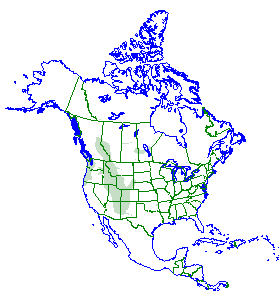
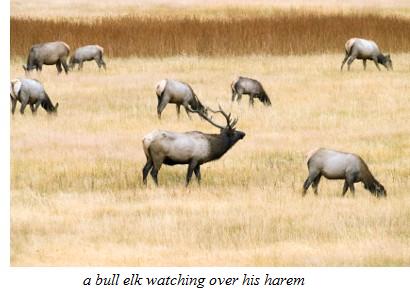
 Following the rut the males depart, leaving the harems to merge into large winter herds. These herds sometimes number up to 1,000 animals. Led by a mature female the herd will start moving downward with the first deep snows of October and November. They come down through the migration routes in a body. Often thousands of elk migrate single file over the same trail in a couple of days. Animals will sometimes delay their downward migrations until their wily wisdom tells them the fall hunts are over.
 ter three to four hours of sleep, the animal awakes before dawn. During the fall, elk will feed and water an average of 2 hours. More than half this time occurs in the morning. While in the rut bulls feed for only a few minutes. At the height of the rut however, they will likely not feed at all. Cows with calves will feed more in the spring. Cows feed up to 10 hours during a 24-hour period. During their growing years, young elk eat much more than adult animals.


