|
 Highly specialized and rather unique, this handsome and elegant big game animal is much like the environment it evolved in. The pronghorn antelope is strictly a North American institution and very much a part of the western half of our continent. Early settlers misnamed this beautiful animal, but this was probably due to the similarities it had to antelope elsewhere in the world. Be that as it may, it is the only of its family in the world and is found nowhere except in North America. Highly specialized and rather unique, this handsome and elegant big game animal is much like the environment it evolved in. The pronghorn antelope is strictly a North American institution and very much a part of the western half of our continent. Early settlers misnamed this beautiful animal, but this was probably due to the similarities it had to antelope elsewhere in the world. Be that as it may, it is the only of its family in the world and is found nowhere except in North America.
This is truly an animal of wide open spaces and has adapted well to its chosen habitat. The pronghorn has exceptional eyesight and stunning speed. It forages on vegetation that most other species find unpalatable and thrives in hot climates. A very sociable animal, it is found in herds throughout its range. There are few animals that are as enjoyable and as challenging to hunt as pronghorn antelope - after your first hunt, you'll be sure to agree.
1. ABOUT THE ANIMAL
A BRIEF DESCRIPTION
Pronghorns probably numbered 40 million when the first settlers arrived. Overhunting, fencing and loss of habitat reduced the population to dangerously low levels by the end of the last century. Although less than 16,000 remained, enlightened hunting regulations, returned habitats and sanctuaries have enabled this graceful prairie dweller to rebuild its numbers. Total populations have now stabilized at 500,000 - a number that appears to be the present day range capacity. Most game departments manage their herds so as to generally harvest any population increase, except where either a surplus or deficiency exists. Hunting is permitted in most areas, with an annual harvest of around 40,000. Pronghorn populations in some areas are not as stable as the overall population. Variables such as severity of winters, hunter harvest and pressure to reduce herds on land where domestic animals compete for food, all contribute to this instability.
 At first glance the pronghorn appears to be striped. The belly, rump patch and 2 throat bars are white. This changes abruptly into a tan color halfway up the animal's body line, gradually changing into a darker brown on the back. Under the jaw is white, with the top of the face black. Under each ear is a jet-black triangle. The mane, snout and horns are blackish in both sexes. At first glance the pronghorn appears to be striped. The belly, rump patch and 2 throat bars are white. This changes abruptly into a tan color halfway up the animal's body line, gradually changing into a darker brown on the back. Under the jaw is white, with the top of the face black. Under each ear is a jet-black triangle. The mane, snout and horns are blackish in both sexes.
The young are grayish-brown with a white rump and develop adult coloration at 3 weeks. The coat is composed of a woolly undercoat and coarse brittle guard hairs. These can be raised or lowered to regulate body heat. The 4 inch long hairs of the mane, as well as those of the white rump patch, are particularly erectile.
Antelope are horned animals. These horns are grown upon a permanent core, but the outer shell is shed annually. A front prong develops in the male (usually absent in the female) and by late summer can reach a length of 8 to 16 inches in males and less than 5 inches in females. Following the rut (generally in November) the horn falls off. Despite being shed, the buck's horns increase in length with age. Maximum horn size is achieved by the fourth or fifth year.
 Long black eyelashes offer the pronounced eyes some protection from the intense glare of the sun. Even though the pronghorn has excellent vision and can detect movement at a distance of over 4 miles, it often has problems identifying the object. The animal will frequently approach for a closer look - a habit that is often it's undoing. Long black eyelashes offer the pronounced eyes some protection from the intense glare of the sun. Even though the pronghorn has excellent vision and can detect movement at a distance of over 4 miles, it often has problems identifying the object. The animal will frequently approach for a closer look - a habit that is often it's undoing.
The pronghorn is North America's fastest land animal. You'll never forget the first time you witness a herd in flight. When alarmed, animals are capable of reaching speeds of up to 50 miles per hour for short bursts, with leaps up to 20 feet. A herd can run at 30 miles per hour for as far as 4 miles. The lungs and windpipe are relatively large to allow a rapid exchange of oxygen for carbon dioxide waste. While running, most of the animal's weight is carried by the front hooves that contain cartilage pads that cushion the shock. Unlike deer, antelope have no dew claws. As well, the animal often shakes its body after running. Speed, covering brush and depressions in the terrain are used to avoid predators such as coyotes, bobcats, eagles and man.
The pronghorn is one of the smallest North American big game species. Exceptional bucks will sometimes weigh up to 130 pounds but average closer to 100 pounds. Does are approximately three quarters that size.
Scientific name - Antilocapra americana
Subspecies - 5 subspecies are found in Canada and the United States:
- American pronghorn
- Oregon pronghorn
- Mexican pronghorn
- Peninsula pronghorn
- Sonora pronghorn
RANGES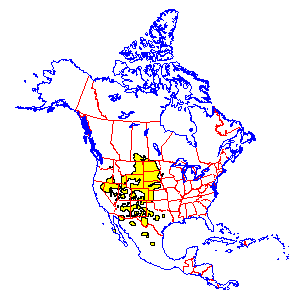
The range of the pronghorn once extended throughout just about the whole western half of the United States. The eastern limit of its range coincided with the western borders of Minnesota, Iowa and the eastern borders of Kansas, Oklahoma and Texas. In a north-south direction the range extended from deep into central old Mexico and Baja California to southern Alberta, Saskatchewan and Manitoba in Canada.
They now remain in a much smaller area of their former range - reduced at least one third in area. The shrinking has generally occurred inward from the entire outer boundary. Dozens of smaller, more isolated units now make up the whole, whereas in earlier times, distribution was noticeably broader.
The major population occurs in a broad band running from Alberta south through to New Mexico. The species has been introduced with some success in Washington, while Wyoming now has nearly one-third of all antelope. States having large antelope herds are Montana, New Mexico, Texas, Idaho, Oregon, South Dakota, Nevada, Colorado and Arizona.
 Pronghorns live in short-grass and mixed-grass prairie. They are also found in desert grassland and sagebrush plains from sea level in the South to northern mountain meadows. Observed at over 10,000 feet elevation, pronghorns require rolling hills and a proper mixture of forbs, grasses and shrubs, with vegetation covering over half the ground. Most suitable habitat has an annual precipitation of 10 to 14 inches. They commonly roam over dry alkaline plains, badlands, sagebrush flats and pastures. Summer and winter range may remain local or apart by as much as 100 miles. Most herds occupy a home range of up to 2,000 acres, while a buck's summer territory is up to 1,200 acres. It's common for a herd to shift its home range over the year to take advantage of water and forage. During autumn and winter loose herds congregate. This includes individuals of all ages and both sexes and can sometimes reach over 1,000 head. It's not unusual to see pronghorns bedded down or grazing in proximity to cattle and mule deer. Pronghorns live in short-grass and mixed-grass prairie. They are also found in desert grassland and sagebrush plains from sea level in the South to northern mountain meadows. Observed at over 10,000 feet elevation, pronghorns require rolling hills and a proper mixture of forbs, grasses and shrubs, with vegetation covering over half the ground. Most suitable habitat has an annual precipitation of 10 to 14 inches. They commonly roam over dry alkaline plains, badlands, sagebrush flats and pastures. Summer and winter range may remain local or apart by as much as 100 miles. Most herds occupy a home range of up to 2,000 acres, while a buck's summer territory is up to 1,200 acres. It's common for a herd to shift its home range over the year to take advantage of water and forage. During autumn and winter loose herds congregate. This includes individuals of all ages and both sexes and can sometimes reach over 1,000 head. It's not unusual to see pronghorns bedded down or grazing in proximity to cattle and mule deer.
The pronghorn, like most other big game species, has felt the influence of man. Unlike other species though, the antelope had to remain in its arid range. Its retreat has been more in the from of ranging higher within the borders of its own range and migrating back and forth into adjacent ranges, than in moving to a completely different area.
The setting aside of lands for atomic testing and military maneuvers has also cut into remaining antelope habitat. While there is neither shooting nor hunting of any game on these lands, the normal increase in the antelope population is kept down by the coyote. Converting desert lands to cropland through irrigation has also taken its toll. However, alfalfa, a standard crop on these reclaimed lands, provides the antelope with abundant food while they use suitable adjacent areas for range. It is now a common sight in this newly developed country to see bands of antelope feeding in alfalfa fields at daylight. After sunup, they normally move back into the desert areas.
FEEDING HABITS
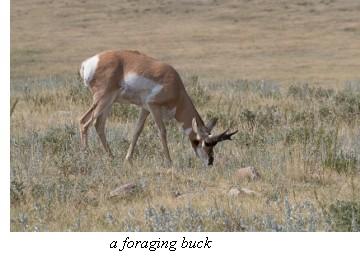
The vast majority of a pronghorn's diet consists of vegetation other than grass. Examples would be clover, lupine, woolly senecio and cut-leaf daisy. They are particularly fond of flowers and fruit when available. Sagebrush, rabbitbrush, cedar, prickly pear cactus and other shrubs are browsed year-round. They become more important in winter, along with dry leaves and grasses like blue grama. Crops such as wheat and alfalfa are sometimes eaten when the opportunity arises.
The animals' teeth are high crowned and continue to grow throughout life. This is an especially important adaptation, due to the gritty food pronghorn eat. Grass seldom plays a dominant role in the diet, so pronghorns do not seriously compete with cattle. Grazing sheep that share the antelopes range create problems - they leave little to eat. Pronghorns will drink if water is available, but they can also obtain sufficient moisture from their forage. Only the severest of droughts causes concern.
CHARACTERISTICS
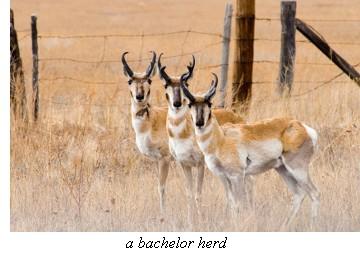
Adult males break away from the large winter herds in early spring and form smaller groups. Some bucks begin to stake out territories as early as March. This consists of piles of droppings, and urine and scent markings. The actual rut lasts from July to early October in the South, mid-August to mid-October in the North, though bucks are capable of impregnating does through most of the year.
A rutting buck executes an elaborate ritual of prancing, head swinging, erecting its mane and rump patches, lip smacking, whining and emitting scent from glands on the back and under the ears. Dominant bucks select the best feeding sites and protect this territory and collected females from other males. Battles between bucks involve staring, wheezing, teeth grinding and fights using their horns.
About 250 days after conception, twins (sometimes one or 3) are dropped to the ground while the female is in the standing position. While the fawning season starts as early as February in the South, most are born in May and June in the North.
 Fawns weigh from 4 to 10 pounds at birth and are able to stand and nurse from the doe within an hour. At 3 days they can run quickly. The doe hides her offspring separately in tall grass to avoid detection from predators. Even though youngsters like to gather by themselves to chase and play, the bond between the doe and fawn remains strong throughout the winter. A few females breed at 5 months of age, although most wait until at least a year. Yearling males are capable of breeding, but most do not because they cannot compete with the older and stronger bucks. Fawns weigh from 4 to 10 pounds at birth and are able to stand and nurse from the doe within an hour. At 3 days they can run quickly. The doe hides her offspring separately in tall grass to avoid detection from predators. Even though youngsters like to gather by themselves to chase and play, the bond between the doe and fawn remains strong throughout the winter. A few females breed at 5 months of age, although most wait until at least a year. Yearling males are capable of breeding, but most do not because they cannot compete with the older and stronger bucks.
The white rump hairs are erectile and are used to communicate. When alerted to danger, animals "flash" by erecting this rump hair that warns others nearby and at great distances. In the open spaces of pronghorn habitat, it is possible to see this flashing with the naked eye for two miles or more. Antelope have eyesight comparable to that of 8x binoculars and can see the flashing at far greater distances. This flashing is also used during the rut as a means of keeping contact, one band with another, and one sex with the other.
Like most other big game species, the largest animals are found at the highest elevations - a fact particularly true of wise old bucks. Pursued antelope will head for high ground and stay in mountainous, bluffy country normally regarded as deer habitat. Startled antelope generally will run in a straight line, not in an erratic pattern like a whitetail deer. Small bands usually run in a single file, with the dominant bucks usually bringing up the rear.
The predominant characteristic of the pronghorn is its ingrained curiosity - antelope are just as likely to stand and gape as run. Only when its interest is fully satisfied and it detects danger will it take off. This trait was one of the causes of its near-extinction. Today however, bands that have contact with man gradually learn that close proximity usually means danger. This has made them become more wary.
Another pronghorn trait of circling back to an area after it has been pursued is perhaps more useful to you as a hunter. Animals that have been frightened out of a basin, often drift back into the area within a matter of hours.
Mortality rates are extremely high for fawns, but after surviving the first year, many pronghorns live 7 to 10 years in the wild. Occasionally, antelopes in captivity live up to 15 or more years.
DAILY PATTERNS
Antelope have traits common to all big game species, and a few peculiar to themselves. Like deer, they tend to drift to lower elevations at night for water. During the heat of midday, antelope climb to rolling plateaus, high points, and hilltops overlooking arid flats to bed down. Like other game, a band will bed in positions where they can see down in all directions..

The pronghorn begins its day early. Excellent vision and bright prairie sunrises allow the pronghorn to get out and feed in the early morning. A pronghorn can feed while standing, walking, or on rare occasions while lying down. Pronghorns are active anytime, but grazing peaks occur before dawn and at dusk. Their normal routine is to move about early in the morning for a couple of hours, then rest an hour or more. There's usually a second feeding period following this. The afternoon is spent lying down and chewing cud. A late feeding period begins as the afternoon draws to a close. When pressured by hunters, daily routine is disturbed and single animals will feed or rest just about any time.
During the spring and summer months, food is readily accessible and a band may only move 100 to 900 yards in a day. With the coming of winter, forage is more difficult to find. To overcome this, animals frequently travel 2 to 6 miles. Antelope also spend more time feeding than do cattle - up to 25 percent more time. This is especially true in fall and winter as the days are shorter and the weather more critical. Pronghorns usually travel to water only once in a 24-hour period - occasionally they will even skip a day. A lot depends on daytime temperature; however, a daily trip is the rule. Timing of the water trip varies with individual bands and it may differ in varying latitudes.
Antelope seldom stay long at a watering place. In an arid habitat, water draws prey as well as predator, making the area dangerous. Pronghorns often stand on a ridge and look things over carefully when coming to water. Then, nervously, they'll move down toward the water. Skittish, they finally move to water's edge, lower their heads, maybe jump back suddenly, then move back. Once all is safe, they drink quickly, then prudently leave. Antelope also like to hang around old, dry lake beds as they sometimes serve as salt licks.
2. HUNTING THE PRONGHORN
GOING IT ON YOUR OWN
Antelope hunting is not generally considered all that difficult. If you have the permit, access and a vehicle to get you there, you're in business. With a little bit of forethought and pre-hunt planning, this is certainly a hunt you can do on your own.
In times gone by there was very little hunting pressure. You and your partner could hunt for days and perhaps run into one or two other hunting parties. Today, you're going to experience a crowded range. At first, this may throw off your game plan somewhat. Due to the vast, open expanses hunted, you'll be able to see for a long way and every other hunter within five miles will stick out like a sore thumb. This gives you the impression an area is over hunted, but nothing could be farther from the truth. Lay down the trees in a prime whitetail patch for a few seconds and start to count other hunters. You would probably go home in disgust before you're even finished.
A do-it-yourself hunter bent on only taking a trophy-class animal is going to experience a rough time. Unless you have hunted the area several times in the past, it is difficult to know where the big ones are. You'll spend a lot of precious time trying to locate the proper combination of suitable terrain and habitat - knowledge the locals already have and are probably using. Unless an outstanding trophy is absolutely what you want and you will settle for nothing less, set your sights lower. A 12 inch buck is a worthwhile antelope in anyone's book.
Be sure to allow enough time when planning your hunt to obtain the necessary permits. Draws are used to parcel out the hunting - this means having your research completed by late spring. Once you have successfully obtained your permit, the serious planning can begin. For the uninitiated, time will drag until opening day. For the seasoned pronghorn hunter, it's worse. Once you have experienced antelope hunting, it will become an anticipated event in your pursuit of favored big game animals.
LET'S FIND PRONGHORNS
Experienced antelope hunters immediately head for the roughest portion of any expanse of hunting country. In the tight basins and narrow valleys between steep and often high ridges, that you'll find an old loner trophy buck. Good bucks seldom stay with the herds once the pressure is on. They go high and they go deep. Few trophy bucks grow old by standing alongside the road amidst bands of lesser animals.
It is also to this rough country that every antelope from flatter country will head when a horde of hunters begins scouring the flats. Most complacent hunters that are used to vehicle hunting don't want to work the rough places, so the hunting isn't crowded. Further, rugged features lend themselves best to a careful stalk. When you come up to the crest of a ridge, get down on your hands and knees and proceed to crawl to where you can cautiously peek over. A trophy may well be within easy range on the other side.
Antelope are definitely creatures of habit. Once a band has used an open gate along a fence line to pass, they will do so again. Although pronghorns are capable of jumping fences, they prefer not to. Often, a band will be pushed along a fence into a corner. Instead of taking the obvious route, which is over, they'll mill around in confusion and present a chance for a shot. A small hollow beneath a fence usually indicates a much-used crossing - it may be used daily by a band crossing from one pasture to another. Look for sign such as scraped off hair and tracks.
Look for a deep saddle in an otherwise steep, high, long ridge. Pursued animals will stream through a deep saddle as the easiest route. Waiting at a strategic point on a draw has paid dividends for more than one patient hunter. Even undisturbed animals will use the path of least resistance. If there is water nearby, movement will usually be sometime during the middle or latter part of the day. Antelope are where you find them. The country they favor is seemingly featureless and without change. This is somewhat true to the uninitiated; however, if you make the effort to leave your vehicle and walk the land, you'll find dips and draws, ridges and low hills. Any of these features hides bands of these unique prairie dwellers.
VEHICLES AND ANTELOPE
Jeeps, pickups and similar offroad vehicles are used for hunting antelope. Even though it's illegal to hunt from motor vehicles, they're useful for getting you deep into antelope range. Pronghorn hunting has long been abused by people using vehicles to chase animals down and get within shooting range. This is not only unsporting, but most game departments really crack down on people who practice it. Do not use your vehicle to pursue game - use it as transportation to and from your hunting spot or for locating animals only. A word of warning, stay on the trail and close any gates you open. Remember, you are a guest on the owner's land - respect their wishes and use courtesy.
The most common use of a vehicle is to "cruise" ranch trails or public roads. Watch and constantly glass for distant bands. Often, if you are patient, it is possible to locate a real trophy this way. If you locate a desirable specimen, the stalk must be planned. Although there is little cover in antelope country, try to park your vehicle out of sight. Any draw, dip in the land or intervening hill will do. If available, stalk on foot along a low ridge or series of ridges. With luck and a short stalk, you may get within 150 to 200 yards. Unfortunately, most of these stalks will take a fair amount of time and your animal could be long gone by the time you close in on its original location.
If you drive, there is no doubt antelope will be located from your vehicle. As an antelope's hearing is fairly keen and its vision is eight times as acute as ours, it is safe to assume that any animal you may see from your moving vehicle has already spotted the vehicle. Under such circumstances, a productive way of handling the situation could be for the hunter to slip unobserved out of the far side of the vehicle that has made a nice easy stop. At once, the driver continues slowly on. Drop low and out of sight. If conditions allow you to remain concealed, circle the game and try to approach it from an opposite direction. You may get a shot while your quarry continues to watch for danger from the vehicle. This ploy can work even if the game is mildly alerted and moves off a short distance as your vehicle comes into sight. Have the driver continue on, completely out of sight. If you have the patience to stay concealed for an hour or so, the animals will often settle down and circle back within rifle range.
STAND HUNTING
Stand hunting can be rewarding in regions where there are heavy concentrations of hunters. Most will work the lower flats, thereby forcing the animals into higher, broken country. Work out the general routes of escape. Post yourself, staying hidden in some form of concealment, on some high knoll, in a low saddle, or alongside a "pass" where antelope are anticipated to travel. Patiently wait for game to move into range. The best time for this technique is opening day of hunting season. Position yourself relatively high.
Stands within range of a waterhole, where legal, can lead to success. Set up your blind, perhaps made up of sage, along a ridge within 100 yards of a waterhole that is known to be used. If undisturbed, pronghorns will travel to the waterhole through any low spot on the ridge, usually in single file and at a walk. If you are properly positioned, the animals could easily come into range before they know a hunter is there.
Another technique is to drive into antelope country, locate a band, then leave your vehicle parked in a gully or draw where its top is visible. Make sure you can walk away in plain sight. Walk out of sight of the game, then sneak back at a different angle to a stand position within rifle range between the game and the vehicle. Antelope are curious and this trait can be their undoing. It might take a couple of hours, perhaps a half day or longer. If unmolested by other hunters, they are as likely as not to pick their way cautiously towards the vehicle to investigate.
STILL HUNTING
Hunting antelope on foot can be one of the most challenging methods of pursuing any big game animal. At first glance, this appears to be impossible. When scanned from a road, typical pronghorn country seems utterly flat with no breaks in the landscape - nowhere for an animal or hunter to find cover. This isn't generally so. Once you step out onto the endless prairie, you'll find low hills, shallow gullies, series of ridges and breaks that provides concealment for both quarry and hunter alike. You're sure to put on some miles, but still hunting will also put you into country most vehicle hunters will never see.
Occasionally you'll locate antelope in flat country or across a broad valley and circling would require too much of an outlay of time and effort. If so, try this technique. Animals will likely be watching as you come into view. Pay no apparent attention to the game. Continue walking slowly and casually at a sidelong angle to the quarry. Move forward at an unhurried pace, but gradually sideways in slow degrees to cut down some of the intervening distance between yourself and the alert game.
If antelope at 500 yards do not feel unduly pressured, you can often approach to within 300 yards before they take flight. The trick here is to give the illusion of not caring whether the game sees you or not, while moving sideways at the same time you move forward. If you stop, look toward the antelope or give any sign that you are aware of its presence, the animals will flee.
When still hunting, follow the natural lay of the land. Don't silhouette yourself against the sky. To conceal yourself, stay at the lowest possible elevation while moving forward. Stop before each basin rim or long ridge. Move up to a high point cautiously and glass the whole area thoroughly without disclosing your presence - often you'll have to crawl up the last few yards before looking over into lower country. Take your time if game is spotted and work out a game plan for the stalk. Antelope that are not alarmed do not normally move great distances.
Often in rolling hill country, you'll come upon antelope at long rifle range. If they immediately spook, drop into the best concealment available. Assume a solid shooting position and wait for the animal's characteristic pause on the crest of a hill. Frequently, there's a chance for a shot before they disappear from sight.
STALKING THE PRONGHORN
Stalking pronghorns is the ultimate challenge in big game hunting. Any approach must be planned and thought out with care. There is little cover in antelope country. Any irregularity in the landscape, a small draw or series of ridges may form a passage for you to carefully close in to rifle range of 200 to 300 yards. Spotting animals is not generally the problem - the frustrating aspect of antelope hunting is that any stalk that requires much time may find the animals long gone before you arrive.
Stalking pronghorns is the ultimate challenge in big game hunting. Any approach must be planned and thought out with care. There is little cover in antelope country. Any irregularity in the landscape, a small draw or series of ridges may form a passage for you to carefully close in to rifle range of 200 to 300 yards. Spotting animals is not generally the problem - the frustrating aspect of antelope hunting is that any stalk that requires much time may find the animals long gone before you arrive.
Most of the time stalking within range of spotted game will be accomplished on foot. The basic procedure, regardless of conditions, is to move within the terrain so that all changes in elevation are utilized and you come upon your quarry from an unsuspected point of the compass. More often than not, this means circling for a considerable distance in order to come upon the animals from behind an opposite direction.
The best field position for shooting pronghorns is the sitting position. It allows you an uninterrupted sight above intervening brush and small hills. This position is quickly assumed and nearly as solid as the prone position. If antelope pause on the crest of a hill and there is no obstructions between you and your game, assume the prone position. If an elevated feature in the landscape can be used as a forend rest, a standing pronghorn at 300 yards should be an easy shot. Antelope habitat is open country and also windy. At times you'll have to allow for wind drift at long ranges. The most practical way to learn wind allowance is to practice shooting at long range on windy days in advance of the hunt.
HUNTING WITH A PARTNER
Although the driving of antelope in open country and trying to control their movement is just about impossible, they may be manipulated through the use of partner. When hunting with a partner, be prepared to split up at the first sight of game. Your partner can carry on until out of sight, then double back to where you separated and find cover. You circle in a direction to creep up behind the game, staying out of sight. If you make it without detection, you're apt to get a chance. If the antelope are spooked into movement, they are likely to circle back or run towards the area from which it thought your partner had left.
LOGISTICAL CONSIDERATIONS
This is the easy part. Equipment consists of a set of maps, a good pair of binoculars, a spotting scope, your rifle and a vehicle that can negotiate a bit of rough country. Antelope hunting is not usually the logistical nightmare an elk hunt would be nor does it have to be. Hunts are generally without the pressures of other types of big game pursuit.
3. RIFLES, CARTRIDGES & OPTICS
REQUIREMENTS OF A PRONGHORN RIFLE
The best rifle for antelope is one you handle very well. It should be capable of tight, consistent groups at 300 yards - the type of shooting that requires a high performance, precision rifle. Choose one with a light, crisp, trigger-pull. Also, weight should be reasonable as you'll likely be carrying your rifle for many miles before the hunt is over. Equip it with a wide sling.
Levers and pump actions are not usually found on antelope range and semi-automatics are best left at home. A bolt-action from a reputable manufacturer is probably your best choice. What you want is superb accuracy, not firepower. A high quality rifle with a single shot action is at home on a pronghorn hunt as well.
CHOOSING THE RIGHT CARTRIDGE
Because of their sharp vision and their open habitat, antelope are generally shot at long range. Shots at less than 200 yards are the exception. Opportunities out to 300 and 400 yards are common. Also, an alerted antelope's erect rump hairs create an illusion of size, especially when running. The lead necessary to intercept them at extended range is often underestimated, causing you to shoot back of your aiming point.
Choose a high performance cartridge with exceptionally flat-shooting bullets of reasonable weight. The best antelope cartridges are those shooting bullets of at least 100 grains, preferably 120 grains and over. Lot's of retained energy and high velocity at ranges up to 400 yards is also necessary. For those of you that are one-gun hunters, choose a cartridge in the .270 or .30 caliber range. Although antelope are not big animals, don't discount their ability to carry a lot of lead if marginally hit. With their oversized lungs and heart, pronghorns can run a long way if hit with a marginal bullet from an inadequate cartridge. Our choices for availability, reliability and ability to do the job are below:
| CARTRIDGE |
BULLET WEIGHT |
COMMENTS |
|
|
|
| .243 Winchester |
100 gr. |
Low recoil / high accuracy |
| .25/06 Remington |
120 gr. |
Open country / long range |
| .257 Weatherby Magnum |
100 gr. |
Fast and potent |
| .270 Winchester |
130 gr. |
Hits hard, excellent round |
| .270 Weatherby Magnum |
130 gr. |
Overkill for antelope |
| 7 mm Remington Magnum |
150 gr. |
Long range |
| .30/06 Springfield |
150 gr. |
Heavier recoil, versatile |
| .308 Winchester |
150 gr. |
Accurate, does the job |
The 7mm Remington Magnum and .270 Weatherby Magnum cartridges are fine for hunting trophy antelope, but have an excess of power. They'll work well for one-rifle hunters who must use their firearm on larger game. Much has been written of the hot 6mm cartridges, such as the .243 Winchester and the 6mm Remington. With 100 grain bullets, such caliber's are fine for antelope up to 250 yards. Beyond 300 yards a more potent cartridge is desirable.
OPTICS FOR PRONGHORN HUNTING
Your rifle should be equipped with a good scope of 4 to 6 power. If your preference is a variable, 2 1/2 to 9 power do nicely. The crosshair should be fine as you could be shooting at animals out to 400 yards.
The best single piece of equipment for the antelope hunter other than an accurate rifle is a pair of good binoculars. Minimum magnification should be at least 8 power. Purchase the best lightweight pair you can afford - you'll use them a lot. Additional equipment should include a light spotting scope. This is best used in sizing up individual animals after locating them with your binoculars. When you start your stalk, leave it in the vehicle.
4. SHOT PLACEMENT
MAKE THAT FIRST SHOT COUNT
Antelope are not particularly hard to put down - hit the right spot and this animal with its small body size will fold without so much as a kick. Hit the wrong spot and you'll find out how tenacious the pronghorn can be. Always try to put your bullet squarely in the heart-lungs area for a quick, humane kill. Remember the small body size. It would be unwise to use the head or neck as your target because of that and it would ruin the mount or the cape. Stay with the heart-lung shot.
Gut-shot animals and leg hits are usually the result of shooting at running antelope. It is common to underestimate the distance to and the speed at which pronghorn's run. Any running animal will give you trouble. Eventually, both types of wounds will likely be fatal, but the chase will be long, arduous and frustrating. Resist the temptation.
WOUNDED PRONGHORNS
A wounded pronghorn can be hard to recover. It can carry a lot of lead, even if only slightly misplaced. The animal will head for the flattest expanses available where visibility goes on forever. Wounded antelope will usually continue to move until they die. The best method of finishing off a wounded antelope is not to wound one - use enough rifle and cartridge. Pass up questionable shots and especially running shots at long range.
If an antelope is wounded, your best technique is to gain height. Go immediately to the highest elevation. From there the animal can be watched in its retreat across the lower flats. From this elevated position every effort should be made to finish off the animal before it gets completely out of range. Should the wounded animal get out of range completely before it is dispatched, your best course is to watch its retreat with binoculars until it lies down. Then give it an hour to stiffen up before approaching.
5. CONCLUSION
THE FUTURE OF PRONGHORN HUNTING

Pronghorns probably numbered around 40 million when Europeans first arrived on North America's grasslands. Hunting, fencing and general loss of habitat drove the population down to precariously low levels in the early 1900s - less than 17,000 on the entire continent. As late as the 1920's the pronghorn appeared slated for extinction.
Enforced hunting regulations, sanctuaries and returned habitats have allowed this graceful prairie dweller to rebuild its numbers to the point where hunting is permitted in most regions where it is found. The total population has stabilized at 500,000, with an annual harvest of approximately 40,000. Today, herds of antelope, some numbering over 1,000, can be seen in numerous parks and refuges. Outside these areas, travelers are often delighted to see individuals standing on roadside hills in many parts of the West.
In recent years, there has been a widespread program of trapping and transplanting the animals into regions where range is thought to be suitable for antelope. If we continue to rehabilitate spot regions where an antelope population once existed but has been depleted, more huntable populations will emerge.
Wise conservation procedures and more stringent hunting laws, together with an awakening to the danger of losing the species, will all combine to save the antelope. In the broadest sense, today's pronghorn population is now at an optimum state. The animals are now utilizing the full extent of their range: desert lands, sagebrush areas, arid flats, and dry foothills having the sparse and short vegetation they prefer.
Whether you hunt the pronghorn, stalk it with a telephoto lens, or simply watch bands surge across the desert plains, the excitement is unparalleled. This is one of our most graceful and appealing big game animals; it is well managed and far from endangered. Once the pronghorn "bug" bites you, you'll keep coming back.
|