|
 Scouting isn't hunting, it's scouting. If that statement sounds obvious, it is, but all too often the two are taken to be the same thing. Well, they're not. The dictionary defines scouting as, "To spy upon or explore carefully in order to obtain information; reconnoiter" and hunting which is defined as, "to pursue game or other animals in order to capture or kill them". The whole point to scouting is to gain information prior to actually partaking in the hunt, therefore increasing your chance of success. Scouting isn't hunting, it's scouting. If that statement sounds obvious, it is, but all too often the two are taken to be the same thing. Well, they're not. The dictionary defines scouting as, "To spy upon or explore carefully in order to obtain information; reconnoiter" and hunting which is defined as, "to pursue game or other animals in order to capture or kill them". The whole point to scouting is to gain information prior to actually partaking in the hunt, therefore increasing your chance of success.
To avoid being distracted from the job at hand, do your field scouting prior to the open hunting season where possible. Obviously, if you're able to scout out an area prior to the actual hunt, you'll increase your chances of success tenfold. Plan your scouting excursion as close to the start of the season as you can. When you arrive in your hunting area, you want to ensure conditions are much as you experienced during your scouting expedition. Unwelcome surprises can make for a ruined hunt.
 1. SCOUTING OUT AN AREA 1. SCOUTING OUT AN AREA
PRE-SCOUTING PREPARATIONS
Before you head out, determine where you want to hunt. Check the state or provincial annual kill figures against hunting licenses issued. This will give you a clear picture of what to expect. Remember that open seasons are determined year-by-year dependent on local conditions and conditions do change. Do your research during the off-season..
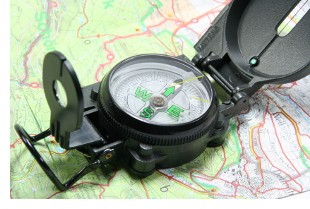 Maps, preferably forest cover or contour, are absolute necessities. These are available through U.S. Geological Survey offices, Government Map offices or sporting goods' stores in areas you want to hunt. A county map that shows which land is owned by who will save you a lot of running around trying to locate landowners for access permission. Maps, preferably forest cover or contour, are absolute necessities. These are available through U.S. Geological Survey offices, Government Map offices or sporting goods' stores in areas you want to hunt. A county map that shows which land is owned by who will save you a lot of running around trying to locate landowners for access permission.
Buy the best compass you can afford and learn how to use it. It is invaluable for use in reading maps and pointing the way home after a long, hard day afield. We'll talk more about the compass in a later chapter.
COMMON SENSE POINTERS
If you have access to your area prior to the hunt, here are some ways to undertake pre-hunt scouting. Again, scout as close to the start of the season as possible.
- Talk to everyone in your proposed hunting area, including ranchers, farmers, forest rangers, conservation officers and anyone else you come into contact with.
- Use the telephone. Call local experts such as fish and game officers and biologists. If they have the time, most will talk to you.
- Attend local fish and game meetings. This can be a wealth of information as you come into contact with other hunter's who may know the area you're interested in. And who knows, they may even give you accurate information.
- Invest in a good set of binoculars. At dawn and dusk, glass the areas you can access from as high a vantage point as possible. Study the range thoroughly.
- Carry a notebook and your map. Note sightings, sign, access, distances, and anything else that can help you. Write information directly on the map. Use your map to draw up a game plan for opening day.
2. SCOUTING OUT THE GAME
THE WHITETAIL DEER
If you're after a trophy buck, Boone & Crockett statistics and local Fish & Game competition results will often indicate where big bucks are taken on a regular basis. Some areas consistently produce bigger bucks than others.
Most whitetail country is fairly open. A simple drive through the countryside at dawn and dusk can give you tremendous insight into whitetail activity. A partner travelling with you will double the acreage you can scan and even allows you to watch where you're going from time to time. Watch for horizontal objects in the brush - most things grow vertical in whitetail country. Walk the edges of your intended hunting areas. Look for any sign that would indicate whitetail activity. And remember, look for a small animal as most deer stand only three feet high at the shoulder.
MULE DEER
Often, your hunt for mule deer will take place on private land. The vast ranches of the West are prime mule deer habitat and pre-season scouting will free up your hunting time. It accomplishes several things; you'll get to know the lay of the land, you'll learn where you can find access, you'll develop a "feel" for the area, you can scout out the animals and determine their movements and finally; it's the perfect opportunity to gain permission for access during the actual season.
The use of binoculars is absolutely essential. Mule deer are basically open country animals that will be found on mountain slopes, across desert flats and along prairie ravines. Once animals are located, a spotting scope allows you to observe individual trophies close up, without having to disturb them or walk the intervening distance to where you found them.
The location of your actual hunt will largely depend on when your hunt will take place. Your arrival may coincide with the migration of deer to lower elevations. If so, locate possible migration routes and predetermine likely spots for taking a stand in narrow passes or other sites. Knowing the winter range after deer have migrated is essential for late season hunts. When your hunt will take place during early season, scout out the high country on summer range. More than one hunter has done their pre-season scouting, arrived at the spot where the herd was located in August and found the deer were far removed in October.
ELK
Your first step in determining where you want to hunt is, for the most part, dependent on where permits are available. Check with the state or provincial wildlife office in your preferred area - this will give you a clear picture as to what you can expect. Start your research as early as March or April. Those areas that issue permits by draw generally have made their selections by June.
A contour map is a necessity. Even if you cannot visit the area prior to the hunt, a serious map study will give you an idea as to access, potential elk valley's and ridges, water drainage and elevations. Time spent on this activity is not wasted.
Elk will generally be up high during the pre-season and will remain high well into the open season. Use your binoculars and spotting scope to glass mountain meadows and high open slopes. If you're able to access your actual hunting area, walk the edges and look for resident activity. Elk also need to have access to water. Rivers and high-country lakes are a definite draw for elk. Walk the shores and search for access routes to the water. If your hunt occurs during the late season downward migration, use much the same strategy as for mule deer. Learn the routes.
MOOSE
If you're after a trophy animal, Boone & Crockett statistics will indicate where big bulls are taken on a regular basis. Invariably, Alaska and the province of British Columbia dominate the lists, however, don't ignore many other fine hunting areas - exceptional trophies can be taken wherever moose are legally hunted.
Access is generally not a problem as most moose hunting occurs on government or crown land. Be aware of one major problem you may encounter. Outfitting and guiding services operate in certain areas. Although they have no right to keep you from hunting "their" range, they will often give you a hard time if you show up. Clients engage them, often at great expense, to provide a wilderness hunt and when locals show up, neither the client nor the outfitter is impressed. Give them a wide berth.
Scout as close to the start of the season as possible. Talk to everyone in the area - including loggers, road crews, forest rangers, conservation officers and anyone else you come into contact with.
Buy the best compass you can afford and learn how to use it. There won't be many roads or visible landmarks where you're going. Many a moose hunter has involuntarily spent nights in the bush for want of this simple instrument. It's the best insurance you'll carry. Glass old burns, open meadows and lake shores in areas you can access. Study the edges thoroughly. Walk your intended hunting areas. Look for any sign that would indicate moose activity. Carry a notebook and your map. Note sightings, sign, access, and distances directly on your map.
Most good moose country is densely forested and wet. Gear up accordingly. Proper footwear and superior rain gear are absolute necessities. You'll also find that access to an all-terrain vehicle or horses is good management when hunting moose.
PRONGHORN ANTELOPE
If you can't do any pre-season scouting, arrive in your area at least a couple of days prior to the hunt. Any scouting is better than none at all. If you arrive on opening day, you'll join the masses and spend your hunt chasing bands of small bucks and does. Any prior scouting may show a suitable buck is using a certain basin or general area as a home base. Armed with that knowledge, at least you'll have a place to start on opening morning.
Most people associated with pronghorn country are helpful and will talk to strangers. Antelope hunters belong to a strange fraternity. If you're parked by the side of the road while scouting and hunting, parties often stop, visit, compare notes, exchange sighting information and just generally pass the time of day. How comparable is that to whitetail hunting? Stop at ranches along your way. Ranchers can be surprisingly helpful. Most will let you know where the bands are hanging around, give you locations of access roads, and in all likelihood, give you permission to hunt on their land. The one item that is common to all is that they'll request you stay on established trails. They don't want vehicles roaring all over the delicate landscape creating ruts that cause land erosion. Honor their wishes.
The best time of the day to scout pronghorn country is anytime. Start out just prior to dawn and cruise the fence lines slowly. Use your binoculars often. Look for anything that doesn't quite fit in to the landscape. What at first appears to be a cluster of boulders, often turns out to be a band of bedded antelope. In typical pronghorn range, any feature that is higher than a foot off the ground is suspect. Most of your scouting efforts will be spent looking for the animal itself, not animal sign. If pronghorn are in the area, it will soon become evident. One last point to remember when scouting for antelope - if a band or single trophy buck is spotted in an undisturbed location, it's likely to be in the area on opening day.
THE BLACK BEAR
Black bears are where black bears are. Cruise the back roads in known bear country. In spring, the surest sign to look for is piles of manure alongside the road in close proximity to new plant growth. Where a bear feeds, it will generally continue to feed. Along rivers and lakes, search for tracks in the soft shore sand. Black bears frequently travel such areas with great frequency. Where farming occurs adjacent to wilderness areas, glass the edges of barley fields where grain is present. Black bears have a great love for cereal grains.
|