|
 Many volumes of books have been written about the myriad of cartridges developed over the years and their merits. There have been hundreds of cartridges introduced over the years, in all diameters and configurations. Scores have been truly unique, while others have merely been introduced under different names or had slight variations engineered into them. With this volume, it is hoped you gain a better understanding of cartridges. Many volumes of books have been written about the myriad of cartridges developed over the years and their merits. There have been hundreds of cartridges introduced over the years, in all diameters and configurations. Scores have been truly unique, while others have merely been introduced under different names or had slight variations engineered into them. With this volume, it is hoped you gain a better understanding of cartridges.
When hunter's meet, talk of rifles, cartridges and hunting exploits abound. With cartridges, anyone who has ever owned a rifle and even some of those that haven't, will be glad to tell you the merits of their own favorite caliber. Unfortunately, most of these storytellers are long on theory and short on practical experience. To separate fact from fiction, talk to a ranger, guide or outfitter. These people earn a living from toting a gun. When a job has to get done, it's the old standbys that get the call, and for good reason.
1. PRACTICAL CONSIDERATIONS
GET DOWN TO BASICS
Misconceptions abound around cartridges and the job they can do. Cartridge performance cannot be judged by case size, case length, bullet diameter or velocity. There is no one best caliber. Common sense and practical consideration must be used in the evaluation and application of a cartridge. This translates down to the way a bullet performs after leaving the barrel and how much energy the bullet retains when striking an animal at whatever range.
For the experimenter, bench rest shooter and collector of rifles, the number of available cartridges in different calibers is staggering. For the serious hunter though, you would do well to leave most cartridges at home when you go afield. As in most things, when there is a job to be done, it's prudent to rely on the tried and true. Stay with a cartridge that is readily available and can be located in the most obscure of places. If you reload, avoid a cartridge that has drawbacks, such as a short neck or the need for a compressed load.
A serious consideration, for you the hunter, is the availability of cartridges for your hunting rifle. Situations arise regularly where the supply of ammunition you brought along is used up in the field. Sighting in a rifle that has experienced stock warpage due to adverse weather or was inadvertently knocked about, misses that were not anticipated and ammunition that is lost or misplaced are all very real situations a hunter can find themselves in. And you'll generally find yourself in these situations far from home.
It's fine that the "Shooters Cartridge World" store at home stocks even the most obscure cartridge, and probably in every conceivable bullet weight. Generally speaking though, it is highly unlikely the small sporting goods store or service station in the area you want to hunt will offer the same selection. The choice of brands and bullet weight is usually smaller still. These merchants will not carry a lot of inventory or devote much space to a product that only sells three months out of the year.
THE CELEBRATED EIGHT
If you only heed the following advice, you will almost eliminate the problem of locating cartridges for your rifle when afield. A select number of cartridges have gained almost universal acceptance in North America over the years. For all practical purposes, the only calibers a hunter should consider when in the field are:
- .243 Winchester
- .25/06 Remington
- .270 Winchester
- 7 mm Remington Magnum
- .30/30 Winchester
- .308 Winchester
- .30/06 Springfield
- .338 Winchester Magnum.
While many cartridges have appeal, these eight cartridges have stood the test of time and continually come out shining. There are many good reasons they are among the most popular ever introduced. First and foremost, they do the job and do it well. If you are truly honest with yourself, a little research shows that the vast majority of other cartridges developed try to equal or slightly improve upon existing performance. For hunting, the results are negligible and give you no practical advantage.
To drive the point home, most other cartridges compare directly to one of these eight outstanding performers. Each cartridge was originally designed to perform a different and distinct function. Ballistic coefficient, sectional density, weight, diameter and construction of a bullet determine performance, along with the neck angle, powder capacity and length of the case. For hunting in North America, we don't have to look any further.
2. RECOIL
THE ENERGY WE ENDURE
Recoil is often the difference between an adequate shooter and an exceptional shooter. Hunters severely handicap themselves by selecting a cartridge that simply has too much recoil, real or imagined, for them to comfortably handle. Stay within your capacity to handle recoil. When speaking of recoil, always keep in mind there are two types; perceived recoil and recoil energy.
Perceived recoil is what you actually feel - the recoil delivered to, and absorbed by your body. Design of the rifle stock is critical. A poorly designed stock will appear to kick much harder than a well-designed stock. Butt plate design, recoil pad, rifle weight and how you hold your rifle all contribute to perceived recoil. Choose a rifle of proven design that fits comfortably. Aesthetics are secondary. Use a rifle/cartridge combination that lets you shoot comfortably, handle your game and delivers minimum perceived recoil.
Although muzzle blast has nothing to do with recoil, it will affect your ability to handle a cartridge. Relatively large amounts of powder and high muzzle velocities tend to create deafening noise. The recoil on some magnums is only moderate, but the noise causes flinching. To shoot well, it is wise to go with the cartridge that will give you the least recoil and muzzle blast, and still do the job.
An average shooter handles up to about 20 foot pounds of recoil without being affected, while veteran shooters find 30 pounds still within their comfort range. With practice and a well-designed rifle, even the .338 is not out of the question. If you developed a flinch on the range, it is likely to show up in the field. When shooting at game, recoil seems to become a non-issue - you feel no recoil, but your body remembers.
There is one other point to consider; the total weight of your equipped rifle. A light rifle may be more pleasant to carry, but if it doesn't improve your shooting, you're limiting yourself by having it. The heavier your rifle, the less recoil you'll feel.
FREE ENERGY RECOIL
Recoil energy itself can be calculated. The table below presents an accurate picture of actual free recoil energy a cartridge will develop and allows you to compare from cartridge to cartridge.
| CALIBER |
BULLET |
VELOCITY |
FREE RECOIL |
|
WEIGHT |
(fps) |
ENERGY (ft/lbs) |
|
|
|
|
| .30/30 Winchester |
170 |
2200 |
9.1 |
| .243 Winchester |
100 |
2960 |
10.7 |
| .25/06 Remington |
120 |
3000 |
13.2 |
| .308 Winchester |
150 |
2820 |
17.1 |
| .270 Winchester |
130 |
3110 |
21.3 |
| 7 mm Remington Mag. |
175 |
2860 |
25.4 |
| .30/06 Springfield |
180 |
2700 |
26.9 |
| .338 Winchester Mag. |
250 |
2660 |
40.2 |
|
|
|
|
All rifles in the listing above are assumed to have an arbitrary total weight of eight pounds. This includes the rifle itself, scope, scope hardware, sling and a loaded magazine. Total weight of a rifle is the major factor in free recoil energy. If the rifle you are considering is a pound lighter than eight pounds, increase the free recoil energy by about 15% - if it is a pound heavier decrease the free energy recoil by approximately 15%.
3. CARTRIDGE DESIGN
ELEMENTS OF A CASE
Centerfire cartridges have been with us for over a century. They are normally formed from a brass blank and have four components; the case, a primer, powder and a bullet.
 The "bottle" or "shoulder" type of case is the most common for use in rifles. Even a rimless head type uses a shoulder to control headspace. Headspace is the term that describes the fit of a cartridge in a chamber and is measured as the distance from the breech face of the bolt to the part of the chamber that halts the case's forward movement. One advantage of a bottle case is the neck can be reduced or enlarged to create a cartridge of smaller or larger caliber. The "bottle" or "shoulder" type of case is the most common for use in rifles. Even a rimless head type uses a shoulder to control headspace. Headspace is the term that describes the fit of a cartridge in a chamber and is measured as the distance from the breech face of the bolt to the part of the chamber that halts the case's forward movement. One advantage of a bottle case is the neck can be reduced or enlarged to create a cartridge of smaller or larger caliber.
The "straight" case includes such cartridges as the .458 Winchester Magnum and the .444 Marlin. Most straight cases have a slight taper and a semi-rimmed or rimless head.
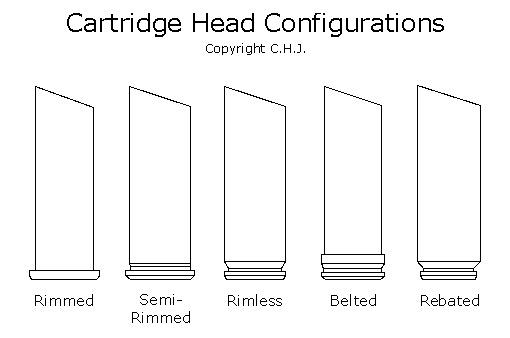
HEAD TYPES
Today there are five types of head design available on North American cases. They are:
- Rimmed - An example would be the .30/30 Winchester. Most early cartridges were of the rimmed design.
- Semi-Rimmed - The only current examples of this type rifle cartridge case are the .225 Winchester and the .220 Swift.
- Rimless - This is the most common type of head design. The .270 Winchester and .30/06 Springfield are typical rimless cartridges.
- Belted - The belted case is normally a feature on magnum cartridges, such as the 7 mm Remington Magnum and the .338 Winchester Magnum.
- Rebated - Not a common head design, the .284 Winchester is the only case that currently employs it.
THE BULLET
The selection of centerfire cartridges is extensive - about a hundred different rifle cartridges are now loaded in North America. As in cartridges, bullets come in almost every shape you can imagine. There are boat-tails, spitzers, semi-spitzers, round-nose, flat-nose, full metal jacket, hollow points and many more. Your task is to find the best possible combination for your caliber, cartridge, rifle and game hunted. It's not as difficult as you might think.
Today, almost all factory bullets are accurate, leave minimum bore fouling and expand as promised. Premium bullets such as the Remington Core-Lokt, Winchester Silvertip, Nosler Partition, and Speer Grand Slam, offer near faultless performance on expansion and penetration. Ideally, you want controlled expansion over a wide velocity range. Hunting bullets are designed for a combination of penetration and expansion that is right for a particular size of game animal. Game is generally classed as small game, varmint, light game, medium game, large game and dangerous game. Keep in mind, a light bullet designed to take woodchucks at 400 yards will not perform well on deer sized game. When hunting small game for meat or fur, you need to kill game cleanly with the least amount of tissue damage. The best choice is reduced velocity loads, preferably non-expanding. The varmint shooter wants high velocity, long range accuracy and fast bullet expansion on impact.
Big game hunters have many factors to consider. It's best to select a bullet weight in relation to the size of game hunted. Medium sized game such as deer, require medium weight bullets - 100 to 165 grains. For large game, 165 to 210 grain bullets are called for. Selection for dangerous game is critical. For maximum stopping power, 225 and 250 grain premium bullets are the right choice. The caliber of your cartridge will certainly determine bullet choice.
Be aware of which bullet is designed for which game. Errors in bullet selection causes crippled and lost game. A final bit of advice - read the literature available from cartridge manufacturers and follow their recommendations for hunting applications.
4. CARTRIDGE SELECTION
.243 Winchester (.243" bullet diameter)
The commercial version of this round was introduced by Winchester in 1955 for it's Model 70 bolt action and Model 88 lever action rifles. In its class, this 6 mm cartridge is unsurpassed. An extremely accurate cartridge, the .243 Winchester is based on a .308 case necked down to take a .243 inch diameter bullet. With 100-grain bullets, the .243 Winchester is ideal for taking deer and antelope - this bullet is constructed to give good penetration and controlled expansion.
One reason for the successful reception of the .243 is the greater sectional density of the lighter weight bullets, which mean you have better remaining velocities for long range shooting. The light recoil, even with the heavier bullets, make the .243 an ideal first gun or for recoil sensitive hunters. It is the smallest caliber suitable for big game and is an exceptional choice for varmints.
.25/06 Remington (.257" bullet diameter)
This cartridge was around for many years as a wildcat. Never an outstanding performer, the .25/06 only came into it's own with the development of very slow burning powders - velocity improvement then became significant. In 1969, Remington offered their Model 700 rifle chambered for a standardized .25/06. Today, all major rifle manufacturers offer bolt actions in this caliber.
This is a very fine extra-long-range cartridge and is well suited for open country, as it is fast shooting with a flat-trajectory. With the very large case capacity in relation to the bullet diameter, the noise levels and muzzle blast is quite high. Recoil is moderate, but be sure you can handle the noise. The .25/06 is a .30/06 cartridge necked down to accept a .257 inch diameter bullet. With ample power at 300 and 400 yards, the 117 and 120-grain bullets are the correct choices for deer sized game.
.270 Winchester (.277" bullet diameter)
Introduced by Winchester in 1925, the .270 is one of the most commonly used big game cartridges. The .270 was developed from the .30/06 cartridge with a slightly longer neck. Necked down to accept .277 inch bullets, it is a high velocity, long range, flat shooting cartridge, originally designed for use in the Winchester Model 54 bolt action rifle. There is no doubt the .270 has and continues to do its job well - this cartridge has far more fans than detractors.
The .270 has noticeably less recoil than the .30/06 and is at least as accurate. The 130-grain bullet is the most popular weight and its effectiveness on light and medium game is well known. Another solid performer in the .270 offering is the 150-grain bullet. The trajectory is almost as good as the 130-grain bullet, but it provides higher energy and better penetration on larger animals. This is one of the better so-called all around cartridges and will be with us for a long time to come.
7 mm Remington Magnum (.284" bullet diameter)
Introduced in 1962, at the same time as the Remington Model 700 bolt action rifle, the 7 mm Remington Magnum has become a classic of modern cartridges. It is based on a shortened, necked-down, 300 H&H belted magnum case and delivers less recoil than comparable .30 caliber magnums. The bullet is .284 inches in diameter and is commonly available in weights from 120 to 175-grains. It has been said that 7 mm is the optimum diameter for a hunting bullet when recoil, bullet weight and the ballistic coefficients are taken into consideration.
The 7 mm is capable of extremely fine accuracy and is easier on barrels than other caliber's that are considered hot. Loaded with a 175-grain bullet, this is an outstanding performer on larger species, although it should be considered the minimum for heavy game. In recent years, the 165-grain bullet has gained popularity due to its superior ballistics. The 7 mm is a potent big-game round and rifles chambered for it are available from all the large gun makers.
.30/30 Winchester (.308" bullet diameter)
The .30/30 Winchester was introduced in 1895 and initially offered in the Winchester Model 94. The designation .30/30 was derived from the fact that this cartridge had a 30 caliber bullet and 30-grains of smokeless powder. This is still one of the most favored deer and black bear cartridges, although it now seems to be falling from its position of immense popularity. Limited only by its velocity; shots at game should not be taken at over 150 yards.
This cartridge is generally offered in a lever action rifle, but we mention it here due to its popularity. With the tubular feeding found in most rifles chambered for this round, flat-nosed 170-grain bullets are the best choice. Again, stay within the constraints of accuracy, range and game size.
.308 Winchester (.308" bullet diameter)
Developed for the military during the late 1940's, the 7.62 NATO was adopted by NATO nations as a standard military cartridge. Winchester was the first to realize the potential of this round for commercial manufacture and introduced it as the .308 Winchester in 1952 for their Model 70 bolt action and Model 88 lever action rifles. Available in most popular makes of rifles, this cartridge easily places in the top ten list of all time. The short case also adds appeal, as a short action can be utilized in the lighter and more compact rifles that are very much in demand today.
The .308 is capable of tremendous accuracy and has now become the standard of most match shooting. In the field, this cartridge performs just as well. Shorter than the .30/06 cartridge, the .308 comes very close to its performance - within 100 to 200 feet per second. Even so, because of its slightly inferior ballistics as compared to the .30/06, it really should not be considered for heavy or large game. One hundred and fifty grain and 165-grain bullets perform well on all light and medium sized game, but 200-grain bullets are not recommended for hunting. They simply cannot be driven fast enough to make them effective.
.30/06 Springfield (.308" bullet diameter)
This is probably the most popular centerfire cartridge ever developed. Originally developed in 1903 for use by the military, an improved round was made available in 1906, designated the "Ball Cartridge," caliber .30, Model 1906. The name was eventually shortened to .30/06. Over the years, this cartridge has become the one all others are compared to. Another testimony to its popularity is the availability of firearms in .30/06 - almost all rifle manufacturers chamber for this round.
One big advantage of the .30/06 is that there has always been a wide choice of bullet weights and styles available in .30 caliber. One hundred and fifty grain bullets are ideal for deer, antelope and sheep, while the 180-grain bullet will take care of elk, moose and bear. The 165-grain is probably one of the best all round bullets for all North American thin-skinned game. If you are going to select a single rifle for all your hunting, the .30/06 will probably serve you best.
.338 Winchester Magnum (.338" bullet diameter)
This cartridge is potent, accurate and is an exceptional performer on big game at long range. The .338 Winchester Magnum was introduced in 1958 and originally chambered for the Winchester Model 70. It is based on the .458 Winchester Magnum case, necked down and designed to be no longer than a standard .30/06 case. This allows the .338 to be worked through a standard length action. In the West, ammunition is widely available and you have a large selection of rifles to choose from. All major rifle manufacturers now offer at least one model in .338.
The .338 is a premier elk, moose and bear cartridge, developing a muzzle energy of nearly 4000 foot-pounds. A powerful, flat-shooting cartridge, the .338 Winchester Magnum is the most popular big-bore magnum in North America. This is probably the largest caliber where felt recoil is within acceptable limits for hunters. Recoil and noise can be distracting, but it is the smallest of the true heavy cartridges. Two hundred to 250 grain bullets are all available and all will deliver outstanding performance.
5. BALLISTIC TABLES
This ballistic table is intended to give a quick reference on the various statistics common to the eight cartridges referred to. All tests were conducted with a 24 inch barrel and in optimum conditions, but actual performance may vary by as much as 5% or more.
| Cartridge |
.243 |
.25/06 |
.270 |
7 mm |
.30/30 |
.308 |
.30/06 |
.338 |
| Bullet Weight |
100 |
120 |
130 |
175 |
170 |
150 |
180 |
225 |
Velocity (f.p.s.)
muzzle
100 yds.
200 yds.
300 yds.
400 yds.
500 yds. |
2960
2697
2449
2215
1993
1786 |
2990
2730
2484
2252
2032
1825 |
3060
2776
2510
2259
2022
1801 |
2860
2645
2440
2244
2057
1879 |
2200
1895
1619
1381
1191
1061 |
2820
2533
2263
2009
1774
1560 |
2700
2469
2250
2042
1846
1663 |
2780
2572
2374
2184
2003
1832 |
Energy (ft./lbs.)
muzzle
100 yds.
200 yds.
300 yds.
400 yds.
500 yds. |
1945
1615
1332
1089
882
708 |
2382
1985
1644
1351
1100
887 |
2702
2225
1818
1472
1180
936 |
3178
2718
2313
1956
1644
1372 |
1827
1355
989
720
535
425 |
2648
2137
1705
1344
1048
810 |
2913
2436
2023
1666
1362
1105 |
3862
3306
2816
2384
2005
1677 |
It becomes quickly evident that neither bullet weight, velocity or the energy statistics from a single caliber can give you an accurate picture of how a cartridge will perform. A higher velocity at 500 yards will not necessarily give more energy at 500 yards. Also, bullets are constructed differently and will perform different jobs at various velocities and ranges.
As most game will be taken at 200 yards or less (in field conditions, 350 yards is a long, long way away), determine which cartridge will do the best job on the game you will be hunting. The next chapter will show you how the weight of an animal is in direct relationship to the amount of energy it takes to provide a clean kill.
6. BIG GAME WEIGHT RELATIONSHIPS
Weight, Distance & Velocity
Muzzle energy alone is not enough to determine how effective a given cartridge/bullet combination can be. Bullet construction, bullet weight, bullet velocity and several other variables all play key roles. Animal weight and mass are also critical. If you understand these relationships and choose your cartridge/bullet combination using these recommendations, you should never find yourself in a situation where more gun is needed.
To assist you in determining game weight, distance to the game and bullet velocity relationships, we have included three charts.
- Possible weights of the most popular North American adult male game.
- At what distance a certain weight bullet can handle a given game weight.
- The bullet weight and velocity needed for a predetermined game weight.
If you know just two factors, down-range bullet velocity and bullet weight, it's simple to calculate which game is manageable with your own pet load. Follow the example below and you'll see how easy it really is. A game factor has been pre-calculated for you.
EXAMPLE: .30/06 with a bullet weight of 180 grains and 100 yard velocity of 2469 feet per second
Bullet
Velocity
(fps) |
|
Bullet
Velocity
(fps) |
|
Bullet
Velocity
(fps) |
|
Bullet
Weight
(gr) |
|
Bullet
Weight
(gr) |
|
Game
Factor |
|
Game
Weight |
.2469
(a) |
x |
.2469
(a) |
x |
.2469
(a) |
x |
180 |
x |
180 |
x |
1.5 |
= |
731.47374 or 731 lbs.
(b) |
(a) - Place a decimal point in front of each Bullet Velocity
(b) - Round off the calculated Game Weight number to determine game weight for your cartridge
Chart 1 - Adult Game Weight
Big game weights vary to a large degree from one geographic area to another. An adult bull moose can weigh 600 pounds in Wyoming; while an Albertan bull moose will average 1,000 pounds and the giants of Alaska reach 1,600 pounds or more. Along the same lines are members of the mule deer family. The diminutive coastal blacktails of British Columbia are large at 80 pounds. It's close relative, the Colorado muley, would not be considered exceptional at 300 pounds. The only big game animal that more or less remains the same weight from area to area is the pronghorn antelope. Game weight listings are arbitrary. The above table lists the average weights known to be accurate on a continent-wide basis. The best policy is to check average game weights in the area you plan to hunt prior to departure.
| Species |
Average (lbs.) |
Exceptional (lbs.) |
Upper Limit (lbs.) |
| Antelope |
80 |
100 |
125 |
| Whitetail Deer |
125 |
225 |
350 + |
| Mule Deer |
150 |
250 |
400 |
| Bighorn Sheep |
175 |
250 |
300 + |
| Black Bear |
200 |
400 |
650 + |
| Caribou |
250 |
400 |
600 |
| Grizzly Bear |
500 |
1,000 |
1,500 + |
| Elk (Wapiti) |
500 |
800 |
1,000 |
| Moose |
650 |
1,200 |
1,600 + |
note - females weigh approximately 1/3 less than males
Chart 2 - Game Weight / Distance Relationship
There is a direct relationship between the weight of an animal, the distance of the shot, and the weight of the bullet being fired. While we have all heard the stories of bears being dropped with one shot from a .22 caliber rifle, it pays to be practical.
All cartridges are loaded to give optimum kills with a properly placed bullet. These tables all assume the hunter will strike an animal in a vital area of it's body. Marginal hits will result in wounded game, while some shots will drop any animal in it's tracks, regardless of it's body weight or it's distance from the shooter.
With big game hunting, there are firepower standards set that will insure the hunter is adequately armed for the game pursued. Make it a practice never to go afield under-gunned.
| Cartridge |
.243 |
.25/06 |
.270 |
7 mm |
.30/30 |
.308 |
.30/06 |
.338 |
| Bullet Weight |
100 |
120 |
130 |
175 |
170 |
150 |
180 |
225 |
Game Weight at:
muzzle
100 yds.
200 yds.
300 yds.
400 yds.
500 yds. |
390
290
220
160
120
90 |
580
440
330
250
180
130 |
730
540
400
290
210
150 |
1,070
850
670
520
400
310 |
460
290
180
110
75
50 |
760
550
390
270
190
130 |
960
730
550
410
310
220 |
1,630
1,290
1,020
790
610
470 |
Chart 3 - Bullet Weight / Velocity / Game Weight Relationship
A bullet of a given weight should be travelling at a certain velocity to cleanly kill an animal of a certain weight. Use the table below to determine if the cartridge you have chosen will have the velocity down range to do the job it was designed to do.
| Bullet Weight (gr.) |
Velocity (f.p.s.) |
Game Weight (lbs.) |
| 100 |
3300
2900
2500
2100 |
540
370
230
140 |
| 120 |
3300
2900
2500
2100 |
780
530
340
200 |
| 130 |
3200
2800
2400
2000 |
830
560
350
200 |
| 150 |
3100
2700
2300
1900 |
1,000
670
410
230 |
| 165 |
3000
2600
2200
1800 |
1,100
720
440
240 |
| 170 |
2400
2000
1600
1200 |
600
350
180
75 |
| 175 |
3000
2600
2200
1800 |
1,240
810
490
270 |
| 180 |
3000
2600
2200
1800 |
1,310
850
520
280 |
| 225 |
3000
2600
2200
1800 |
2,050
1,330
810
440 |
| 250 |
2800
2400
2000
1600 |
2,060
1,300
750
390 |
7. CONCLUSION
WHERE DO YOU GO FROM HERE?

The cartridge selection presented in this guide was limited for a variety of reasons. First and foremost, they are the cream of the crop. Combined, they probably represent 90% of the cartridge sales in North America. Over the years their worth has been proven time and time again and continue to do so - they do the job. Also, you have to make a choice. Most hunters don't have the luxury or resources available to own more than one or two rifles. Choosing from a stable of eight cartridges is a lot easier than trying to sort through the merits of many.
Before you lay your money down, ensure you have chosen for the right reasons. Your cartridge must have:
- the potential for accuracy
- suitable ballistics
- bullets available that are designed for the game you are hunting
- a reasonably flat trajectory
- recoil you can handle
- reasonably priced, easily obtained ammunition
- firearm availability
- the capability of being versatile
- reloadability, in some cases
Obviously, there is not one right cartridge choice for all hunting situations. The conditions you encounter in the field will dictate to a large degree the right cartridge, bullet and rifle combination for you and your anticipated hunting circumstances. Of the ninety-plus available cartridges, all will perform well within their design limitations. Remember though, you'll seldom go wrong if your choice is the cartridge other comparable cartridges compare to. Have a safe and successful hunt!
|