|
 In North America, if you want to hunt the biggest, this largest member of the deer family will certainly meet your expectations. The first time you come upon this magnificent beast in its harsh environment you'll be suitably impressed. Enormous in size and with an appearance unlike any other big game animal, a bull moose in all its majesty can best be described as having an attraction all it's own. Once you have experienced the thrill of hunting moose, you'll be drawn back time and time again.
There are four species of North American moose: the American, the Northwestern, the Shiras and the Alaska - the Shiras moose is the smallest and the Alaska moose is the largest. Perfectly adapted to the habitat it ranges in, moose have inhabited northern regions throughout the world for a million years or more. For the hunter, the task of taking on this animal in its own turf puts a whole new meaning on the word, "challenge".
1. ABOUT THE ANIMAL
A BRIEF DESCRIPTION
 Though considered homely by some, moose have developed a number of features that are very useful in its environment. Long legs let it wade and feed in deep water, and also easily navigate deep snow, muskeg and fallen timber. Big splayed hoofs and large dewclaws buoy it up on soft ground. A long, overhanging nose is used for stripping bark and hooking over tree limbs that it pulls down to feed upon. Big ears give the moose a keen sense of hearing. The "bell" of hair-and-hide hanging from its neck drains off water when it raises its head from feeding on aquatic vegetation. Though considered homely by some, moose have developed a number of features that are very useful in its environment. Long legs let it wade and feed in deep water, and also easily navigate deep snow, muskeg and fallen timber. Big splayed hoofs and large dewclaws buoy it up on soft ground. A long, overhanging nose is used for stripping bark and hooking over tree limbs that it pulls down to feed upon. Big ears give the moose a keen sense of hearing. The "bell" of hair-and-hide hanging from its neck drains off water when it raises its head from feeding on aquatic vegetation.
The Shiras moose is the smallest of the species. Adult bulls can weigh 1,200 pounds, stand 6 feet high at the shoulder and have antler spreads of over 4 feet. The largest is the Alaska moose, especially in the Kenai Peninsula. Big bulls weigh nearly a ton, stand 7 feet at the shoulder, and have antler's spread well over 6 feet. American and Northwestern moose are midway in size. Cows are approximately one-third smaller. The moose's coat is generally a blackish-brown with lighter tan underparts. Calves are unspotted.
 The mating season or "rut" runs from early September to sometime in November, peaking out for two weeks in late September. No harem is collected. A bull courts a cow until mating is achieved, then departs in search of another. Males become extremely aggressive during this time - sparring, pushing matches and occasional battles break out to determine superiority and the right to mate a receptive cow. The mating season or "rut" runs from early September to sometime in November, peaking out for two weeks in late September. No harem is collected. A bull courts a cow until mating is achieved, then departs in search of another. Males become extremely aggressive during this time - sparring, pushing matches and occasional battles break out to determine superiority and the right to mate a receptive cow.
Females are not inactive during the rut and actively seek out males by bawling or moaning. The estrous cycle extends for 20 to 22 days with females being receptive for a week or two. The actual period of heat lasts for one day.
In late spring, one or two calves are born, each weighing about 30 pounds. Labor lasts about 15 minutes and the calf is on its feet in one day. Reaching 130 pounds by October, both sexes become sexually mature during their second year. Cows can reproduce annually until 18 years old, although few moose survive in nature past 10 years.
Scientific name - Alces alces
Subspecies - 4 subspecies are found in Canada and the United States:
- American moose
- Northwestern moose
- Shiras moose
- Alaska moose
RANGES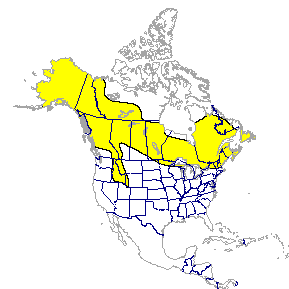
While elk were pushed into the higher elevations of western mountains to escape the advances of man, moose have migrated towards the northern reaches of our continent.
During historic time's moose have expanded their range northward in the boreal coniferous forest and into the forest-tundra woodland. Occasional individuals wander out onto the tundra in the Northwest Territories and a population has been successfully introduced in Newfoundland.
This species will generally remain in the vast timbered country of the North, although sightings are becoming more common on the prairies wherever woods and water coincide. Moose require a combination of cold weather and heavy timber. As well, moose need a habitat with lots of water - rivers, lakes, and streams. It frequents the bushy areas along shores, forest openings and recently burned, logged or flooded areas.
Spruces, tamarack, balsam fir, aspen, poplar and maples are trees commonly found in typical moose habitat. The presence of willow, alder and dwarf birch thickets are absolutely essential. Canada, Alaska, and the northern portions of some states offer the only large areas left on the continent that provide the necessary combinations.
Moose are not known to be a migratory animal. Unlike elk and mule deer that migrate to winter feeding grounds, the moose remains in its same general area the year round. Where 18 inches of snow will normally force elk to migrate downward, moose can survive in nearly twice that depth.
Today, the moose is found from Alaska, where it was virtually unknown a century ago, down through all the wooded country of Canada and southward to just inside the borders of the northernmost states in the Great Lakes region. Moose are also found along the Continental Divide, into the states of Montana, Wyoming, and Idaho.Elk are being reintroduced into many areas where they once thrived. They are also being transplanted into areas where it once appeared they could not. On Afognak Island, off the coast of Alaska, transplanted animals are thriving in that harsh environment. Adapting to the local forage, elk on Afognak Island eat the soft shoots of the spiny Devil's Club shrub.
East to west, this animal ranges from the Atlantic Ocean to the Bering Sea in the Arctic. The moose also occurs throughout northern Europe and Asia from Scandinavia and the Ukraine east to Siberia, Mongolia and northern China.
FEEDING HABITS

Moose feed on a large variety of foods. They browse on the twigs and leaves of many kinds of plants, particularly dogwood, willows and aspen. Grasses and marsh plants are also sought. Aquatic vegetation growing in lakes and streams is particularly relished in summer. During this season of the year, animals are seen at the edges of water or feeding in it. Adult moose will stand virtually submerged in deep water, lowering their heads underwater, grazing for long periods of time on underwater growth. Where a moose cannot reach these succulent plants, it can actually dive in deep water (up to 20 feet), remaining below for up to one minute.
When winter ice prevents the moose from reaching their favorite foods, they turn to twigs, bark, leaves and branch tips. Since moose have no upper front teeth, twigs are snapped off and bark is peeled with the upper lip and lower incisors. Two winter foods are willows and quaking aspen. Another is the second growth found in old burns. When reaching for tender branch tips, moose push over smaller trees with their heavy bodies. After nibbling the green branch tips, they allow the tree to spring back. Meadows containing willows are popular and in the West are known as moose pastures.
An adult moose requires a tremendous amount of forage to fuel its huge body and maintain its good health. An average of 45 pounds of vegetation is eaten per day. This rises to 65 pounds in spring and up to 120 pounds or more in autumn.
 CHARACTERISTICS CHARACTERISTICS
The moose is the largest member of the deer family. Physical features are its palmated antlers (males), massive body, long legs, large overhanging muzzle, and the "bell" or flap of skin hanging from the throat. The head is horse-like, and although their eyesight is poor, this handicap is offset by exceptional senses of hearing and smell. While not generally vocal, bulls do "croak" loudly during the rut and cows bawl; both bellow and grunt when under pressure. In spite of its size moose can attain speeds of up to 35 miles per hour and move through heavy cover without making a sound.
Normally passive animals, moose fight and defend themselves by striking with the front feet and bull's also challenge prospective opponents with their antlers. Laid back ears and an erect mane signals a direct threat. Antlers begin to grow each April and are fully formed by September, The first set appears as knobs, with full sets are developed from ages 6 to 12 years. The skin or "velvet" that nourishes the antler bone dies and is rubbed off in early fall. Maximum spread can be up to 80 inches and weigh over 75 pounds. Antlers are dropped in at the new year and are often gnawed on by rodents for calcium. To annually grow such an immense structure is truly a feat.

Most active at dawn and dusk, moose will move all day. Generally quite sedate, these awkward looking animals can be quite playful at times. Calves are often seen running in circles, splashing through water, chasing and sparring with each other. Due to the cold region's moose favor, long legs have evolved to handle normal snow cover. Movement is hampered at depths over 2 feet and 3 feet or more may cause difficulties. Moose "yard up" in some regions when deep snow conditions are encountered. Beaten trails can then be used to facilitate feeding and movement.
Although moose do not migrate as such, they often use one range in summer and another in winter. Forage, quantities of snow and protection from the weather are the deciding factors. Movements may be only a few miles to over a hundred miles. Home ranges can be unusually small for such big animals. Even though some animals range up to 100 square miles, most moose spend their entire lives in a relatively small area - usually within 1 to 6 square miles. Ranges are larger in summer than winter than in winter. Moose are not known to be territorial and are generally loners. The exception to this is in late fall and winter when loose groups of several animals may come together.
Population densities in suitable habitat average from 0.3 to 3 animals per square mile. Man's destruction of forest, hunting and severe winters all help determine the health of a given moose population. It should be noted the predation by wolves and bears (mainly on calves) are important factors in controlling the number of moose in an area. Wolf control often has to be used in order to ensure proper moose populations in certain areas. It is generally accepted that a ratio higher than one wolf to 20 moose results in a declining moose population.
DAILY PATTERNS
 For the most part, the daily pattern of a moose revolves around feeding. They require tremendous amounts of forage. This species does not follow a strict feeding schedule - these animals can be found at this activity at any time of the day or night. Normally however, when food is plentiful during the summer and fall seasons, there are two periods when feeding is heaviest. These are from just before dawn to a couple of hours after and again late in the afternoon. Other than making the occasional short trip to water, and lying or standing sleepily in a comfortable stand of forested cover, there is usually not much activity. Bull's have been known to stand for hours without movement, brain's apparently idling, seemingly enjoying the simple and pleasurable pastime of doing nothing. At those times, the animal will commonly be in a relatively open area along a lake shore or a forest-edge feeding ground. If threatened, they simply melt noiselessly into the nearby woods. For the most part, the daily pattern of a moose revolves around feeding. They require tremendous amounts of forage. This species does not follow a strict feeding schedule - these animals can be found at this activity at any time of the day or night. Normally however, when food is plentiful during the summer and fall seasons, there are two periods when feeding is heaviest. These are from just before dawn to a couple of hours after and again late in the afternoon. Other than making the occasional short trip to water, and lying or standing sleepily in a comfortable stand of forested cover, there is usually not much activity. Bull's have been known to stand for hours without movement, brain's apparently idling, seemingly enjoying the simple and pleasurable pastime of doing nothing. At those times, the animal will commonly be in a relatively open area along a lake shore or a forest-edge feeding ground. If threatened, they simply melt noiselessly into the nearby woods.
During the summer and fall seasons, moose like to feed and wade in the water. Here the animals can find relief from daytime heat and enjoy some brief freedom from summer flies. However, this does not mean moose only favor low-country, bogs and muskeg. They also like the high timbered plateaus with jutting points and promontories. Always keep in mind though, day or night regardless of their elevation, moose will not be found far from water.
 Like other big game species, moose tend to descend at night and go higher when morning breaks. In good moose country you will observe the big animals coming down from timber at dusk to the edges of lakes and streams. They feed in these locations until it is fully dark and often remain through the night until daybreak. With the coming of full sunlight, moose start to move upward onto adjacent ridges or into wooded rolling hills where they can find suitable shade and a secure place to rest. Like other big game species, moose tend to descend at night and go higher when morning breaks. In good moose country you will observe the big animals coming down from timber at dusk to the edges of lakes and streams. They feed in these locations until it is fully dark and often remain through the night until daybreak. With the coming of full sunlight, moose start to move upward onto adjacent ridges or into wooded rolling hills where they can find suitable shade and a secure place to rest.
When filled up, moose retire to thicket's and spend the greatest part of their day dozing and chewing their cud. A number of beds may be used during the day and night. Old beds are not purposely reused, but the animal will stay in a preferred area. An individual deposits about 15 to 20 pellet groups per day - indicative of its prodigious appetite.
2. HUNTING THE MOOSE
GOING IT ON YOUR OWN
Undoubtedly, the two best places to go moose hunting are parts of Canada and the state of Alaska. For non-residents, getting into moose country generally requires time, effort, money, outfitters and guides. For the resident hunter, it can be as simple as packing a lunch, grabbing a favorite rifle, jumping into the family car and driving a couple of hours.
Dependant upon your place of residence, moose hunting can be an easy or complicated matter. As a non-resident, your arrangements will likely have to be made through professionals who look after every detail. With that in mind, this section is mainly for the hunter who has the means to go it on their own.
Today, for the most part, moose are not legally hunted in the continental United States. There are a few exceptions such as Wyoming, Montana, and Idaho. In these states, hunting is allowed for a limited number of animals each fall. A certain number of hunters are chosen from a list of applications through a draw system. The ratio of those who are drawn to the number of applicants is usually extremely low. In at least one state, once you have drawn a permit and taken a moose, you may not again apply for the species.
LET'S FIND MOOSE
Moose are generally located by accessing prime areas on horseback, by all-terrain vehicle, on foot, or by boat. Some hunter's use light aircraft to spot the animals, then stalk them. Once moose are found, the actual hunt is often on foot. To increase your success, learn the different forms of calling. In a lot of situations, it's much more productive to have moose come to you, rather than you going to them.
The first lesson you learn when moose hunting is how well so large an animal can conceal itself. Its dark-brown coloration blends with dark timber, the dense shadows of thick evergreens, and the charred stumps of old burns. One reason any moose can remain unseen is they sometimes stand perfectly still for long periods of time. They do not fidget or move their heads about, a relatively unique habit among big game species.
Excepting the rut period, moose move about relatively little. Their chief interest is definitely food. Both sexes must rest and become strong and fat. This is in order to have the physical vigor necessary to reproduction or to survive the long, cold winter ahead. Often a bull will stand in one position for hours without moving. In heavy willows or timber, hunter's often walk within several yards of stationary animals and do not detect them. On foot, you can pass on one side of a stand of willows and an animal on the other side will remain unnoticed.
After the first heavy frosts, the willow and aspen leaves will fall which translates into a blessing for the moose hunter. In a period as short as one week, willow pastures and stands of deciduous trees are transformed into a field of bare stalks and trunks. A 1,500 pound moose will then stand out in this type of habitat and be easily noticed. Under such conditions, use your binoculars to their best advantage. It is not uncommon to spot trophies at extreme distances when this transformation occurs.
Look for moose by river beds, around small lakes, and in creek bottoms. Tall timber in close proximity to wet areas are prime areas. Stands of poplar and aspen hold animals as well, as long as there is heavy cover nearby. Locate open coniferous forest, inter-spaced with small clearings. Willow pastures, old burns and logged out areas are also desirable.
STAND HUNTING
"Stand hunting" is defined as taking a fixed position, be it in a tree, on an artificial elevated stand or a concealed spot on the ground. Don't confuse this with "still hunting." A still hunter moves in a cautious, snail-like pace through moose country. Most stand hunting for this species will take place on the ground. Make sure you are well concealed and keep movement to a minimum. Any windfall, outcropping, pile of rocks, tree stump or dense brush will serve your purpose. The strategy here is to break up your outline. Remember to give yourself a good view. If you must move to shoot, rethink your position. Any movement at all spooks game.
When stand hunting, most of your "hunting" will occur prior to the season. Scout the area; find well-used trails, feeding areas, escape routes and crossings. Determine the direction of prevailing winds. This is the activity that will pay you dividends. When erecting a permanent stand of any kind, do so at least three months prior to the season. Allow the animals to get used to its proximity. Try to construct a structure that will blend into the natural features of the area.
During the rut, a stand will pay back the biggest dividends. If you have taken the time and put in the effort to learn how to call, you'll need a stand. Although some bull's will barge right in, most come in very cautiously and detect you before a shot is presented. Proper concealment is necessary when calling.
STILL HUNTING
The term "still hunting" has come to mean the act of hunting quietly in search of game. This is stop-and-go hunting that is attempted by many, but perfected by few. There is not a pace that is too slow. When you think you're finally moving slow enough, cut that speed in half and pause more often. Any movement forward faster than a quarter mile per hour is strolling. Properly done, still hunting is somewhere between stand hunting and stalking. This is a productive method where a defined "patch" of country must be covered.
Walk the higher ridges, and try to locate game from above. Any hill overlooking a river bed, a pond, a creek bottom or any other body of water is a good place to still hunt moose. You can be rewarded through careful study of these areas in all directions with binoculars, spotting scope or even the unaided eye.
Hunting the shoreline of lakes on foot is another effective way of locating game. If there are many moose in the area, trails will be deep and easily read. Work these trails at daybreak and dusk, always into the wind and watching not only the trail, but the adjacent water and timber as well.
When choosing a route for still hunting, a hunter should always plan to be working into the wind. Don't allow game to pick up your scent. As in any other form of big-game hunting, the hunter sees best while moving slowly or at rest. Game sees worst while on the move. Even a moose with its acute sense of hearing can be defeated by a still hunter. Actually plan each step before you take it. Let other hunters that are on a forced march move game for you. They will cause game to move more than normally and increase your chances. Always stay alert - moose can be anywhere.
Successful still hunting depends on a thorough knowledge of the country, an understanding of your quarry's habits and weaknesses, and the sheer physical ability to move slower than thought possible for hours at a time.
HUNTING OFF THE WATER
In a region with lots of water, hunting moose from a canoe can be productive. At daybreak or dusk paddle your craft noiselessly along the shoreline. Watch carefully around each bend as it comes into view. Moose often feed in shallow water just off shore. When startled by the approach of a canoe, the animal will tend to whirl back towards shore. You'll have a moving target as it heads into timber.
Don't shoot a moose in the water. You have no idea of the difficulty you'll encounter when trying to dress the animal after it has been killed. The best you can do is try to float the animal into shallow water, chop off pieces and drag them out. It's an exhausting, miserable and messy job - once experienced, you won't repeat it!
STALKING MOOSE
Once your quarry has been located, stalking moose is comparable to stalking any other big game animal. Study the lay of the land. Find a suitable approach that takes advantage of the best cover and features of the terrain. Once you've determined wind direction, stalk noiselessly to within rifle range. The moose's senses of hearing and smell are definitely keener than their vision. If you snap a twig or rustle some foliage, a moose will stop. Remain motionless and these animals will often walk right on by you at 50 yards or less.
HUNTING WITH A PARTNER
Hunting with a partner can be a very productive method of hunting moose. The basic goal is to move game into the path of you or your partner. This requires planning and cooperation from both. Partner hunting provides companionship and two heads working toward a common goal can give you a greater chance of success.
 If you think a particular patch of timber may be holding moose, you can organize a mini-drive. Have your partner circle so as to be in a position to see the far end of the patch. Then you push through the patch, flushing the game through the opposite end. When game is thought to be in a ravine, you can work the ridge looking downward. Your partner hunts the bottom hoping either to spot the moose or move it into a position where you, at the higher elevation, will have an opportunity at a shot. If you think a particular patch of timber may be holding moose, you can organize a mini-drive. Have your partner circle so as to be in a position to see the far end of the patch. Then you push through the patch, flushing the game through the opposite end. When game is thought to be in a ravine, you can work the ridge looking downward. Your partner hunts the bottom hoping either to spot the moose or move it into a position where you, at the higher elevation, will have an opportunity at a shot.
LOGISTICAL CONSIDERATIONS
Moose are big, period! Even a distance of a few hundred yards to your vehicle can prove to be insurmountable to a moose hunter on foot. If you don't have the means available to haul the animal out, let it go. Any machine suitable for negotiating wet areas or access to horses will do. Bring along a hand winch, hand saw, ax and rope - dressing out a moose is a prodigious task. Use the best rainwear and footwear your budget will allow. Don't skimp in this area. Warm clothing and a quality compass are necessities.
3. THE RUT AND THE ART OF CALLING
THE AMOROUS BULL
During the first part of September, the rutting season begins. The rut generally starts about the time leaves turn color and may last from a month to six weeks. Both sexes become extremely active, travelling far more than at any other time of year. The bull shakes off his easy going ways and starts to roam outside his home territory. Instead of being a lethargic, detached creature, he is suddenly deranged by the urge to reproduce.
Prior to the rut the velvet is rubbed from their antlers, turning them into gleaming weapons. Once the rut has begun, this animal becomes stately and arrogant - with  a very short temper. Anything, including hunters, that gets in his way is fair game. a very short temper. Anything, including hunters, that gets in his way is fair game.
A sexually active bull will travel far and wide in search of cows. Where normally he would quietly retire, he now becomes a beast with a mission; crashing through timber grunting challenges to all. He may fight, but it will invariably be with a bull of similar stature. A young bull often hangs around a more mature bull who has already collected a cow. He'll keep his distance and will run off if seriously challenged. The transformation that takes place during the rut is a big help to hunters - it keeps bull's on the move and lowers their usual guard.
Bull moose are content to stay with one cow at a time. Unlike breeding elk, which collect a harem, bull moose locate a receptive cow, stay with her a few days then move on. Bulls will service as many willing cows as they can find. By the end of the rut he is spent, thin, and bedraggled. He has fed very little in the last 4 to 6 weeks and now must start to diligently feed. Fat must be put on for the winter ahead.
Both sexes are excessively vocal during this cycle in their year. The sawing wail of the cow and the deep, croaking grunt of the bull indicate the seriousness of their intentions. What the hunter attempts to do is imitate these sounds.
THE ARTIFICIAL CALL
 During the rut, moose are hunted by artificial calling. The most common form is comparable to bugling for elk. A horn constructed of birch bark, a commercial call or even something as simple as the cupped hands are generally used to imitate the bawling call of the cow or the grunt of a bull. Even a large plastic bottle (1 gallon or more) with the top cut off and a 3 foot long shoelace placed hanging through a small hole drilled in the bottom works well. The shoelace is wetted and slowly pulled through the fingers. With practice, this call has a reasonable resemblance to a cow's rasping call. Whatever method you choose can be effective if done right.! During the rut, moose are hunted by artificial calling. The most common form is comparable to bugling for elk. A horn constructed of birch bark, a commercial call or even something as simple as the cupped hands are generally used to imitate the bawling call of the cow or the grunt of a bull. Even a large plastic bottle (1 gallon or more) with the top cut off and a 3 foot long shoelace placed hanging through a small hole drilled in the bottom works well. The shoelace is wetted and slowly pulled through the fingers. With practice, this call has a reasonable resemblance to a cow's rasping call. Whatever method you choose can be effective if done right.!
Good areas for calling are just inside the edges of brush or timber around lake shores and from low, timbered areas leading toward meadows and bogs. Locate a wallow if you can. This is mud dug up by the front hoofs of a rutting bull to a depth of up to half-a-foot and can be several feet in diameter. The bull urinates in it, then wallows in the reeking mess. Sit hunched down in a concealed stand and grunt or bawl with the instrument you're using. Wait a few minutes and try again. Try for an authentic sound that would be irresistible to any bull within hearing distance.
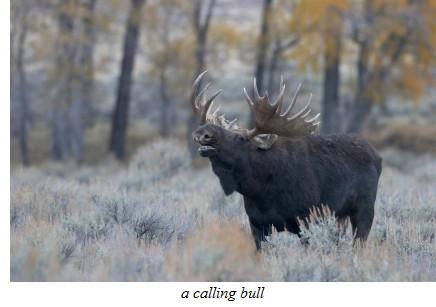 Another form of calling is to dump a hatful of water into a lake at late evening. At a slow dribble, this noise approximates the sound of a cow urinating - a noise that a rut-crazed bull cannot resist. On a calm day this sound will carry far. With this form of calling, the inexperienced "caller" is probably as accomplished as the veteran. We bring up this method of calling to point out that even unconventional calls can bring in an interested bull. Another form of calling is to dump a hatful of water into a lake at late evening. At a slow dribble, this noise approximates the sound of a cow urinating - a noise that a rut-crazed bull cannot resist. On a calm day this sound will carry far. With this form of calling, the inexperienced "caller" is probably as accomplished as the veteran. We bring up this method of calling to point out that even unconventional calls can bring in an interested bull.
Throughout moose range, calling works relatively well during the rut. To learn the proper sounds of rutting moose, invest in a commercial recording. Spend the time necessary to practice and perfect this "art" form. Few moose hunters are naturally adept at calling and if not done right, you may arouse suspicion rather than eagerness in a listening bull.
A lot of moose hunters are guided. If you fall in this category, it's likely best to leave the calling to an experienced guide. Your guide will know the time, the probable places, and the circumstances under which calling will work. Done right, there is no bigger thrill than a love-sick bull charging in to your waiting rifle.
4. RIFLES, CARTRIDGES & OPTICS
REQUIREMENTS OF A MOOSE RIFLE
Any modern firearm will function well when moose hunting, however, due to the rigors, terrain and adverse weather encountered, choose a rifle that is well constructed, durable and preferably a bolt-action. Rifles for moose hunting do not require rapid firepower, light weight or compact size. What they do require is reliability, accuracy and a cartridge that will put down a massive 1,500 animal permanently and humanely.
It's a fact moose prefer wet conditions. The new synthetic stocks and stainless metal components offered in some rifles today is a moose hunter's dream. Moisture does not affect their point-of-aim and they are largely impervious to rust. Most of the well-known gun makers offer one or more models with these features. A beautifully figured wood stock is nicer to behold, but for the practical hunter, esthetics should be way down on your list of priorities.
If you are a one-gun hunter, go with a major manufacturers bolt-action model in a caliber suitable for large game. Make sure the fit is right for you - you'll probably purchase it in a relatively potent caliber. Equip it with an appropriate scope and a functional sling. You'll receive many years of trouble-free service from this rig.
CHOOSING THE RIGHT CARTRIDGE
Never go moose hunting undergunned. The massive bulk of a bull requires a potent, heavy-caliber rifle and a large diameter, well-constructed bullet. Don't get caught up in the tales of trappers and natives who have been taking moose all their lives with a .30/30. They're able to pick their shots and get in close - you may not always have that luxury. In the far North, your ammunition must be available at any small outlet. Most outfitters would be reluctant to allow you into camp if you showed up with anything less than a .30/06 caliber. Trophy moose are hard to come by; don't blow it with the wrong setup..
Most moose hunters are after a mixed bag of game. This often includes grizzly, sheep, elk and caribou. This wide variety of available game can dictate your choice of a rifle and cartridge. The sheer size of a moose would suggest the need for a cartridge of adequate power and a relatively large bullet diameter. The fact that trophy moose are also often shot at long range prescribes a cartridge of flat trajectory and high down-range energy. The ideal cartridges for deer would be a bit shy on the knock-down power necessary when used on an animal five or six times as large. As well, moose can absorb a lot of lead and have a remarkable tenacity for life. Our choices for availability, reliability and ability to do the job are listed below:
| CARTRIDGE |
|
BULLET WEIGHT |
|
|
|
|
|
| 7 mm Remington Magnum |
|
165 gr., 175 gr. |
|
| .30/06 Springfield |
|
165 gr., 180 gr. |
|
| .300 Winchester Magnum |
|
180 gr., 200 gr., 220 gr. |
|
| 8 mm Remington Magnum |
|
185 gr., 220 gr. |
|
| .338 Winchester Magnum |
|
210 gr., 225 gr., 250 gr. |
|
| .375 H&H Magnum |
|
270 gr., 300 gr. |
|
For most moose hunting, especially when combined with hunting other species, the minimum rifle-cartridge combination should be the .30/06 or its equivalent.
OPTICS FOR MOOSE HUNTING
A well-constructed, medium-powered scope is your best choice. Not any model will do - it must be able to handle magnum cartridges and have a superior ability to withstand the elements. Make this purchase with care and a lot of thought.
Carry and use binoculars. Moose blend into their natural habitat and more than one moose has been taken by a hunter that was able to pick out a flicking ear. One of the best accessories for locating moose is a small spotting scope. Not only will it save you many a step and a lot of disappointment, it also assists in appraising size and trophy potential.
5. SHOT PLACEMENT
MAKE THAT FIRST SHOT COUNT
Moose are generally shot at in open areas. They are enormous targets and will usually be standing or moving slowly - take every opportunity to call your shot. The best spot to place your bullet is in the lung area, just behind the tip of the shoulder. Avoid shots through the shoulder itself. The heavy shoulder blade can and will deflect even potent cartridge and bullet combination. Any shot to the head and neck area is not desirable. Brain shots are extremely hard to make and the neck of a mature bull is composed of tough meat and bone.
Moose that are lung shot with an adequate cartridge usually travel no more than 50 yards and often any moose hit in a vital area will not move from where it was shot. If they are still on their feet after a solid hit, they'll reel and stagger, giving you an opportunity for a finishing shot. Approach any downed animal with extreme caution.
WOUNDED MOOSE
It is never desirable to wound a moose for obvious reasons. This is a big, tough animal that will cling to life tenaciously. They also range in some of the most impregnable habitat on the North American continent. Even with fatal wounds, moose can travel with amazing speed and agility through tangles you'll have difficulty crawling through.
When you take up the track of a wounded moose, watch carefully for visible sign such as blood and kicked-up ground cover. Clearly mark your starting spot and subsequent sign. It will make your job much easier if you lose the trail and have to backtrack. Proceed cautiously and scan the surrounding cover often as a hard-hit animal will lie down if not pressed hard. If you have the misfortune to gut-shoot or wound a moose in muscle tissue, you'll be in for a long and arduous session and chances are the moose will escape.
6. CONCLUSION
THE FUTURE OF MOOSE HUNTING

Although the moose was almost wiped out in the continental United States by the turn of the century, its survival was never really threatened in its northern ranges. With diligent protection it has returned to both its former eastern and western habitat. Estimates now place the total North American population at well over one million animals. The same numbers are currently present in Eurasia.
Contrary to popular belief, clear-cut logging generally contributes a positive effect to any given moose population. Mature forest provides very little suitable ground vegetation for animals to feed on; whereas a logged-out area is rich with new growth. The trick here is to find the proper balance of activity.
Oil exploration has also opened up many new areas that were once inaccessible to moose hunters. After an area has been explored and drilled by oil companies, the net result is a network of forestry roads. Usually, these roads are opened to the public after the major drilling activity has taken place that makes it extremely easy for the average hunter to access prime moose country.
There are several factors that contribute to declining populations. The wolf is one such factor, but since they are now controlled in numbers, they no longer pose a serious threat to this magnificent beast. Disease and tick epidemics rear their ugly heads from time to time, but they tend to be localized and relatively short-lived. Man's contribution to reduced numbers of moose is poaching and unregulated hunting.
Even with all the negatives that nature and man present, wise management of this valuable denizen of our northern forests will ensure the moose a favorable future. Hunters can look forward to the pursuit of this splendid big game animal for many years to come.
|