|
Tracking is the art of interpreting an animal's activities by way of their tracks and other sign. Indications of recent or past presence indicate the status of game where you hunt. If you can correctly interpret what you see, you can tell where game has been and when, if an animal was just passing through, or most important, tracking allows you to follow the trail of a wounded animal. Even though you can't eat tracks or sign, its presence is certainly better than no indication at all. Keep in mind that animal sign, no matter how old it may be, is always better than finding no sign at all.
Learning to track uses many skills. Observation, experience, common sense and patience allow you become a good tracker. While in the field, if all you do is look for the animal itself, your hunting will be mediocre at best - locating and understanding animal sign will increase your chance for success to a degree you never thought possible.
1. TRACKING
WHAT IT TAKES TO SUCCEED
The question is often asked, "Why can some hunters be so consistent in their ability to locate game and others can't find an animal even if it stepped on them?" Much of the skill of successful hunters can simply be attributed to patience and their talent for observation. The average once-a-year hunter doesn't have a lot of those qualities. As soon as tracking is found to be a bit difficult or there's an apparent absence of sign in the area, the conclusion reached is there is no game. Not so with the hunter who has learned to harness patience and observation. Some people have it and some don't. Most people excel in what they are interested in - you'll succeed if you have an interest in the animal you're pursuing, practice patience and observe your surroundings.
Learn to tell the track of an elk from that of a moose; the difference between pronghorn and mule deer spoor; whether it's a grizzly you're following or a black bear. All big game animals leave a distinct track and even where there are similarities, there are differences. The same applies to droppings and other sign. Some animals have an obvious signature. With others, you need to seek out the subtle distinctions.
Hunters with an interest in learning to track should try to interpret all tracks seen. If you locate the track of a deer, do you think it was made by a buck or a doe? Was the animal walking, trotting or running? If running, why? Traveling or feeding? How old are the tracks? These are all questions that can be answered by any hunter skilled in the art of tracking. With time, you can also answer these questions. Every hunter owes it to their quarry to avoid wounding it. If it happens and it will, do everything possible to follow up. You owe it to yourself and your game to have an awareness of animal sign and what it means. Tracking wildlife through sign left is like fitting the pieces together in a jigsaw puzzle. It can be as simple as identifying which species left the sign or as challenging as following a whitetail with a superficial wound. The harder the challenge, the more satisfaction there is in fitting the pieces together properly.
ESSENTIAL EQUIPMENT - THE COMPASS
Always carry a compass and know how to use it. It's not hard to get turned around and even lost while tracking, especially when following a wounded animal. With a compass all possibilities of getting lost are eliminated except one, when you don't believe what your compass is telling you. Do not second guess a compass reading - they don't lie.
To get the most use out of your compass, take a reading before starting out on a track. This allows you to know the direction you start from and which way is out. Knowing at this point rather than guessing later will save you a great amount of stress and indecision. You'll also follow the sign with more confidence and your comfort level will be higher.
WHERE TO START
The following statement is going to sound a little silly at first, but the you should generally start tracking wildlife by following their tracks the way they appear to go. All to often, a hunter will start on a track and after a short while, realize they are following in the wrong direction. Unless you are interested in seeing where an animal was, make sure you start out in the right direction. When it is not entirely clear which way the tracks are going, such as in powder snow or sand or a hard surface, there is a way to solve the mystery.
If toes or claws are visible in prints, they are the best evidence of the route of a track. The direction they point is the way their owner is moving. When moving, all animals dislodge sand, dirt, debris or snow with their hoofs. There is always some disturbance, no matter how minute. As they step or leap forward, some ground material is usually pulled or pushed in that direction. The loose particles on the ground build up on the front side of tracks. Therefore, if toe or claw marks are not visible in the footprints, the location of this buildup in relation to the track gives you the necessary information as to direction. One of the most important rules in tracking is that what appears to be obvious at first is not always what has happened. Once you become well-versed in this art, conclusions are reached quicker, but your interpretation can still be in error.
DETERMINING THE AGE OF TRACKS
The likely age of a track is determined through a combination of what you observe and the application of a little common sense. To start with, the hunter should always compare game tracks with other tracks of a known age - your own, the tread marks from a vehicle tire, the tracks of domestic animals. Aging tracks is dependent on a lot of variables. The ground cover the tracks are imprinted on, weather conditions, and the animal pursued are all factors that come into play. Due to these variables and others, it is sometimes difficult to tell exactly how old a given track is. At other times it can be relatively easy.
There are ways to tell the age of most tracks. Often weather can be a great help. If your area was subjected to a heavy rainfall all night and tracks are fresh and sharp first thing in the morning, they have to be very recent. How long a track will remain sharp and fresh looking depends on the makeup of the soil and the weather. If frost occurred the night before and there is still frost in the tracks, you can be sure they were made probably well before dawn. A track made since frost has collected is obviously fresher than one made before. Even after frost has melted or dew has lifted you can generally tell when the track was made. The path of an animal that has moved across turf heavy with frost or dew is easy to follow even though it is hard to see the tracks themselves. Animals can be trailed through vegetation because they disturb it as they pass over it. The heavier an animal is the easier he is to trail this way. A small animal does not displace much grass; however, any big game animal passing through bends down some of the stalks and changes the natural position of blades. Follow the disturbed grass.
When tracking in snow, be aware that as snow melts the tracks tend to increase in size or spread out. They'll fade and become distorted. A small track can soon appear to be a very big track under these conditions. Be careful when trying to age tracks made in wet clay, or clay-like mud. Prints made in these materials can become semi-permanent, eroding slowly. Even damp clay will dry and keep a track looking sharp for weeks or even months. Tracks in gravel or dry sand are never very good. These materials do not hold an impression. This makes it virtually impossible to differentiate an elk track from a moose track.
A track in a protected spot can look very fresh for an extremely long time. In an arid windless climate, dry draws can shelter and protect tracks for amazingly long periods. As well, moist soil that is shaded has a way of keeping tracks in remarkable condition. If you are doubtful of the age of tracks, take a branch and sweep a selected piece of ground clean in late evening. Any tracks you find the next morning have obviously been made during the night.
In tracking any animal, other signs can tell you how old tracks are, even if the tracks themselves do not tell the story. If the animal has defecated and the pellets are still moist, the animal has passed by recently. If a wind is blowing, tracks in loose and sandy soil can quickly fill up. In this case a track that looks fresh is fresh.
Aptitude in aging tracks comes from lots of field experience and some basic understanding. The more you look at tracks under different conditions, the more adept you'll become. Eventually will be able to judge how old they are, not always to the minute or hour, but at least to the nearest day. When the conditions are right, your knowledge will give you an edge in making accurate estimations of track age.
THE SIGNIFICANCE OF DROPPINGS
There are signs other than blood and tracks that indicate an animal's presence. All big game animals leave droppings and do not go out of their way to relieve themselves. This sign is found where the animal feeds, near water, and along its daily routes. Size, the age, and to an extent, the content of droppings, can tell you a lot about an animal.
Droppings that are soft and pliable to the touch will usually have been deposited within a few hours. Pellets that are still warm when felt, or steaming on a cold day, indicate the animal should not be far ahead of you. With luck, you may still be undetected and could come upon the animal at any time. The overall size of droppings can help you determine how large the animal that produced them is. Big piles of droppings in that are not strewn about usually mean a large animal that was not moving. A fresh track in a pile of recent droppings could mean at least two animals are traveling together. A point to remember is that a big game animal almost never places a foot in its own droppings.
SOME OF THE SUBTLE DIFFERENCES
As was stated before, much can be learned from observation, common sense and experience. Although some sign jumps out at you, other indicators are not as obvious. A large, heavy animal will make deeper tracks than a smaller, lighter animal of the same species where soil conditions are identical. The cloven hoofs of heavy animals, will be more splayed than those of a lighter animal. Also, a certain amount of hoof splaying is a sign of old age in an animal. This is similar to the fallen arches of older human beings.
As a rule, males make larger tracks than those of females. With horned and antlered big game the front feet are generally larger than the hind feet. However, anyone who tells you that a given track belonged to a big bull or, in the case of deer the track was made by a mule doe, is often mistaken. Unfortunately, big tracks usually go with big bodies - not necessarily with big antlers.
TRACKING AND TERRAIN
On some types of terrain, sign is easy to locate. Some types make it just about impossible to track on. Soft, sparsely grassed or sandy, loamy soil is a breeze. Rocky ground or gravel is just about impossible. Muskeg is difficult. It will clearly show the passage of an animal, but due to its wet spongy nature tracks are indistinct and often filled with water.
In snowfall areas, the type of terrain encountered becomes secondary. There is nothing like a fresh "tracking" snow. With new snow, you can follow a deer, elk, or moose as fast as they can walk. It can be of benefit, but only if a hunter can properly read the sign. Old tracks can look new and powder snow tends to make tracks soft and unclear. Deep snow makes the going tough for both the hunter and the animal.
On the desert, sand and rock make for difficult tracking. However, if you're fortunate, you'll encounter rain. After a long rain has stopped, the raindrops will have washed the sandy floor of the desert clean and all tracks seen are fresh. The heavy loam found in a woodland setting can be very conducive to tracking, although a heavy cover of fallen leaves and other debris can effectively screen tracks.
2. LOCATING WOUNDED GAME
O.K., YOU'VE MADE THE SHOT - NOW WHAT?
Chances are your game has been anchored on the spot, but what happens if the animal runs off after the shot? Thousands of animals are wounded and left to die every year, solely because hunters won't go over to where the animal was and look for any sign of a hit. Most wounded animals can be recovered simply and with ease - usually within a hundred yards. A lot of the time they leave a trail even the most uninitiated could follow.
How can you tell you have made a hit? You can't always tell and that's why you must follow up every shot, even if you're positive you missed. If you're a fairly good shot and the sight picture looked good when your rifle went off, a walk over to the last place your game was seen is imperative. Even if you can't find immediate evidence of a hit, check the area closely. You might have missed the exact spot by a few yards.
REACTIONS OF WOUNDED GAME
Most times an experienced hunter can tell a hit was made and even make an educated guess as to where. The bullet strike can often be heard. A soggy thud usually means a gut-shot. A hollow whack means a hit in the chest cavity. A sharp crack means a bone has been struck. Gut-shot animals generally hump up and run off with their head down. If an animal sags at the front end and then runs off, this generally means a hit in the forward portion of the body - most likely in the lungs. If an animal leaps straight up in the air and runs off blindly, it generally means a heart shot.
A wounded bear will fall down, then quickly get up. If not hit hard, they run off fast. A smaller animal reacts more to a hit. A well-placed shot in the chest cavity will generally knock an animal the size of a deer or antelope to the ground. On the other hand, large animals like elk and moose will often walk away with no sign of being hit.
If an animal has been shot at and does anything out of the ordinary, it generally means a hit. Watch for one animal in a group to veer away from the others and head downhill - chances are it's wounded. If you shoot at a deer and it stops behind a bush, this is almost always a sign of a hit.
WHERE TO START WITH WOUNDED GAME
If you have shot at a game animal and think you have a hit, make a mental note of the spot and move towards it. When the animal is on the other side of a canyon or a ravine, this is easier said than done. Often you'll miss the spot by fifty or more yards. Before you cross, look the country over and pick out a definite landmark. A boulder, dead tree or open meadow will do. If you can locate no landmark, mark the spot from where you shot with something that is clearly visible. You may have to go back and start over.
On occasion you'll lose a trail. All of a sudden the sign will disappear. The animal may have changed direction, the blood could have stop flowing, or maybe the terrain has changed and the tracks you were following disappeared. Don't panic. Return to the last good sign you found and start making larger and larger circles until more sign is found. Tie a brightly colored piece of cloth to a tree or bush where the last sign was discovered. You will probably cut the trail again while circling.
BLOOD AND OTHER EVIDENCE
Once you have located the spot where the game was standing when shot at, look around for signs of a hit. Your first reaction will be to look for blood, but be aware an animal may not bleed at once. Bullets do not always exit an animal. A small entrance hole in the hide may not match up with the hole in the body when the animal moves. Bleeding can then be internal. Also look for hair sheared off by the bullet. Sometimes it is possible to make an educated guess as to the body location of a hit by the type and color of the hair. In most cases you'll find the higher the hit on an animal the darker the hair.
If you find bright, scarlet blood that is frothy, chances are you made a lung shot. An animal shot directly through the lungs seldom goes far. The lungs either collapse instantly or they fill with blood. This, in effect, suffocates the animal. If you're sure of a lung shot, concentrate on the first 100 yards or so. Chances are your animal didn't go further. Big splashes of dark blood that contain evidence of stomach contents mean a shot somewhere in the abdominal cavity. A gut-shot animal will die in due time, but if it's pushed hard it can travel a long way. An animal so wounded can be recovered, but it is not easy. This type of tracking takes a lot of determination and persistence.
A shot through the body cavity behind the shoulder makes an animal very sick and distressed. If the liver is hit, the animal will appear to be in great pain. The liver is full of blood vessels and bleeding is heavy - death will usually occur in a short time. Smooth, well-defined spots of blood almost always means a muscle wound. The body cavity has not been penetrated and usually these types of wounds are not fatal. Odds are the animal will recover - it's not likely you'll locate an animal with a muscle wound.
Look for other evidence than blood; bits of bone could indicate a broken leg. Tracks leading away will confirm this. Blood location on high grass and bushes will show the relative height of the wound. If there is blood on both sides of the trail, it is clear the bullet has gone clear through. If you find evidence the animal has fallen and gotten up again, it's likely to be hit hard and not long for this world. A wounded animal will sometimes stumble and fall, leaving bits of hair and splotches of blood on the trail.
THE FOLLOW-UP
If you arrive at the spot where your game was hit and find it gone, follow very quietly and carefully on whatever trail you can find. If the animal is hit hard in a vital organ, you'll usually find it dead within 50 to 150 yards. If it is gut shot or has a broken leg, hope you can find the animal within a quarter of a mile - otherwise you'll be in for a long chase.
When hurt, an animal's first reaction is to leave the immediate area. If not pushed, they tend to lie down and watch their back trail. Loss of blood may then permit for an easy approach or after-shock recovery could allow the animal to get up and travel a long way.
Again, the first hundred yards on a trail is critical. Every effort should be made to finish the animal at the first opportunity. If you are with a partner, one should do the trailing while the other walks quietly to one side and concentrates on spotting the game. Try to locate and finish an animal the first time it lies down. When a wounded animal knows it is being followed, fear injects a new shot of adrenaline. It's alertness increases and you'll have a difficult time in getting close. Locate the animal and finish the job in its first bed - otherwise the job of hunting it down becomes extremely difficult. If you spook an animal from the spot in which it has lain down, wait a half hour before taking up the trail again.
The first instinct of a wounded animal is to pick out a thick patch of brush in which to conceal itself. Circle such patches to see if the tracks come out. If they don't, you should have the animal located. Always approach a spot where a wounded animal may be lying in such a manner that you can shoot if it attempts to run off. It's not true that a wounded animal always runs downhill. Generally though, a wounded animal would prefer not to climb - especially with a broken leg and a hit in the lungs. Wounded animals also develop a tremendous thirst. If not pushed too hard it will generally head to the nearest water.
If an animal falls but doesn't die, shoot again. Spoil a little meat rather than lose the whole animal. A wounded animal is also in great pain and shock. For a short time it doesn't think of much else. If a gut-shot animal is knocked down or lies down, it will usually remain there for a short time until the shock wears off. For that reason, it is essential you go straight to the animal - or to the spot where the animal was last seen standing.
DANGEROUS GAME
Be extremely cautious if a wounded animal is potentially dangerous. Remember, your first priority is to locate the animal and not blindly wander into it. This is where most hunter's get charged and possibly mauled or killed.
Never approach nasty cover without absolute care. If you come to a thicket that looks suspicious, circle to see if the game has exited. If not, throw stones into the cover or use some other method to get the animal to betray its exact location. If you are hunting with a partner, which you should be when pursuing dangerous game, position one of you near the probable exit spot before attempting to drive the animal out.
Never try to follow a dangerous animal at dusk - wait until daybreak. The animal may have stiffened up by then or with luck, has died. Even so, always proceed as if you have a potentially dangerous situation at hand.
3. ANIMAL SIGNATURES
WHITETAIL AND MULE DEER
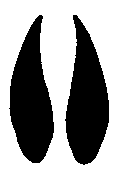 Over most of their range, it is difficult to mistake deer tracks with other tracks, although whitetail and mule deer tracks may be confused. The only real way to distinguish between whitetail and mule deer track is when the animals have been running. Running whitetails leave tracks with hind feet ahead of the forefeet, while mule deer bound with hind-feet prints behind those of the forefeet. Even though the largest mule deer may leave tracks slightly larger than the largest whitetail's, don't use this criteria to identify the difference. A 1/4 inch difference on a 3 inch track is difficult to discern. Over most of their range, it is difficult to mistake deer tracks with other tracks, although whitetail and mule deer tracks may be confused. The only real way to distinguish between whitetail and mule deer track is when the animals have been running. Running whitetails leave tracks with hind feet ahead of the forefeet, while mule deer bound with hind-feet prints behind those of the forefeet. Even though the largest mule deer may leave tracks slightly larger than the largest whitetail's, don't use this criteria to identify the difference. A 1/4 inch difference on a 3 inch track is difficult to discern.
Fawn tracks might be mistaken for javelina tracks in the javelina's range. Fawn's however, have much sharper toe prints - opposed to a javelina's blunt and rounded toe imprints. Where range overlaps, pronghorn tracks may cause confusion, but antelope have no dew claws which appear on deer tracks in soft ground. The rear of a pronghorn track is also broader.
It has long been argued there is a way to differentiate buck tracks from doe tracks. There is no sure way. A buck may or may not sink deeper in soft earth depending upon age and size. A buck could drag his feet more, but all deer show drag marks in snow or sand an inch or more in depth. Drag marks may indicate the track of a buck - or of a big old doe!
A buck scrape is used to attract does and advertise a buck's intentions during the fall rutting season. Using hoofs and antlers to scrape out a patch of bare earth from 2 to 6 feet in diameter on the ground, the location picked is usually directly under a low-hanging branch that he can hook and prod with his rack to get in the mood. He then urinates in the scrape, mixing this into the mud by scraping it with antler tines and front feet. Keep in mind that large bucks make large scrapes. Also, a series of scrapes is often made with up to half a dozen along a buck's usual travel route, often on a long ridge top.
Deer rubs should also be mentioned. The rub of a whitetail or mule buck is usually made on a coarse shrub or bush, such as a small evergreen in the north and a sapling cedar or pine in the south. Rub's are simply a spot where deer have used their antlers to scrape bark and brake branches from a sapling. You will rarely see large trees being used. Most common are those an inch or less in diameter.
Due to the rather open habitat of much mule deer range and the large territories of many bucks, mule deer rubs are not abundant in any one area. As well, mule deer rubs as not as noticeable as those of whitetails. This is also true of scrapes.
Where cattle and horses are pastured in deer habitat, they frequently rub their necks on larger trees. Occasionally a hunter mistakes these for deer sign, but the size of the tree used and the heights off the ground are dead giveaways. Obviously, tracks at the base of the tree will often identify the animal in question as well. The rub of a deer is at head height or slightly less. This means three feet or lower as a rule.
In given area's, bucks seem to prefer particular sapling or shrub types in their choice for rubbing. If you can discover what the sapling of preference is, watch for them as they can help you locate animals.
Deer droppings are another sign to look for. Depending on the size of the deer and the type of forage they are feeding on, these may be anywhere from a half inch to an inch in length. When deer are eating soft summer food the droppings do not separate into individual pellets. Except where mule and whitetail range overlaps, deer droppings cannot be easily confused with others. Occasionally rabbit droppings may cause you to hesitate. This shouldn't happen too often as those of rabbits are round, not elongated.
Deer beds will give you some indication of the presence and the number of animals using a range. Beds are not intentionally reused, so they are of interest only in passing. The only information flattened grass or melted snow of deer beds will offer is a guess as to whether a buck or a doe made them. Groupings of three are generally left by a doe and two fawns. A large, single impression may be a big buck, but then again it may have been made by a big dry doe.
Although bucks will occasionally wallow in the mud of a scrape in which they have urinated, deer wallows are not common. Don't spend a lot of time looking for this type of sign, as it's highly unlikely you're going to find it.
ELK OR WAPITI
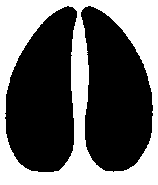 Although the tracks and droppings of elk are large and not easily confused, there can be other animals present on elk range that might leave somewhat similar sign. Often deer are present, but their tracks and droppings are considerably smaller. As well, in many areas, there are also moose. A moose track is longer, and not as rounded - droppings are also larger. Unlike the solitary moose, an elk band will leave a wealth of sign. Although the tracks and droppings of elk are large and not easily confused, there can be other animals present on elk range that might leave somewhat similar sign. Often deer are present, but their tracks and droppings are considerably smaller. As well, in many areas, there are also moose. A moose track is longer, and not as rounded - droppings are also larger. Unlike the solitary moose, an elk band will leave a wealth of sign.
Cattle commonly utilize the same range and even though they also herd, tracks left by cattle are much more blocky and generally more rounded than elk tracks. Domestic calf tracks are as much as an inch longer than elk calf tracks, and that much smaller than an adult elk track. Adult elk tracks are about 4 inches long on average.
Where cattle and elk tracks are found together, look for droppings to identify the elk. Certainly cow droppings are not remotely like those of elk. Tender summer foods can cause elk droppings to resemble cattle stools, but are much smaller - to perhaps 6 inches in diameter. During autumn, droppings take the shape of pellets. From 3/4 inch to about 1 1/2 inches long, they are always larger than those of deer and in lesser amounts than those of moose, where some confusion may be possible.
Compare old and fresh scars on aspen and other deciduous trees. This sign indicates elk have been using a range. Damage caused by rubs on saplings indicate a bull's presence during the rut. Rubs around an alpine meadow definitely show a rutting bull is in the immediate vicinity. You can distinguish elk from deer rubs. At greater height, the twigs and branches are ripped over a greater reach of trunk, and the tree is usually larger than one a deer would select.
Seek out salt and mineral licks. Wallows are also used by bulls in rut. Usually along the edge of a meadow where the ground has damp, deep, rockless topsoil, wallows are often a dozen or more feet across.
Close examination of elk range during the rut will turn up places where a bull has torn up tall grass and sod with his antlers. A lovesick bull also scrapes the ground with his forefeet. In heavy timber it is not unusual to discover a concentration of beds. These are spots where a herd has been resting and the vegetation will be matted down. A gregarious animal, elk are always active, always moving, always roaming a large area. Because of this, elk leave an abundance of signs. Herd makeup and animal numbers can be determined by carefully evaluating all these indications of their presence.
MOOSE
 If you're hunting moose, you'll need to recognize the sign they leave. Moose sign is generally quite obvious because of the animals sheer size. In prime country, tracks are one of the most numerous forms of moose sign. There is usually little confusion, as an adult moose track is unique. However, in some places there are other hoofed animals present, but the size of moose tracks easily separates them from those left by whitetail or mule deer. If you're hunting moose, you'll need to recognize the sign they leave. Moose sign is generally quite obvious because of the animals sheer size. In prime country, tracks are one of the most numerous forms of moose sign. There is usually little confusion, as an adult moose track is unique. However, in some places there are other hoofed animals present, but the size of moose tracks easily separates them from those left by whitetail or mule deer.
Caribou tracks are sometimes found in moose habitat; however, they are very distinctive. The two hoof portions are very rounded and show blunt toe imprints. Although some confusion is possible between moose and elk tracks, moose tracks are much more pointed and narrow. Mature moose generally leave a noticeably larger track than adult elk.
The ground in which tracks are imprinted often makes it difficult to determine their size and shape. Mud, muskeg and the matted forest floor where moose are commonly found can confuse the issue. However, a clean, adult bull moose imprint of the two large hoof portions will measure from 6 to 6 1/2 inches in length. Where dewclaws are also printed, the entire length of track may be over ten inches. A mature cow track is smaller, measuring from 5 to 5 1/2 inches in length. Calf imprints are smaller yet.
Tracks are not always a good indicator of moose populations in a given area. Because they browse, it doesn't take many moose to leave a lot of tracks in places that print them most plainly. In one night of feeding, a single moose can leave enough tracks in a small area to give the impression several have been using the area for some time.
Droppings are one sign that gives an indication of animal activity and a clue to abundance. During the fall and winter, pellets are rounded, or occasionally rounded with an indented end. They average 1 1/2 inches in length, which is larger than elk pellets. As with most ungulates, summer droppings seldom form in pellets and can be a soft shapeless mass. The quantity of moose droppings at any given stopping place, such as around a bed, will give you an indication of area usage.
Moose beds, in either grass or snow, cannot be easily distinguished from those of elk when both occupy the same range. Moose beds are usually larger than those left by elk, mainly due to the animal's size and a number of beds in one spot could indicate an elk herd. Multiple bedding spots in a general area will give some indication of abundance or at the very least, show the presence of one resident animal that is using the area.
In winter moose feed heavily on fir or other evergreens. A browse line seven or eight feet off the ground can easily be seen in such a timber stand, with most of the twigs and branches nibbled off. Where willows are abundant, their tops are closely cropped and a patch will appear as if individual bushes were pruned to about three feet off the ground. Where moose winter, some willow patches are over browsed until all but destroyed.
Look for bark signs on aspens and poplar. Moose love to eat the tender bark and a recently fallen tree will show much evidence of this. The chipped off bark is often mistaken for the gnaw marks of beaver, but there is seldom bark missing from the underside of a log and these trees can be a long way from water.
Wallows are used both in summer and during the rut. As with elk, these wallows will be located in damp earth that is relatively free from rocks. As well, a salt lick is also an easily spotted sign, although neither sign is as plentiful as tracks, droppings or browse lines. Where animals are forced to spend several winter months, shed antlers dropped at midwinter and whitened by exposure over time, offer evidence that the animals have been active in the area and probably will be back the next winter.
PRONGHORN ANTELOPE
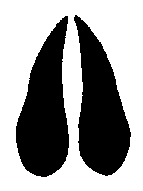 When locating pronghorns, sign is not very important where the animals are concerned. Tracks around a water hole or even out on the bald prairie give some indication of animals in the vicinity. However, if the animals are using a particular range, you can simply scan the area either with your eye or your binoculars - you'll soon locate animals themselves. When locating pronghorns, sign is not very important where the animals are concerned. Tracks around a water hole or even out on the bald prairie give some indication of animals in the vicinity. However, if the animals are using a particular range, you can simply scan the area either with your eye or your binoculars - you'll soon locate animals themselves.
Habitat doesn't usually contain a lot of cover. When lying down on a hillside, a band blends well and is difficult to spot at times. The white portions, which may appear to be pale rocks at a distance, will catch your eye. More often then not, out-of-place features turn into antelope when you bring your binoculars to bear.
Pronghorns have no dew claws and imprints show only the two halves of the hoof. The front track measures about 3 inches on mature animals, the smaller hind track a 1/4 inch shorter. The rear of a pronghorn imprint is wider than a deer's. Even so, where mule deer utilize the same feeding and watering areas, it is almost impossible to distinguish positively between the two tracks. Your success in separating tracks depends on your experience as a tracker and the ground in which they were made.
Droppings are also very much like those of deer. Some pellets may be smaller, around 3/4 of an inch, but many deer droppings are the same dimension. When antelope feed on green, soft vegetation, their droppings are often a soft, uneven mass. Again, this type of dropping is much as that left by deer. During summer and fall, when a varied combination of different foods are eaten, a more distinct dropping is found. Pellets are rounded or slightly oval.
Scrapes made by the forefeet are the most distinctive sign pronghorns leave. A small scraped-out place is pawed out. The animals then urinate and defecate in it. This is such an inherent trait that individual animals paw out numerous such scrapes daily. The problem in making use of such sign is that pronghorns are always on the move. An undisturbed band may stay within a square mile for days at a time, but will visit practically every part of that area during an hour.
BLACK BEAR
 In a habitat where the ground is matted with fallen vegetation or other ground cover that does not readily hold tracks, a black bear can move without leaving any apparent sign. However, any bear that becomes established in a particular territory invariably marks its presence. Tracks show in dirt, mud, sand or snow. In a habitat where the ground is matted with fallen vegetation or other ground cover that does not readily hold tracks, a black bear can move without leaving any apparent sign. However, any bear that becomes established in a particular territory invariably marks its presence. Tracks show in dirt, mud, sand or snow.
Bears are known to walk flat-footed, with the hind foot leaving a print that is likened to that the human barefoot track. Claw marks show in front of the toes and the toes on either side of the foot are opposite to those of a human. The print of a front foot shows the pad or ball of the foot, plus toes and claw marks. The tracks may or may not include the small, rounded heel.
There is little room for confusion with a black bear track. Although a black bear print might be occasionally mistaken for that of the grizzly, tracks of adult grizzly are far larger with a longer stride. Forefoot tracks of mature adult blacks of average size are about 4 1/2 inches long by 3 1/2 to 4 inches wide. The hind foot is 3 1/2 to 4 inches wide by 7 inches long. When walking or running, black bear hind-foot prints always show up ahead of the fore feet.
One of the most fascinating signs of the black bear occurs on the bark of trees. Look for tree types that have fairly smooth, soft bark, such as poplar and birch, maple or aspen. When a bear climbs one of these trees, each claw sinks into the bark. The resulting wound bleeds but eventually heals and in time a scar is formed. With age, these scars become rounded and expand, and look like the imprint of toes. All this means for sure is that a black bear climbed a particular tree several seasons before. You can be certain though, if there are many scared trees in a given area, they may indicate that you are in prime bear habitat. A further search may well turn up fresher sign.
Blacks will also rake trees with their claws. Rough-barked evergreens often have new or old claw marks. Bears may make them when climbing, or they may simply rear up and claw a tree for no apparent reason. They also rub up against certain trees, especially when shedding their heavy winter coats. This action wears the bark smooth and these trees may also have claw marks.
Torn bark is a very common sight. Black bears rip it open with their claws and teeth to lick the sap that bleeds out or to eat the soft inner bark. Rotten stumps or logs are shredded where the bears eagerly seek out ants and beetles. Broken limbs on wild fruit bearing trees also mark where black bears have been foraging.
Always be alert to all these signs. Also watch for bear trails - they only appear in certain places. Alongside a stream, river or lake shore, in a frequently used bedding place or near an abundant food source are the prime places to locate trails. Bears that frequent garbage dumps or who have found a source of carrion, perhaps a winter-killed big game animal where they feed daily for some time, make well-packed trails that are easily seen and followed.
While out hunting, look for piles of droppings. It is easy to judge from these scats whether a bear has been using a given place regularly, or recently. Just out of hibernation in spring, black bears immediately head for hillsides with southern exposures, open meadows and roadsides. New growth appears first in these places and the tender new growth form manure that is soft and left in large piles. More solid foods such as meat, tend to make droppings firm. These droppings will be 1 to 1 3/4 inches in diameter and in pieces several inches long.
SIGNATURE SUMMARY
Big game animal signatures are where you find them. There are no animals that do not leave at least some sort of sign. Although tracks and droppings are the most common and evident, don't discount the other sign that has been identified in these pages.
Study of animal signatures is an enjoyable pastime that can be practiced by hunter and non-hunter alike. A concerted effort to read sign will certainly increase your success as a hunter and allows you to not only find game, but to track wounded animals as well.
4. CONCLUSION
AN IMPORTANT PART OF HUNTING
We have all heard of hunters who could apparently follow a mouse through impossible terrain and never miss a trick. A great deal of mystery has sprung up around a few outdoorsmen because of their capacity to stay with an animal in tough situations. Surely, much of this mystery has been perpetrated by the hunter who is bewildered by the thought of pursuing animals by their tracks and sign. Many people are so unobservant that any ordinary bit of tracking seems to them like an act of the supernatural.
A great deal of what can be gleaned from any sign comes from observation, common sense and experience. Once you gain an understanding of how, why, when, and where game animals leave a record of their passing, this knowledge can add immeasurably to the success of your hunt. Keep your eyes open and your mind working. Associate the sign you locate with the game you seek - correctly interpret what you see. The many aspects of assessing game country may seem complicated at first, but the fundamentals are simple enough. If you constantly practice alertness, keen observation and concentration, you will find yourself intuitively sensing whether or not an unfamiliar area is worthwhile.
Big game covers a lot of territory and it's a knowledgeable hunter who knows where to look for tracks and sign. Locating animals depends on understanding your quarry's habits. Once you become a practicing tracker, you'll often take one look around in strange country and accurately predict where game is likely to be. Such skill is based on past experience and observation. With a knowledge of the basic traits of game, it's possible to narrow down the area where it might be within a large region.
Look for sign, identify it as to species, determine the number of animals that made it, age it, then begin to look for the game itself. Along with known game attributes, sign will help lead you to your quarry. Do some intelligent scouting ahead of the season. If an animal's requirement of food, water and cover is present, and abundant and fresh sign of the animals themselves are evident, you are in good hunting country. Prime habitat is, in the final analysis, determined by the sign left by the animals. Of course you can misread sign, but even experts overlook important sign. Remember, to succeed, stay with it.
|