|
 The rifle is defined as, "A firearm with a rifled barrel, designed to fire one bullet at a time and is fired by a single person from the shoulder using both hands." A hunting rifle takes this definition one step further - it must also be convenient to handle, have a high degree of accuracy, utilize a dependable action and be capable of firing a cartridge with a bullet that is adequate to humanely dispatch the game hunted. The rifle is defined as, "A firearm with a rifled barrel, designed to fire one bullet at a time and is fired by a single person from the shoulder using both hands." A hunting rifle takes this definition one step further - it must also be convenient to handle, have a high degree of accuracy, utilize a dependable action and be capable of firing a cartridge with a bullet that is adequate to humanely dispatch the game hunted.
The hunting rifle is what this chapter is all about. Within these pages is the information you need to choose the right rifle for the job at hand. You'll learn about the different modern rifle actions available, stock configurations, accuracy considerations, which rifles are best suited to what game, and much, much more. Your knowledge of this subject will expand to where you will be able to make an informed choice in picking this most vital of all hunting accessories - the hunting rifle.
1. ACTION TYPES
THE BOLT-ACTION
The large number of inexpensive postwar Mausers and Springfields played a large part in springing the bolt-action into prominence. Where lever-actions and single shots once ruled the hunting scene, bolt-action rifles have become more and more common and now dominate most hunting camps today.
The bolt-action is a very uncomplicated mechanism. It performs breech closure by a "turn bolt" moving along rails within the receiver. The bolt is manually pushed forward and then rotated down in order to lock by means of tightly fitted lugs. This locking action also cocks the firing pin. Lifting the bolt handle rotates the lugs out of their locked position and allows the bolt to be pulled back along the rails. The cartridge case is extracted at the same time and ejected from the action at the end of the bolt travel. When the cycle is restarted, a fresh cartridge is picked up from the magazine and chambered on the push forward. In the right hands this action can be cycled extremely fast.
"Straight-pull" bolt-actions have also been developed but never enjoyed the following turn bolts have. In this type of action the manual action of pushing forward the bolt causes a simple reciprocating movement. The locking action is usually accomplished by cams.
BENEFITS OF THE BOLT-ACTION
All styles of modern actions are dependable and sturdy, but the bolt-action stands out due to its strong lockup. Nothing else can come close. Although there is still stretch in the brass case when fired, moderate powder loads allow the case to be reloaded many times. The one-piece stock found on nearly all of today's commercial offerings give tremendous support for the action and allow you to bed or float the barrel for best accuracy. Action strength is second to none. Some bolt-actions will allow 100,000 psi or more before failing, while other styles have a 40,000 to 50,000 psi safety limit. The only factor that keeps load pressures down is the current case strength limits.
HANDICAPS OF THE BOLT-ACTION
There's no doubt the average hunter will be slower getting off that second shot with a bolt-action, as compared to a semi-auto, pump or lever-action. This is also the only rifle design that does not have a flat-sided receiver - the bolt protrudes. They do not slide in and out of scabbards as well as, say, the lever action. Bolt-action rifles generally carry well; however, the bolt handle does get caught on things. Other rifle designs may come to the shoulder quicker, but there are many fine handling bolt-actions out there.
Due to its inherent locking strength, the bolt-action rifle is the only intelligent choice for many of the potent cartridges available. Unfortunately, the design is a case of extreme overkill for some applications. The 22-rimfire is a fine example of where this type of strength is just not necessary. Even so, most manufacturers offer the .22 in a bolt action, mostly due the large number of hunters who carry a bolt-action for big game.
THE LEVER-ACTION
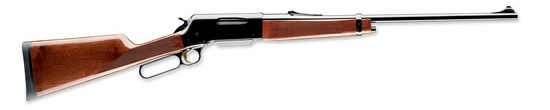
The lever-action has a breech action operated by a hand lever that lies beneath the rifle. As well, this lever usually forms an extension of the trigger guard. On the lever down-stroke, the action is unlocked, the fired case is extracted from the chamber and ejected from the rifle. At the same time, the backward movement of the breech bolt forces the hammer to be cocked. On the up-stroke, a new round is picked up. The cartridge is then rammed home into the chamber. All this is accomplished by a simple down-up stroke of the lever. The trigger is generally an integral part of the lever - your finger never leaves it. Magazines of a lever-action can be tubular, box style or rotary. The bullet pressing on the primer of the preceding bullet rules out the use of pointed bullets in the tubular style.
BENEFITS OF THE LEVER-ACTION
The Model 94 Winchester and many of its imitators offer flat surfaces. This feature allows for clean access to saddle scabbards and ease in storage and handling. There is little to snag on. As well, levers are lightweight and generally short in length. These attributes make the lever-action extremely fast, and a joy to carry. You can train yourself to quickly place shot after shot onto a target. There's no groping for the bolt, the finger does not leave the trigger, the gun can remain in the shooting position and the eye stays on target. All it takes is a little discipline. Most lever-action designs can carry quite a bit of ammo.
This style of rifle also comes in a large selection of cartridges. From the diminutive .22 caliber to the potent .30/06 and 7mm Remington Magnum (Browning Model 81 Long Action BLR), the lever-action has seen them all, though the .30/30 Winchester remains the most popular choice. Winchester also offers a Model 94 Big Bore Side Eject in .307 Winchester and .356 Winchester. These rounds are close on the heels of the .308 and .358 rounds. The lever action has served well for the past one hundred years and will no doubt serve well into the future.
HANDICAPS OF THE LEVER-ACTION
Not all lever-action designs offer the strength necessary to handle high-powered rounds. The early 94's experienced extraction problems after 40,000 psi breech pressure. At lot of these early problems have been rectified through re engineering. Today, Winchester, Browning and Savage, the big three in lever-action rifles, each offer models that will chamber cartridges for all but the largest, dangerous game. Regardless, the camming power of the lever-action is not as strong as the bolt-action. That is one major reason this type of action is not used on target rifles. The distance of rearward bolt travel also limits the use of certain long cartridges.
The original Model 94 also has top ejection, which caused severe problems when mounting a scope. It got in the way. Side mount scope mounts and side-eject models have eliminated the problem. The two-piece stock is also difficult to tune for accuracy.
THE PUMP, TROMBONE OR SLIDE-ACTION
The Slide-Action is a unique American system. It is also known as the Pump and Trombone Action. The terms aptly describe a mechanism used in rifles in which a forward-rearward action is given to the forestock or "pump handle" beneath the barrel. Pulling back the pump handle unlocks the breech bolt, extracts the cartridge, ejects it and at the same time, cocks the gun. Pushing it forward opens the breech and reloads the chamber from the magazine. Slide-Action rifles retain their popularity because a lot of hunters use a pump shotgun for bird game.
BENEFITS OF THE PUMP, TROMBONE OR SLIDE-ACTION
This is one smooth and fast action. As in shotgunning, you can fire it repeatedly without taking it off your shoulder, more so than even the lever-action. Both hands always remain on the rifle. Of sturdy construction, slide-actions sport flat receivers and are very handy in tight places. Mounting a scope is simple as the spent case is ejected from the side of the receiver. Slide-Action rifles have always been chambered for potent cartridges. Remington has long been the champion of this design and offers their model in .243, .270, .280, .30/06, .308 and the 35 Whelen. For sheer speed in firing several rounds, the slide-action rivals and can actually outperform a semi-automatic.
HANDICAPS OF THE PUMP, TROMBONE OR SLIDE-ACTION
The slide-action has plenty of accuracy for most hunting situations; however, the two-piece stock essential for working the action does not lend itself to tack driving performance during benchrest competitions. The action lockup and extraction power are not usually as powerful as those of some bolt-actions. The design also allows the cartridge to stretch more as it is fired, which necessitates full-length resizing for the reloader. Even with these slight disadvantages, if you like the features of a slide-action rifle, purchase the gun. Any lack of popularity is perceived and certainly no reflection on the weapon design itself.
THE SEMI-AUTOMATIC ACTION
Semi-automatics are just that, self-loading. True automatic weapons can empty their entire magazine on a single pull of the trigger. A semi is a modern mechanism in which the loaded and cocked firearm fires the cartridge, ejects the fired case, inserts a live cartridge and recocks the action all with one pull of the trigger. There are basically three types of semi-auto actions: gas-operated, blowback and recoil-operated.
The gas-operated is powered by gases from the exploding propellant. Bled-off gas is channeled into a special chamber that contains a piston, which pushes the breech block back. This action extracts and ejects the fired case and recocks the action. A recoil spring then forces the bolt back, chambering a fresh round. The action is closed and locked.
The blowback is the simplest and least expensive semi-auto to construct. The rearward motion of the cartridge case forces the head of the case against a heavy, free-moving breechblock. This movement extracts and ejects the case, while recocking the action at the same time. A spring then forces the "floating" breechblock back into position, picking up another round on the way. Once chambered, the rifle is ready to fire again.
The recoil-operated system uses the law of motion. Every action has an opposite and equal reaction. Recoil forces the breechblock rearward and in the process, extracts and expels the fired case and cocks the rifle. As in the blowback system, the spring-assisted return feeds a new round into the chamber.
BENEFITS OF THE SEMI-AUTOMATIC ACTION
The semi-auto is flat-sided and very trim, which makes for easy handling and comfortable handling. Since this rifle needs only aiming and trigger pull, follow-up shots can be made very quickly. Speed of fire is the key point. This design can also be chambered for a large number of cartridges, ranging from the popular .22 rimfire to the very potent .338 Winchester Magnums. This says a lot about the strength and versatility of this action and contrary to public opinion and misguided beliefs, semi-automatics are extremely reliable.
HANDICAPS OF THE SEMI-AUTOMATIC ACTION
The biggest complaint about a semi-automatic seems to be that they jam easily - they just aren't reliable. This just isn't true. Modern actions are dependable and will operate flawlessly with a little basic care. For reloaders, case life appears to be shortened in rounds chambered through a semi, but full-length resizing helps. Some hunters will also claim this type of action is not as accurate as a bolt-action - and that may be. However, the semi-automatic has plenty of accuracy for most hunting situations. Also, the loss in muzzle velocity through the utilization of powder gases is negligible. The biggest handicap semi-automatics have is that the hunter all too often depends on sheer firepower to score, rather than picking each shot carefully.
THE SINGLE-SHOT ACTION
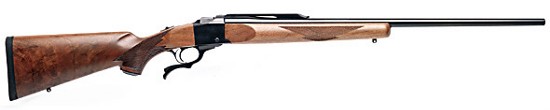
Single-shot designs were the first rifles to accept modern cartridges. Some of the systems utilized were the Rolling Block, the Standing Breech and the solid-frame Dropping Breech. Many variations of this type of action were invented, but they all used the lever-action principle. They operated by pulling down on a lever, which in turn opened and closed the action. In some cases the lever also acted as the trigger guard, in others the lever was a separate unit.
Bolt-action designs, when used without a magazine, became a bolt-action, single-shot rifle. Today, the most common chambering offered is the 22-rimfire. A turning bolt system is extremely strong and any North American cartridge in existence can be fired by this action. Some very accurate target/varmint rifles are bolt-action and single-shot.
BENEFITS OF THE SINGLE-SHOT ACTION
The biggest advantage in using a single-shot is in your head. You have to make that first shot count. As a hunter, you'll position yourself better and take more time to make that shot. Most single-shot actions are quite foolproof and can utilize a very short action.
Due to the simplicity of the action, a single shot rifle can be very light in weight. They lend themselves well to takedown forms for packing and stowing in small areas. The loading is positive and there are very few moving parts. This type of action can be manufactured inexpensively or built into a finished package that would be the envy of any serious gun buff. The Ruger No. 1 is a fine example.
HANDICAPS OF THE SINGLE-SHOT ACTION
The only disadvanage evident is that you have no immediate second shot. This inconvenience can be remedied to some extent by practice. Some hunters hold a spare cartridge in the fingers that grip the forearm. Immediately upon firing, the action is broken open and the second cartridge is rammed home. The rifle is brought back to bear within a second or two.
As well, the availability of high power single-shot rifles was a problem a few years ago. Not so today. Several well-known manufacturers offer this design in anything from the .22 Hornet to the .458 Winchester Magnum. You will also find a large selection of .22 rimfires.
ACTION SUMMARY
Your first consideration in choosing which action is right for you is the function it will be intended to perform. For plinking, a .22 rimfire semi-automatic might fit the bill. Long- range shooting may demand the accuracy of a tuned-up bolt-action. A left-handed hunter may only be comfortable firing a lever or slide-action rifle - with their choice in bolt-action rifles limited. An avid shotgunner could prefer a slide-action rifle to match the action of their shotgun.
Most hunters today, at least in the West, have clearly stated their preference. More often than not the bolt-action is appearing in hunting camps and for good reason. There's no stronger or more accurate firearm. Manufacturers are bending over backwards to offer compact versions, lighter weights and are building these rifles with more durable materials.etting, the difference in groups fired with it and a fixed-power scope of the same magnification tends to be the same.
Whatever your reasons for choosing a certain type of action, it is a matter of personal choice. All modern hunting rifle actions are safe, dependable and rugged. With proper care, any modern well-built rifle will give you many years of trouble free service.
2. THE ACCURATE RIFLE
RIFLE TERMINOLOGY
 |
|
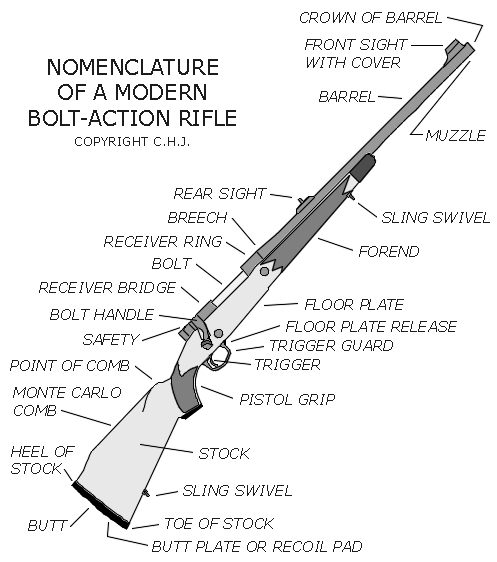
For definitions of the terminology used here, refer to the glossary at the end of this chapter.
Only the descriptions of external components of a rifle are referred to in this illustration.
|
IT STARTS WITH THE CARTRIDGE
It has been said that some cartridges are inherently more accurate than others. Why is this so? An accurate cartridge is one that fires good bullets from good barrels. Case design, case capacity, bore size, case shape, shoulder angle, bullet weight, bullet shape, barrel twist and other characteristics all add to performance in any given round. Most cartridges offered today have withstood the test of time and meet the criteria for potential accuracy.
If you choose a cartridge strictly for the accuracy you can achieve, a mid-size cartridge that delivers moderate recoil and a good balance between powder charge and bullet weight is probably called for. Another factor to consider is whether you can combine this cartridge with a rifle known for its ability to put round after round where you want them. As well, ensure you combine this rifle with the longest barrel available.
BARREL BEDDING, WEIGHT AND LENGTH
As barrels vibrate during firing, bedding of the barrel to the forend plays a major role in accuracy. A free-floated barrel does not make contact with the wood of the forend; however, the action is tightly fitted. A barrel that rests firmly in the stock channel from action to forend tip is fully bedded. Both bedding methods of bedding are acceptable, but the workmanship must be flawless. Any pressure point along the entire length of a barrel will affect the point-of-impact once the bullet whips out from the muzzle.
The heft of a barrel can also contribute to accuracy. Heavier barrels are less affected by flaws in the bedding. They heat up at a much slower rate than light, tapered barrels. As a barrel gets hot, it's dimensions change through contraction. Bedding pressure points might change and your shots may string out. This isn't to say a light barrel is going to be less accurate than a heavy barrel - a lot depends on the quality of the bedding.
Generally speaking, the longer a barrel the more accurate it is likely to be. The added length adds to the stability of a bullet in flight. Although it is a negligible factor, every inch of extra length also helps produce added muzzle velocity to the bullet.
THE TRIGGER CONNECTION
The trigger has no direct bearing on the accuracy of a rifle; however, an inferior trigger will not give you acceptable groups. A good trigger has to be crisp. In other words, it must release cleanly without creep. There should be no flat spots or hesitations in trigger travel. Most factory triggers are factory set at five pounds pull - that means five pounds of pressure are needed to release the sear, which allows the firing pin to fall.
The lighter the pull, the easier it is to fire the rifle. If the pull is too light, your rifle could be over-sensitive to jarring and fire unexpectedly. Too heavy a pull and you'll end up exerting too much pressure. In this situation, the muzzle of the rifle will invariably come up as you squeeze off the shot. For most hunting situations, the factory setting is correct.
THE STOCK
Any stock on a commercial rifle is designed for that mythical human being, the average person. Although you can get just about any custom stock configuration possible, most hunters will settle for a stock that is standard from the factory and surprisingly, rifles out of the box serve the vast majority of us very well. The main point in choosing a rifle is that it fits you well.
The rifle stock performs several functions. It provides you with a steady hold, enables you to maintain good trigger control and to take quick aim. The stock should minimize felt recoil as much as possible and let's face it, there has to be eye appeal to the shooter.
The forend must have the size and shape to keep your hand away from the hot barrel and allow you to maintain control of the firearm. If it is difficult to grip in the showroom, the problem will magnify itself in the field. The same holds true for the pistol grip. It should be shaped so you can steady the butt of the stock against the shoulder, leaving your trigger finger free to squeeze of a shot. The comb should be of a design that is high enough and thick enough that the pressure of your cheek against it steadies your aim. Look for a cheekpiece shape that gives added support to your face.
The net result of the aforementioned features should create a comfortable pressure against the butt, grip and comb. This completes the essential triangle necessary for steady aim. Two factors that determine the position of the eye in relation to the sights are drop of comb and its thickness. Position your cheek comfortably against the comb. The comb should be high enough and thick enough to put your eye in line with the sights. If the comb is too high, you'll crowd down on it and your cheek will be punished from the recoil. Drop at the heel should put the butt comfortably on the shoulder, yet be at a minimum. Recoil effect will be lessened.
Many innovative stock features have come and gone over the years and some have even improved the utility of the stock. As a hunter, be aware of some of the pitfalls that those features can bring you. Forends that are flat on the bottom are meant for benchrest shooting. The same holds true for a sharply curved pistol grip - it works well for a deliberate shot at a range, but can create problems when you have to get your hand around it quickly in the field. An extra-full forend is fine for benchrest shooting. It keeps your hand well insulated from barrel heat after a long string of shots. For the hunter though, any added material built into the design is just a lot of extra weight to lug around.
Excessive drop at the heel or the extra-high, roll-over comb found on some Monte Carlo designs are nice to look at for some, but both can contribute to unacceptable felt recoil and tend to cause painful slaps on the cheek. Stay on the safe side and choose a more classic design for a working rifle. The less difference in drop between the comb and heel the better. If a rifle recoils in a straight line and the buttplate is wide enough to distribute recoil over a large area, you'll get a minimum of felt recoil. This is very desirable in a hunting rifle.
Length of pull is determined by the length of the stock from the center of the butt to the front of the trigger. If length of pull is too short, your trigger arm will be uncomfortably crowded when you bring the firearm to bear. Too long and you'll stretch to find the trigger. Both situations are unnatural and not conducive to good shooting. Factory stocks usually run about 13 1/2 inches. Again, this is a compromise. If you are short in stature, a pull of 12 3/4 inches could be called for. A taller person may need as much as 14 inches. Fortunately, most manufacturers now offer models with longer or shorter pulls. If a standard pull doesn't feel right to you, take the time to find a stock design that does.
There are really only two add-ons to a stock that you should consider. The use of a sling is mandatory on a hunting rifle, not just a convenience, but a necessity. It helps to reduce arm fatigue, frees up the arms to push aside brush and climb, and provides a fourth point of pressure to further steady your aim. If sling swivels are not present on your new rifle, have them installed even before the scope.
The other add-on is a rubber recoil pad. It will absorb some of the recoil, but more importantly, provide a non-slip surface when your rifle is brought to the shoulder. Not to be forgotten is checkering on the forend and pistol grip. A good checkering job has definite eye appeal and serves a functional purpose as well. The crisscrossing lines allow you to grip the stock without slippage. Look for well defined, sharp points.
Last but not least is stock material. In North America, the traditional material for a rifle stock is walnut. There are few woods that are as suitable. It has a straight grain, is fairly dense, is light in weight and finishes beautifully. Many other woods are used as well and are very serviceable. Maple, birch, cherry, rosewood, and even mesquite is available. A word of caution though; if you want walnut, be sure it is walnut. Walnut finish means just that, it's some other wood that is stained with a walnut colored finish.
Laminates have been around for some time. Laminated wood resists warpage well and is very strong, but the distinct design that results when the blank is shaped is not appealing to the eye of some. With that, synthetic material is still a hunter's dream. Plastics, fiberglass and polymers are warp-free, can be molded to exact tolerances and are virtually unbreakable. Although synthetics are the material of choice for serious hunters, there still is not a finish that can hold a candle to a fine piece of wood. Aesthetics do count.
The importance of good stock design can't be overemphasized. Anyone will shoot better with a well-designed stock that fits. When that rifle comes to your shoulder, several things should automatically happen. The butt must find its proper spot on your shoulder without searching. Your cheek should lie firmly against the cheek piece and your eye immediately align with the sights. Elbows will be at exactly the right angles and your trigger finger should be within the trigger guard. If all the aforementioned happens without adjustment and fidgeting, you've got the right stock for you.
WHAT YOU CAN'T SEE, YOU WON'T HIT
As with the trigger, the sight is not directly linked with accuracy in a rifle, but as is stated in this sections title, "What you can't see, you won't hit." With open sights, the peep sight reigns supreme. The advantage is the target is always in open view - iron sights cover a part of the target. The scope sight is king. It magnifies the target and gives a fine, clear aiming point with the reticle.
Another important feature of the scope sight is that it can actually gather light, giving you a distinct advantage in low light situations. Scope sights come in every imaginable configuration and magnifying power. The scope sight is definitely the hunter's choice.
THE TUNE-UP
A rifle can be tuned for better accuracy in several different ways. Glass-bedding the action will add strength and zero tolerances to the metal/wood fit. This procedure is also used with excellent results on the barrel to barrel channel fit. By eliminating all pressure points along the length of the barrel channel, your rifle will deliver the same point-of-impact every time. Sometimes a free-floated barrel needs a pressure point to increase its accuracy. Any thin piece of material slipped under the barrel at the right spot will do the job. The bedding screw may have to be tightened or loosened slightly to alter the pressure points as well.
For safety's sake, trigger modification, headspace adjustment and other mechanical tune-up should be performed by a competent gunsmith.
A FINAL WORD
Accuracy is a relative thing and means different things to different people. Creating a single hole with a three-round group is the goal of a benchrest shooter. A varmint shooter is looking to anchor a woodchuck at 300 yards with a single shot. There is one bottom line for the hunter though - a big game animal presents a large vital target area. Any hunter that can consistently place three-inch groups at a hundred yards in field conditions is better prepared than most and has an accurate rifle. You're not driving tacks out there. You just want to do the job you set out to do, bring home your game.
3. RIFLES FOR BIG GAME
DEER RIFLES
In the brush and woods, there is probably no better rifle than the venerable old .30/30. You want a short, handy, lightweight, relatively fast shooting rifle that is adequate for medium-sized big game. Recommended though, is any one of the new generation, carbine-length bolt-actions that have appeared on the market in the last few years. They come in any caliber from the .243 to the .30/06. Some weigh as little as 5 1/2 pounds and are stocked in every material available. And keep in mind, a flat-shooting rifle is out of its element here, so any rifle that can give reasonable accuracy out to 150 yards is fine. Semi-automatics and lever-actions also perform well in close quarter hunting situations.
Wherever shots tend to be in the 200-yard-plus range, a high-intensity, flat-shooting rifle is called for. This is common when hunting mule deer out west. Because of the longer distances, a caliber from .270 and up retains its velocity better and delivers more energy downrange. A reliable bolt-action with a longer barrel from a reputable manufacturer should be your first choice.
BLACK BEAR RIFLES
Black bears are usually taken as the opportunity arises when hunting other big game. Whatever rifle you happen to be carrying when you come across a bruin will do the job; although the .243 is probably a little light. When contemplating a rifle just for black bear hunting, a medium-action bolt-action, chambered for rounds such as the .308 works nicely. This combination of action and cartridge can be put together in a neat little package and will perform well in close and long-range action. The .30/30 lever-action does a bang-up job up to 100 yards. As well, any semi-automatic you would use for deer-size game knocks them flat. A single-shot rifle is not recommended as you are dealing with a potentially dangerous game animal.
ANTELOPE RIFLES
This is a dweller of the open plains. Although you may have the opportunity for a close shot, count on at least 200 yards or more. Look to a rifle that belts out a real long-range round. If ever you need tack-driving accuracy for big game hunting, this is it. It doesn't take a lot of bullet to knock down a pronghorn, as this is a small, rather fragile animal - what it does take is some good shooting. The recommended rifle would be a bolt-action, capable of shooting at least two-inch groups at 100 yards. Some hunters take to the field with their trusty old lever-actions, but they'll generally experience a lot of frustration for their efforts. This is also one situation where an accurate single-shot will perform well.
ELK AND MOOSE RIFLES
Elk are tenacious, but moose are larger. Both animals require a large caliber, heavy bullet that packs a lot of wallop. The strongest action type is the bolt-action and is the only choice recommended. Your firearm should definitely be capable of close-in work or booming shots across canyons. Most importantly, choose a rifle that can weather a lot of storms; literally! These largest of our big game animals inhabit some of the wettest, thickest, most rugged terrain on the continent.
Stock warpage is common and more than one rifle stock has been broken during the rigors of the hunt - synthetic material stocks really come into their own here. The use of stainless steel metal components could be used here as well. Rust is a constant threat. Several of the major rifle manufacturers offer models with synthetic stocks or stainless steel metal components or a combination of both. While it is not necessary for you to depart from the traditional walnut-stocked and blued rifle, this is one hunting situation where it makes a lot of sense.
A good sling system is an absolute must. The rifle you choose will likely be heavy to handle the cartridge required. You'll find the rifle slung over your shoulder more than in your hands. Strong scope mounts and rings should complete the package. Potent cartridges tend to knock the scope around a good bit.
4. GLOSSARY
The terms that are generally associated with rifles and their function are often misunderstood, misapplied and grossly misused. To assist you in gaining a better understanding of rifle terminology, this glossary is a word guide presentation of the most commonly used terms and the currently accepted definitions.
By studying this section, you'll add to your vocabulary and be able to converse with the best of rifle enthusiasts and hunters alike. Welcome to the language of the rifle.
ACTION - The breech mechanism by which the rifle is loaded, the cartridge is locked in the chamber and the firing sequence takes place.
BARREL - The metal tube, made of iron or steel, of a firearm through which the bullet passes.
BEDDING - That part of the stock into which the barrel and action fits.
BLUING - A process of treating metal gun parts in a bath of metallic salts and water, thereby coloring them in various shades of blue to prevent rust.
BOLT - A steel rod-like assembly which moves back and forth in a bolt action, sealing the cartridge in the chamber during firing.
BOLT FACE - The forward end of the bolt which supports the base of the cartridge and contains the firing pin.
BORE - The hole in the firearm barrel through which the bullet passes.
BORE DIAMETER - The measurement from one side of the bore to the other. In a rifled barrel this means measurement of the bore before the rifling grooves are cut.
BREECH - The rear end of the barrel; in other words, the portion of the barrel into which the cartridge is inserted and contained.
BUTT - The rear end of a stock; the portion that rests against the shoulder.
CALIBER - The inside diameter of a rifle's barrel, measured from land to land; in other words, it's the diameter of the bore before the rifling grooves are cut in. Caliber can be expressed in hundreds of an inch (e.g. .22, .30 etc.), in thousands of an inch (e.g. .270, .338 etc.) or in millimeters (e.g. 7mm, 8mm etc.).
CANT - This is to tip or lean your gun to one side when in the aiming position. Cant usually results in inaccurate shooting.
CARBINE - This is simply a short rifle; developed to be carried while performing other functions. When it is chambered for the same cartridge as the longer-barreled rifle, its accuracy and regularity of ballistics are usually not as good as those of the rifle.
CHAMBER - This is the enlarged and specially shaped portion of the barrel at its rear end, into which the cartridge is placed prior to firing. The chamber holds the cartridge and directs the bullet into the rifling in proper alignment.
CLIP - A metal case designed to hold a number of cartridges for loading into the magazine of a rifle.
COCK - This action sets the firing pin into position for firing.
COMB - The upper edge of a rifle stock upon which the cheek rests.
CROWN (muzzle) - The very end portion of the muzzle of the barrel. Often the crown is recessed to protect the rifling.
EJECTOR - A component whose function is to throw the cartridge case free from the firearm after the shot has been fired.
EXTRACTOR - A hooking device which is generally attached to the bolt and which pulls the fired cartridge case out of the chamber and presents it to the ejector.
FIRING PIN - That part of the breech mechanism which strikes the primer of the cartridge. It is axially mounted and spring-propelled, as in a rifle bolt.
FLOOR PLATE - The detachable metal plate at the bottom of the cartridge magazine of a bolt-action rifle. The floor plate is usually hinged at the front and held by a release spring located just ahead of the trigger guard.
FOREND - The forward portion of a shoulder-arm stock. Located under the barrel, the forend serves as a hand-hold.
GLASS BEDDING - The use of a synthetic compound to form a barrel channel and / or a seat in the stock for the action.
GRIP - The small portion of the stock gripped by the trigger hand. The name varies depending on its shape - pistol grip, straight grip, etc.
GROOVES - see RIFLING
HEADSPACE - The distance between the face of the bolt and the base of the cartridge case and is measured in thousands of an inch.
HEEL - The rear end of the upper edge of the gunstock or the top of the butt.
LAND - The uncut portions of the barrel left between the rifling grooves.
LENGTH (stock) - The distance from the front of the trigger to the center of the butt.
LOCKING LUGS - A series of projections on the bolt of a firearm designed to fit into corresponding slots in the receiver to lock the action in closed position for firing.
MAGAZINE - The part of a repeating firearm which holds the cartridges in position ready to be transferred one at a time into the chamber.
MAINSPRING - A strong spring which actuates the firearm firing pin.
MUZZLE - The forward end of a barrel.
MUZZLE BLAST - The violent disturbance in the atmosphere after the discharge of a weapon. This is caused by the expansion of powder gases into the air.
PITTING - This is the term used to indicate the deterioration of the metal of a rifle due to rusting.
RECEIVER - The "body" of a firearm. This component contains the firing and breech mechanism and to which the barrel, stock, sights etc. are fixed.
RECOIL - The rearward motion of a firearm caused by expansion of powder gases which forces the bullet out of the barrel.
RIFLING - Spiral grooves cut into the bore of a firearm so as to impart rotary action to the bullet during its passage. The object is to give the fired bullet gyroscopic stability so that it travels point-foremost.
SAFETY - A device that blocks the firing mechanism so it can't go off accidentally.
SEAR - The part of a firing mechanism, linked to the trigger, which engages with the hammer or firing pin against spring pressure and when pulled clear by trigger action, allows firing.
STOCK - The part of a shoulder firearm by which the weapon is held for firing.THROAT - The forward portion of the chamber, where it is tapered to meet the bore.
TOE - The bottom part of a rifle butt.
TRIGGER - The part of a rifle mechanism by which the firing pin is released to ignite the cartridge.
TWIST OR PITCH - The angle at which the rifling of a bore has been cut in relation to the bore axis. The degree of twist of rifling is determined by the weight and length of the bullet and the velocity at which it is to be fired. Twist is generally shown as the number of turns in an inch (e.g. 1 turn in 24 inches).
|