The North American Sportsman website was developed to promote hunting in North America. The sections cover everything from hunting individual big game species to hunting techniques to essential accessory information. There's something here for every hunter, whether you're just starting out or an old hand at it.
THE HUNTING CYCLE
Basically, the activity of hunting consists of five very distinct elements; need, planning, preparation, execution and the aftermath. For the sake of argument, we'll call this the Cycle of Hunting.
The Merriam-Webster dictionary defines "need" as a condition requiring relief. That is fairly self-explanatory. For the nine or ten months between most hunting seasons, we give hunting a lot of thought, talk about it at every opportunity and just generally daydream along until we start to close in on opening day. Working on the "Need" segment within the hunting cycle is generally the most enjoyable and the easiest to participate in as it costs nothing, does not have to be packed, can be done during or after working hours and really doesn't have a starting or end date.
Once the need part of the cycle has run its course and we've narrowed down the species were after, we move into the planning stage. For a lot of us, planning for a hunt used to be a quick phone call to your buddy just after 10:00 p.m. on a Friday night to determine who was going to pick up whom at 5 a.m. the following morning. However, those days are gone for the most part. Today, planning tends to be a lot less spontaneous, a bit more onerous and more drawn out than it used to be.
Preparation can be as simple as ensuring you're waiting at the foot of your driveway at 5 a.m. with a hastily packed lunch bag, your favourite deer rifle in hand and a pocket full of shells that match the rifle. Unfortunately, that's not how it works for most of us nowadays. Preparation should begin months prior to your hunt. Hunting opportunities are not what they used to be so you should make every effort to get out front and complete your preparation well in advance.
A prime example of how radically preparation has changed is licensing and permits. Most jurisdictions have now gone to the draw priority system to distribute tags. At minimum, you're looking at committing to your hunt for the game you're after at least three to four months prior to opening day. And in some cases with the priority system, the only option you have is to plan out several years to be successful in a draw.
Execution is the actual hunt. This activity has always been the shortest part of the cycle and will very likely continue to be so. Whether you're out in the back forty for a morning deer hunt or on a fourteen-day three species horseback hunt in the Yukon, it always seems the hunt is over before it begins. There's not much you can do about that perception, except make the most of the time you do have. Hopefully, the other sections in the "How-To-Series" have given you the ability to do so.
We all know what the Aftermath is. That's the time when the hunt is over, the fun part is done. The aftermath is when you have to deal with the trophy, carcass, wash, scrub and clean equipment, dry out everything that needs drying, repair or replace the stuff that has broken down and mentally prepare yourself to go back to the job that pays the bills.
We all deal with the five elements in the cycle of hunting in our own way. The type of hunt and the species we're after will determine to a large degree how complex any one the elements will be. We can't do anything about developing your need, but we can give you a valuable tool for your planning in the next chapter. Preparation is different for all of us and we'll try to give you a couple of common-sense pointers that should give you a bit of an edge. The execution and the aftermath are up to you.
A FINAL CHECK; THE CHECK LIST!
Well, we're one of them. And, you should be too! Most successful hunters use a personal checklist to ensure they don't forget an item that's essential to their hunting trip. Now we do know that many factors have to be considered in hunt planning. What is the type of hunt? Are you just on a day hunt or is it several days? Is the hunt for big game, upland birds or waterfowl? Will you camp, stay in a motel or use other shelter? Will you use a firearm or bow? Are you on your own, with a partner or are you using the services of a guide or outfitter? What conditions will you be hunting in? These are just a few of the questions that will determine the type of list you build and the items included.
At a minimum, categories for your personal checklist should include the following:
Make your best attempt to list out your requirements in each of these categories. Identify the equipment you'll need for the type and length of hunt you're planning. Taking into consideration the mechanics of the hunt are critical, as access to where you want to hunt may limit the equipment that can be taken into your hunting area. If you're backpacking, weight will severely limit equipment. Vehicle access either by pickup or A.T.V. makes a world of difference in the extent and makeup of your list. What's being hunted, where it's being hunted, how the area will be accessed, the type of weather and climatic conditions to be expected, and much more determine what your list will look like.
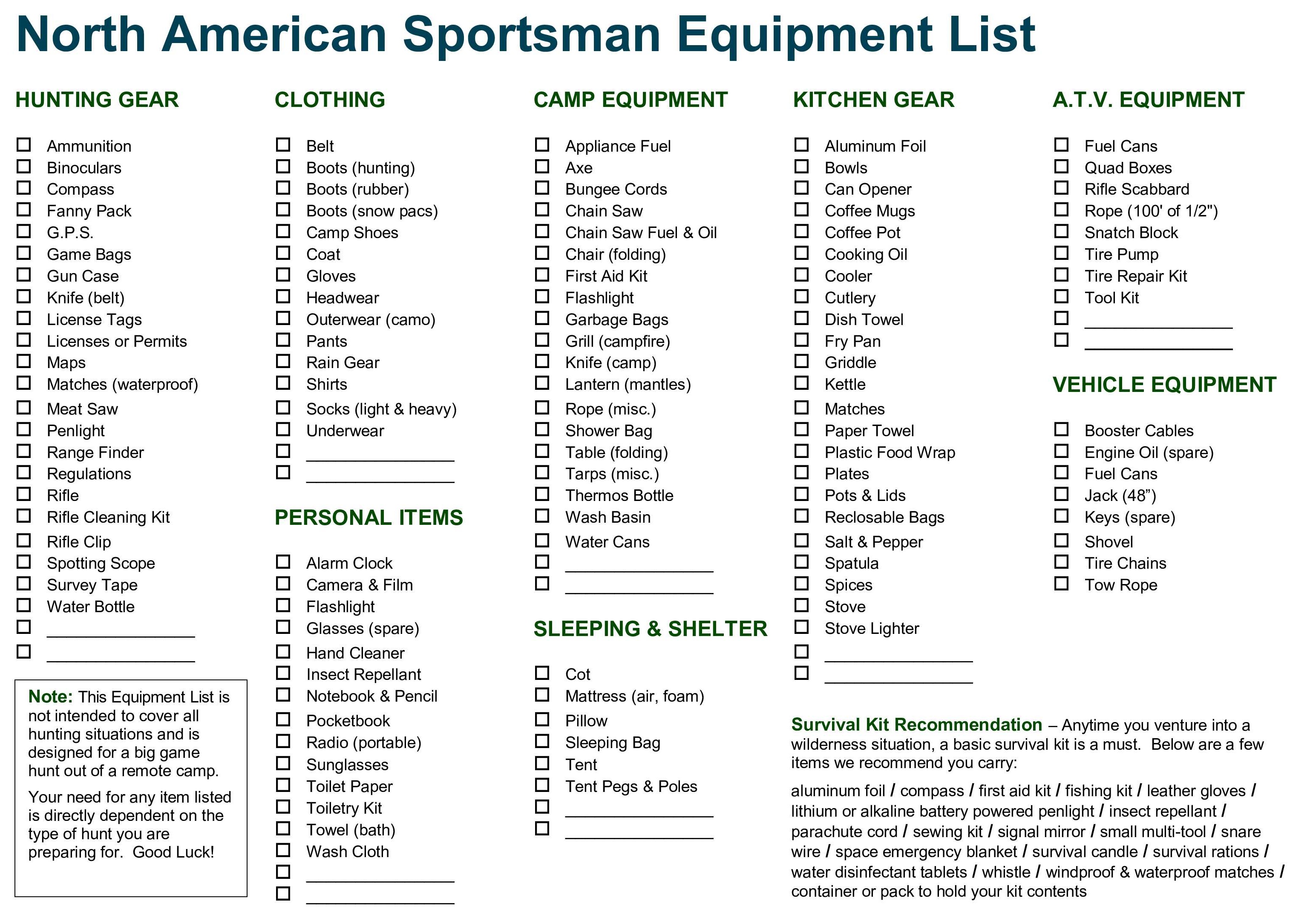
With that said, the next step is to get you started with what we think are the very basics in the planning process, the North American Sportsman Equipment List. This list is by no means complete, nor is it intended to be. Click to open PDF and print it. But, any kind of list is better than no list at all and this one might give you some idea how to create your own for your personal type of hunting you participate in. And, to give you a head start on creating your own list, you can print off our list by clicking this . Clicking the button will take you to a .pdf or Portable Document Format page that has the list in a printable format.