|

Mule deer country can be high watershed country, rolling foothills, the endless prairie or barren desert. It's very close kin, the blacktail, inhabits our western coastal slopes. Wherever this larger cousin of the whitetail ranges, he is avidly sought by serious deer hunters. He is heavily built and has that look of ruggedness about him that other deer can't match. A heavy-antlered mule buck is a sight to behold!
The mule deer is largely under-rated as a first class trophy. This is a game animal that will test your ingenuity, skills and patience as a hunter. Not as wary as the whitetail, he is seldom jittery or nervous. Although a muley will give you the impression at times of being a rather trusting creature, a mature buck can lead you around the hills with the best of them. When taken fairly and on his own turf, old mossy horns will merit a chosen place on your trophy wall alongside your beautiful whitetail buck or that magnificent royal elk.
1. ABOUT THE ANIMAL
A BRIEF DESCRIPTION
The mule deer is distinguished from the whitetail in several ways. From between the ears to a point midway on the face is a recognizable black patch in the form of a solid U. The summer coat is sleek and reddish -brown, becoming thicker, longer and grayish-brown in winter. The forehead, ear fringes and chest are blackish-brown. Both the rump patch and belly are white. Fawns are reddish-brown with rows of white spots on the upper parts.
 Mulelike ears, which are larger than those of either the whitetail or the blacktail deer, gives this species it's name. One of the most distinguishing characteristic of a mule deer is its tail. Ropelike, it's covered with short hairs ending in a black tassel. The metatarsal, or musk glands on the lower hind legs are much larger than on the whitetail. Hoofs are slightly larger and more blunt than the whitetails to aid the mule deer in broken-country travel. As well, the mule deer can cope with deep snow better than the whitetail, which prevents the excessive yarding up in midwinter common to some whitetail regions. Mulelike ears, which are larger than those of either the whitetail or the blacktail deer, gives this species it's name. One of the most distinguishing characteristic of a mule deer is its tail. Ropelike, it's covered with short hairs ending in a black tassel. The metatarsal, or musk glands on the lower hind legs are much larger than on the whitetail. Hoofs are slightly larger and more blunt than the whitetails to aid the mule deer in broken-country travel. As well, the mule deer can cope with deep snow better than the whitetail, which prevents the excessive yarding up in midwinter common to some whitetail regions.
The points of a buck's antlers originate from a main beam that separates, forking out in several directions. The number of points is no indication of age in mature bucks - 4 points plus a brow point on each side is standard for an adult. Antler development and the number of points are directly related to the presence of limestone in the diet. Antlers grow over the summer (up to 1/2 inch a day), are polished by rubbing in August and September, and fall off around January, but sometimes as late as April.
 The mule deer is more sociable than the whitetail and forms combined herds, particularly in winter. The mule deer's generally larger size, along with its stockier build, gives it a blockier, less delicate appearance than the whitetail. Even so, it is by no means less smooth or elegant. The high mountainous regions of the West and far north ranges produce some of the biggest deer and mature bucks can weigh from 200 to 475 pounds. The female is proportionately smaller and carries 1/4 to 1/3 less weight. The mule deer is more sociable than the whitetail and forms combined herds, particularly in winter. The mule deer's generally larger size, along with its stockier build, gives it a blockier, less delicate appearance than the whitetail. Even so, it is by no means less smooth or elegant. The high mountainous regions of the West and far north ranges produce some of the biggest deer and mature bucks can weigh from 200 to 475 pounds. The female is proportionately smaller and carries 1/4 to 1/3 less weight.
Scientific name - Odocoileus hemionus
Subspecies - 9 subspecies of the mule deer are found in North America / 2 subspecies of the blacktail deer are found in North America
The 6 subspecies identified below are most common:
- Rocky Mountain mule deer
- California mule deer
- Southern mule deer
- Desert mule deer
- Columbia blacktail
- Sitka deer (blacktail)
RANGES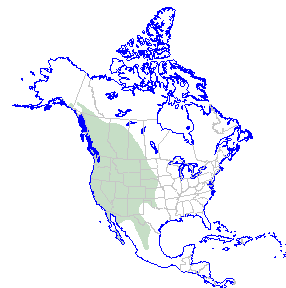
Mule deer and whitetail deer evolved in North America, the former being restricted to the West. From the coastal slopes of the Pacific, to the rugged terrain of the mountainous region that runs along the western spine of our continent, to the foothills and often arid territory of our prairies and deserts, the mule deer has always ruled.
Over its far reaching western range, the mule deer has been divided into several subspecies or geographic races. Out of that, two main groups are so distinct in appearance and behavior that the use of common names has persisted - mule deer and blacktail deer. Other close relatives include the marsh deer and pampas deer of South America. Four species of the tiny brocket deer occur throughout South America, with 2 species reaching as far north as Panama and Mexico. Today, the mule deer is still restricted to western North America. Range extends from southern Alaska, the Yukon and Northwest Territories, south through British Columbia and the Canadian prairies, the entire western half of the United States, into Baja California and the highlands of central Mexico. The blacktail is found only on the west slope along the Pacific, from Alaska to central California. Even though the blacktail is a subspecies of the mule deer, it is different enough that it is given individual attention later in this chapter.
Over such a large area, mule deer are capable of living in unusually different types of environments. The Columbian blacktail inhabits dense, humid forest, and thickets of heavy brush in sometimes arid settings, such as in California. The Sitka deer is found in impenetrable, tangled cover. This deer receives little hunting pressure, mostly due to the inaccessibility of its range - a narrow coastal strip in southeastern Alaska. The Rocky Mountain mule deer is primarily a deer of open forests and broken brush lands. Found in habitat that ranges from alpine meadow, mixed forest, arid plains and open prairie, this subspecies is the most numerous and widespread. The Desert mule deer is more of a specialist. It prefers the desert floor in Arizona and the desert mountains of western Texas.
The mule deer as a species is truly remarkable. It can handle a great diversity of range and sometimes harsh environments, and also handle climatic extremes from -75 F to 124 F.
FEEDING HABITS

The diet of this animal is dependent on where it lives. Close to 1,000 kinds of plants have been listed, including an infinite variety of grasses as the mule deer is primarily a grazer in summer. Where found, herbs, berries, fruit, acorns, pine nuts, mushrooms and sage are all sought. The list also includes the twigs and leaves of shrubs and both deciduous and coniferous trees. Choice is often based on high nutritional content of particular plants.
During spring and summer the deer has access to lots of nourishing food from new plant growth. This is when it builds up fat reserves. In winter, when plants are dormant or snow covered, a deer often cannot maintain its weight as it generally has to eat relatively poor forage - favored winter foods are aspen, willow, red-osier dogwood, huckleberry, Douglas fir, and western cedar.
Survival of mule deer is directly linked to the quality of food plants and the ability of the deer to reach it, particularly in areas of heavy snowfall. Desert drought causes a serious depletion of forage The question of artificially feeding deer on winter ranges often comes up. Experiments with artificial feeding have been largely unsuccessful as the deer's digestive system needs natural foods. Deer will die after periods of artificial feeding. One of the worst disasters occurred in Arizona's Kaibob Forest during the 1920's, when thousands of overprotected deer starved on winter ranges.
CHARACTERISTICS

The mule deer is not a forest animal like the whitetail. Its habitat is generally broken country and mountainous regions. The whitetail also tends to live out its life cycle within an area of a few miles. Mule deer will migrate by gradually drifting between summer and winter ranges. In winter, concentrations of mule deer will be seen far down on desert sagebrush and bitterbrush flats and in areas of only 3000 feet or less in elevation. However, in summer the mule deer move upward into mountain and timber country to escape heat, flies and enemies. This change in elevation may to above timberline to 10,000 feet elevation - a difference of 7,000 feet or more.
The mule deer is known for its bouncing gait, landing on all fours. It can reach speeds of over 35 miles per hour, cover 25 feet in a single jump, and clear a 6 1/2 foot fence. Also, the body can be turned completely in the opposite direction during a single bound. Undisturbed, the deer walks normally and can trot and gallop. Mule deer move through snow less than one foot deep by wading or jumping, but greater depths and crusting decrease mobility. Twenty inches of snow virtually eliminates this species from an area.

A mule deer remains in a small home range with short daily movements if adequate forage and cover are nearby. Summer ranges cover up to 250 acres and to over 5,000 acres in winter. In mountainous regions, animals migrate to winter range at lower elevations for distances of up to 100 miles. Factors such as forage, cover, terrain, water, and climatic conditions determine the carrying capacity of it's habitats. Population estimates range from 3 per sq. mile in prairie to 80 per sq. mile in cover, while winter ranges may hold over 100 per sq. mile. Blacktail populations on the west coast can be as high as 500 per sq. mile.
Mule deer have 32 teeth (no upper incisors or canines) which wear down over years of grinding food - the degree of tooth wear can be used to age individuals with accuracy. The coat hairs are tubular and filled with air pockets - which offer insulation from the cold and buoyancy while swimming. Usually silent, mule deer communicate through whistles, snorts, coughs, grunts, bleats and barks. Primary predators include coyotes, cougars, wolves, lynx, bobcats, black bears, grizzlies, eagles and man. Mule deer multiply by about 25 per cent annually, after normal losses to winter kill, predators, disease and aging. This allows rapid re-establishment after any devastating loss and provides for hunting surpluses. Competent game management sets hunting seasons early in the fall before deep snows. This reduces the take as the animals have not yet concentrated on winter range.
The rut occurs from October to January dependent on the latitude, although most mating takes place in November and December. Bucks engage in terrific battles using their forked antlers and powerful neck muscles, which increase in size at this time of year. Dominant bucks become exhausted in defending does from other bucks and many do not survive the winter ahead - conditions may be such that suitable forage cannot be found to fatten them up sufficiently after the rigors of the rut.
The doe's cycle lasts for about 25 days and she comes into heat for around 24 hours. After 200 days from mating, two fawns (1 to 4) are usually born and each weighs up to 11 lbs. Births occur in June or July and fawns are hidden in a thicket for the first month, nursing every 4 hours or so. They are able to nibble on plants after a few days, run at three weeks, and are weaned at 4 months. Often, only one in four fawns lives past one year. Sexual maturity is attained at 1 1/2 years of age and the average life span is 4 years. In rare instances some survive to 10 years in the wild. Doe's have been known to live for 22 years in captivity and bucks up to 16 years.
DAILY PATTERNS
The main activity periods for mule deer are early morning and evening. This can be extended to several hours after dark, but when a deer needs nourishment it may be out anytime. Deer normally feed little after the sun is well up because they basically avoid heat if possible. In fall and winter, especially on cool mornings, mule deer will be out on the slopes until around 9:00 a.m. At that time most of them disappear, bedding down in cool sites until about 4:00 p.m., when they begin to reappear. Heavy feeding then takes place until after dusk. A feeding deer may have to walk a mile to water, then climb another mile up to a rimrock where it will bed down in the shade of overhanging rocks.

You can take advantage of daily movements - most hunters do. Mini-migration routes followed by feeding deer are usually consistent and allow for ambush. Just the movement from feeding to water to bedding sites exposes the mule deer to a much greater degree than the secretive whitetail. Close observation of these movements often pays off.
Daily movements of mule deer usually extend over a somewhat wider range than that of a whitetail. Perhaps this is simply because their habitat is generally so vast. However, when adequate forage and water are nearby the territory in which any individual deer lives is not large. Often, a trophy buck that has taken up residence around a particular piece of real estate will be seen there week after week.
2. HUNTING THE MULE DEER
GOING IT ON YOUR OWN

Mule deer hunting has evolved numerous practices adapted to the specialized habitat and habits of the animals. There are many ways to hunt this animal. If you have neither the means, the inclination, nor the connections to hunt private ranches, there is a tremendous amount of public land available to the mule deer hunter. Due to its preference for broken, often arid and rugged terrain, the mule deer is a perfect candidate for the hunter going it on their own. In other words, mule deer are generally found where man has not civilized and cultivated the country.
There is no need for elaborate preparation or specialized equipment when hunting mule deer. You just need the means to arrive and the desire to hunt. Often, this game animal is taken incidental to other game animals such as elk and sheep. So much the better, but planned hunts for only trophy mule's are just as rewarding within themselves.
Start by writing or visiting the game department in the state or province in which you wish to hunt. In an effort to build a healthy mule deer population, most areas regulate the hunting of these fine big game animals by using shorter seasons, permit draws and limited license issuance. Research early, late spring is preferable, to take advantage of any draws that may be available. Once you've determined your hunting area, purchase detailed forestry maps to locate access. Study these maps diligently and pre-scout the area by marking likely features, such as irregularities in the terrain, elevation variances and forest cover. This exercise will save you a lot of time if you have the opportunity to actually scout out your destination prior to the actual season.
Much mule deer hunting is done on horseback because of the vastness of some territory. The same method is accomplished by vehicle where possible. The idea is to cover as much ground as possible while constantly glassing. Once a huntable animal is located, the horse is tied up or the vehicle parked and you proceed to stalk the trophy on foot.
LET'S FIND MULEY'S
You will generally shoot at mule deer over much greater distances than with whitetails. Muley's are hunted in more open country and are located in extreme habitats of elevation and intervening cover, which changes how they react to pressure. Like other deer species, mule deer feed and move about in the open during the dawn and dusk periods.
Hunt for mule deer from above if possible. To accomplish this you should do your climbing early in the morning. Just prior to daybreak is optimum. Ridges are fine places to hunt for mule deer - so are points in timbered country that overlook canyons. When day breaks, muley's are most apt to be on the southern slopes leading off ridges. Around mid-morning mule deer go up and over the ridges onto the northern slopes for shade. Ridges allow the game to watch for danger from several directions at once and provide escape routes in several directions. Canyon rims are also good places to hunt mule deer. Check out any area that features rippling humps of land and smaller ravines leading off a main ridge. As well, edge country is good mule deer habitat.
If the hunting season is during a mild, late autumn, most deer in an area will be relatively higher within their range. A good rule for normal fall hunting is to hunt the lower edge of the snow line and down. Heavy rain and snow will move the entire herd lower. Old mossback bucks bring up the rear, often several days after the does and fawns.
Often in hunting mule deer in mountainous habitat, your hunting camp will be considerably removed from your desired deer country. This makes it difficult to capitalize on the best hunting periods and it becomes necessary to hunt during midday. During the day, mule deer tend to gravitate to canyon bottoms, the northern slopes of mountains and heavy patches of brush for rest and shade. Work the aspen patches. Another place old trophy bucks like during midday is the rimrock overlooking big canyons. They will bed down just under shelving rocks, after having scouted for danger in all directions from the ridge. In such a position they can see danger approaching from the canyon or the ridge tops. Take advantage of this knowledge and continuously glass such areas.
DRIVING DEER AND HUNTING WITH A PARTNER
The methods you'll generally use when hunting this deer are different from those in hunting whitetails. Mule deer aren't usually driven. Over much of North America, deer-hunting seasons are open before the deer concentrate for winter. Seldom are deer or hunter populations in any area abundant enough to make driving successful.
Mini-drives are sometimes successful when you hunt with a partner. You can still-hunt through a treed or brush patch on the floor of a gully. Your partner works the ridge; carefully watching the bottom. Any game you move forward will be spotted as it emerges from the strip; either by you or your partner.
STAND HUNTING AND STILL HUNTING
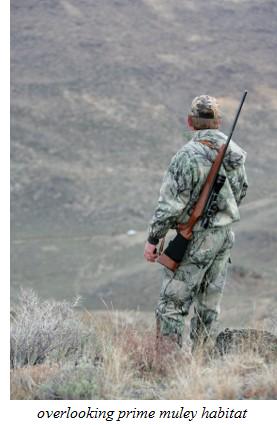
During early seasons, trail watching isn't very productive. Again, due to the vast country mule deer inhabit and the wide disbursements of mule deer, stand hunting would likely be a waste of hunting time. Unless conditions are optimum, concentrate your efforts on the more productive methods of locating deer.
The most popular and successful method of hunting mule deer is still-hunting. In broadest terms, this method could take the form of walking, driving your vehicle or hunting from horseback. The key is to move slowly and cover ground, regardless of your form of locomotion. This is where binoculars are worth their weight in gold. Ninety percent of your time should be spent glassing, covering those limitless distances with your eyes, rather than on foot. This type of hunting requires an intimate knowledge of your quarry.
Use much of the same caution and skill necessary to whitetail hunting. Hunt into the breeze, move slowly and noiselessly and correctly interpret wilderness signs and sounds. One of the best rules for mule deer hunting is to gain elevation. Find the highest point in your area and make an effort to stay as high as possible. Mule deer, like other big game species, see danger better while looking down and retreat from danger by climbing. Therefore, the best technique is to hunt down on them.
Hunting from above has many advantages - you can see better and approach closer. Since deer watch for danger from below, they'll stop on the upper side of trees and brush, exposing themselves to you. Also, the old bucks will be found at the upper limits of their range. Does, fawns and small bucks will be at lower elevations. Hunting high gives you the advantage of being on par with the big bucks, which are generally not threatened by the hunter moving other animals upward.
When hunting tangled canyon bottoms from a high ridge, you often can move game by rolling a heavy rock downward into the brush or trees. Another good way of making game disclose its presence is to throw a rock into such brush patches and tree groves or if you have a stout arm, throw a rock across a gully to the opposite side. The noise and commotion will of this diversion will often scare hidden game towards you or at least into a more visible spot.
STALKING THE MULE DEER
The farther hunted game is from you, the slower it reacts to danger and retreats. Stalked whitetails explode from heavy cover at 50 yards on a dead run; a mule deer that spots you at 200 yards is more apt to take a good look, leave at a slow trot and likely pause before disappearing over a ridge. This alters the necessary speed of getting into action and allows you to form a strategy.
When deer are located, make your stalk utilizing cover to get close enough for a shot. Mule deer are relatively unexcitable; use the same tactic. Continue to stalk slowly even though your trophy may have trotted over a ridge. Chances are good that once you're out of sight, you're out of mind and you may relocate your quarry just over the next rise.
THE RATTLING, CALLING & THE USE OF SCENTS
Rattling, calling and the use of scents are not normally used when hunting mule deer - the animals are just too spread out. Although any one of these ploys could spell success for you in the right circumstances, spend your time wisely. Don't use a strategy that has little chance for success and keeps you waiting for an opportunity that will likely not come.
Like pronghorns, mule deer prefer open spaces. They are most often spotted at a distance by the observant hunter, rather than being drawn in by artificial means.
3. RIFLES, CARTRIDGES & OPTICS
REQUIREMENTS OF A MULE DEER RIFLE
The choice of a mule deer rifle depends on a number of factors: age, weight, eyesight, shooting skill, physical condition and cover encountered. It also depends on whether you hunt for trophies, for meat, on horseback or on foot. Another prime consideration should be what other larger species of big game could be encountered besides mule deer.
A gun's overall weight should not exceed 1/20 of the hunter's weight. If your physical capabilities limit your ability with a rifle to 200 yards, then there is little need for a rifle-cartridge combination with 400-yard potential. You're better off with a lighter weapon having less recoil. The kind of deer hunted also influences your choice of a rifle. Doe's and young deer for the skillet are usually shot at closer range than wise old bucks.
Any rifle for hunting mule deer should also have crisp trigger-pull. Unpredictable trigger-pull will cause you to deviate from your aim and miss those long shots that often present themselves. Rifles should also be equipped with a sling and fit well.
CHOOSING THE RIGHT CARTRIDGE
A prime consideration is the type of terrain you'll likely encounter. If cover is expected to be dense, then a cartridge with a large bullet diameter and lot's of energy is the right choice. In open country, cartridge's with smaller and flatter-shooting bullet's are better.
Generally speaking though, the right cartridge for average mule deer hunting should be a high-intensity cartridge with high velocity and capable of fine accuracy. The bullet should feature good sectional density (for retained velocity at long ranges) and weigh from 100 to 180 grains.
The minimum caliber should be .243 and the maximum need not exceed .30 caliber. Of course, this will be influenced by other big game hunted at the same time.
Our choices for availability, reliability and ability to do the job are listed below:
| CARTRIDGE |
BULLET WEIGHT |
COMMENTS |
|
|
|
| .243 Winchester |
100 gr. |
Low recoil / high accuracy |
| 6mm Remington |
100 gr. |
Similar to .243 Winchester |
| .25/06 Remington |
120 gr. |
Open country / long range |
| .257 Roberts |
117 gr. |
Suitable, but not common |
| .270 Winchester |
130 gr., 150 gr. |
Hits hard, excellent all-round |
| 7 mm Remington Mag. |
150 gr. |
Extreme long range |
| 7mm-08 Remington |
140 gr. |
Very accurate |
| .300 Savage |
150 gr. |
Not common, adequate |
| .30/06 Springfield |
150 gr., 180 gr. |
Heavier recoil, versatile |
| .308 Winchester |
150 gr. |
Accurate, solid choice |
Five of the best all-around cartridges for mule deer in fairly open country, under all hunting conditions, are the .25/06, .270, 7mm Magnum, .308 and .30/06.
OPTICS FOR MULE DEER HUNTING
You'll usually have a better opportunity for a deliberate shot when hunting mule deer than when hunting whitetails. Ordinarily, muley's are located farther off, and either standing or moving slowly. Use a scope sight. Scopes for mule deer should be of high quality, rigidly mounted and of medium power. A 4x scope is perhaps the best all-round magnification, with the 6x a suitable alternative.
Variable scopes are fine, especially where more than 4x or 6x is needed. Also, there are reticles that work better than others for mule deer hunting. Some are used for range finding, some have post-and-crosshair combinations, but one of the best configurations still has to be the duplex style.
Regardless, any scope used should have a heavy reticle - it is more easily seen in low-light situations. The mule deer rifle must be sighted in prior to the hunt. Your sighting-in range should be 200 yards.
4. SHOT PLACEMENT
MAKE THAT FIRST SHOT COUNT
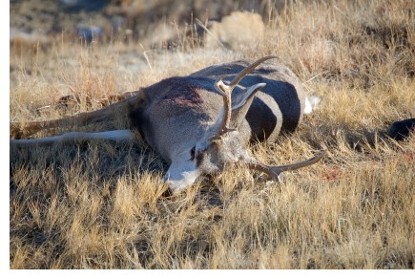 After waiting months and sometimes years for that shot on a trophy mule deer, it is your responsibility to drop that deer quickly, cleanly and with a minimum destruction of meat. Do not attempt to shoot if a good shot is not possible. Running shots, rear end shots and gut shots should be avoided at all costs. More often than not, if a stalk is well executed or you hold off shooting until the animal's position is optimum, the opportunity to call your shot should occur - but only if you're patient. After waiting months and sometimes years for that shot on a trophy mule deer, it is your responsibility to drop that deer quickly, cleanly and with a minimum destruction of meat. Do not attempt to shoot if a good shot is not possible. Running shots, rear end shots and gut shots should be avoided at all costs. More often than not, if a stalk is well executed or you hold off shooting until the animal's position is optimum, the opportunity to call your shot should occur - but only if you're patient.
The best area to aim for on mule deer is the lungs-heart area, just behind the front shoulder and just below the middle point of the animal. Any properly constructed bullet from .243 caliber or larger that misses the exact spot by a few inches in any direction will still kill the animal quickly and humanely. Head and neck shots are tricky at the best of times. There isn't much to shoot at, although if your aim is true, a solid hit will certainly do the job.
Keep in mind most shots are at a fair distance and in unpredictable field conditions. You would be prudent to try for a larger target. Spine shots are deadly - the animal generally drops in its tracks as if poleaxed. Shoot too low though, and a lot of good steaks are going to be ruined.
WOUNDED MULEY'S
Although it's never your intention to wound an animal, it happens. Watch for the reaction of a hit deer. If it drops, immediately chamber another round, stay where you are and watch for further movement. Keep the downed animal in your scope until you're sure it's down for good.
If the animal runs off after obviously being wounded, stay calm and watch its departure route. Wait a few minutes, then carefully take up the trail. On the open prairie, check out any cover that may appear.
Any wounded deer should be approached slowly, with your rifle at the ready. Come in from a direction above and behind the animal. Mule deer are strong for their size. Antlers and the sharp hoofs of a wounded buck can seriously injure or even cause your death. Always finish off a wounded animal with a bullet - never try to cut its throat.
5. BLACKTAIL DEER
A BRIEF DESCRIPTION
For some years now, there has been confusion over the term blacktail. The reason is simple - all mule deer were once called blacktails. When Columbia and Sitka deer were recognized as a separate species, the name "blacktail" was bestowed upon them and the name "mule" was given to the inland branch of the family.
In some respects, the blacktail resembles both the mule deer and the whitetail. On average, a blacktail is midway in size between its two cousins. Bucks weigh from 150 to 200 pounds. Whitetail buck's do not normally reach this size. On the other hand, big mule deer bucks found in British Columbia weigh close to 400 pounds.
The antlers of the blacktail fork instead of all points coming from a single beam. Ears are larger than the whitetail's but smaller than those of the mule deer. Its metatarsal glands are midway in size between those of the other two species. Both the mule and the blacktail have a black patch on the upper part of the face. The tail is black on top and white on the underside.
RANGES
The range of the blacktail lies in a thin strip of country generally following the coastal slope along the Pacific Ocean. The blacktail is found as far south as the middle of California and ranges northward to the islands off lower Alaska. The depth of this strip is normally not great, but does reach inland as far as the Washington-Idaho boundary at the Canadian-U.S. border. Columbia blacktails utilize the vast majority of this range, while Sitka deer are restricted to a narrow coastal strip and some of the offshore islands at the northernmost limits.
HUNTING THE BLACKTAIL
If you really want to experience the challenge of blacktail hunting, try the following exercise prior to open season. Go with a hunting partner into typical blacktail habitat. Post your partner in a given location, while you circle out of sight to a position several hundred yards away. Then, the fun part is to see how close you can come to your partner's position without being detected. Keep in mind that a deer's senses are much keener than those of your hunting partner. Use any strategy you wish.
Whether you succeed in sneaking close enough to get a shot off in a hunting situation isn't really the issue. What the exercise will do is give you some idea as to which hunting techniques will work and those that will not. It will teach you that stalking deer in heavy forest and dense brush will tax your outdoor skills to the absolute limit.
Blacktails are similar to wary old mule deer bucks in their survival strategies. Usually, they will detect you at a considerable distance and run off immediately; depending on sheer distance to escape the danger you represent. On the other hand, they may just lie low in thick underbrush until you have passed. When hunting trophy blacktail's, look for animals away from the herd. Unless the rut is on, blacktail bucks will generally be found a bit removed from the does - and in the more inaccessible places.
In warmer areas of their range, blacktails move from brushy canyons during midday to higher ridges where breezes cool the air. Areas near water are also sought. Blacktails actively pursue cooler temperatures when the sun reaches its apex. In colder climes, crusted snow on the ground causes unavoidable noise. In this situation, stand hunting will be more productive than still hunting.
Good places to hunt are known game trails and ridges where there is encouraging sign. Heads of canyons, and especially the low saddles and passes in hills, are prime blacktail activity areas. Look for those locations where game normally crosses from one canyon or basin into the next unless pushed out of its normal behavior pattern by hunters.
Unlike the mule deer, blacktails are not necessarily found in proximity to higher elevations. Their main requirements are thick tangled cover, a food supply, water and a cool spot to bed.
Hunting from a "blind" near a spot where game is known to pass is gaining in popularity. These blinds are not usually permanent, elaborate affairs. What you want is a simple place of concealment. Clumps of brush, piles of fallen timber, log jams and natural foliage work fine, even if you need to do some arranging for convenience and utility. When rearranging natural blinds near a deer runway, do it at least two or three weeks in advance of the season. This allows game to become comfortable with any changes to its environment and dissipates any man-smell.
More and more hunters are wearing camouflage clothing. Although the danger from other hunters is greater, its value is worthwhile. Camouflage clothing can be purchased at army surplus stores and manufacturers of outdoor clothes also supply it. In autumn, use the brown and green pattern, but when snow covers the terrain, white coveralls provide good concealment - and wear red, regardless of the camouflage you choose.
Hunting with a partner can be extremely productive when pursuing blacktails. One takes the bottom of a canyon or small basin, while the other hunts along the rim or ridge above. Each of you can skirt opposite sides of a large canyon. In heavy cover hunting situations, a partner will more than double your advantage. Two separated hunters can view more country than one. Also, any game that suspects the presence of one hunter may expose itself to the other hunter while trying to avoid detection.
RIFLES AND CARTRIDGES
The most important consideration in choosing a rifle for hunting blacktails is that it is handy. You must also be entirely familiar with it. As you will mostly be hunting at closer range than with mule deer, opt for a shorter rifle that can withstand the humidity and rigors that are common to blacktail hunting.
For the most part, the same cartridges named for mule deer are satisfactory for blacktails. Put the emphasis on its brush bucking ability and retained energy. It doesn't take a lot of power in a cartridge to kill a blacktail deer. You just want the bullet to reach the animal. A lower-powered variable or fixed 4x scope should complete your package.
6. CONCLUSION
FUTURE MULE DEER AND BLACKTAIL HUNTING

Subjected to similar pressures of the whitetail, the mule deer has not adapted as well. For the most part, this species has left its ranges east of the Rocky Mountains and moved into the rough, broken country of the West. Hunting, habitat loss, settlement, over browsing by domestic stock and climatic factors have all acted to greatly reduce mule deer numbers.
Their story has been one of dramatic population fluctuations. Numbering around 5 million in North America prior to the arrival of the first Europeans, only about 500,000 animals were present in the late 1800's. By the mid-1900's, populations had increased dramatically. Unfortunately, remaining suitable habitat was unable to support these increases. After alarming declines in the 1960's and 1970's, numbers have recently stabilized at a higher level. Recent population estimates are around half of their original numbers. The species is still absent from parts of its former range in the East and Mexico.
Blacktail populations face many of the same problems as those of whitetail and mule deer herds. The wolf, cougar, and man are three of the blacktail's greatest enemies, although wolves have greatly decreased in number. Cougar numbers are not large, but adults do kill an average of one deer a week. Deer hunters are on the increase. The good news is none of these enemies has succeeded in moving the blacktail deer from its coastal habitat.
The blacktail likes a humid climate and thrives in areas of heavy, lush vegetation. As well, this forest-loving deer actually prefers to live in areas of first and second growth common to ongoing planting-and-harvesting lumber operations. New, shorter growths admit sunshine into the logged-out areas and promote the rapid growth of the best deer foods.
Game departments do a fine job of managing current herds. Mule deer hunting will be good in the future, but more controlled. Populations are determined by available winter ranges. Surplus animals will be harvested according to the number of mule deer a specific area can support.
|