|

The North American bears are among the our most highly prized big game animals, and a large measure of this appeal is based on their record of being dangerous. In an encounter with any species of bear the element of danger lends excitement and an intriguing glamour to the hunt. And no other North American big game animal has more appeal to our imaginations than the smallest of our continent's bears - the black bear.
The black has always been our most adaptable bear. In its ability to thrive in varied habitat and climatic situations, this bear in some ways might be compared to the whitetail. For us who hunt it, photograph it, or merely try to observe it in the wild, it demands a healthy respect. Always the unpredictable one, it is certainly one of the most interesting of all North American game animals.
1. ABOUT BLACK BEARS
A BRIEF DESCRIPTION
There are four major species of North American bears: the black, grizzly, polar and brown bear. The black bear, while closely related to grizzly and polar bears, has a distinctive profile and face. Compared to the grizzly, its face is straight, not dished and there is no distinctive hump at the shoulders. On a healthy specimen the coat has a glossy sheen. The animal's weight is carried on the soles of rounded feet that are armed with short, stout, well curved, non retractable claws. Black bears are powerfully built with heavily muscled limbs, a very short tail and a massive head. Often the teeth show signs of decay. While it looks somewhat ungainly, especially when fat prior to denning, it can easily outrun a person. This bear is not naturally aggressive, but sometimes can be dangerous.
Black bears vary in weight with adult males ranging from 200 pounds to over 400 pounds. Exceptional specimens can weigh 500 to 600 pounds and more. Females are generally lighter on average by about 20 percent. An average adult stands just under 3 feet at the shoulders and is approximately 2 1/2 times as long as it is high.
As its name implies, this bears fur is generally black, although various color phases do occur in different geographical areas. In its eastern range of Canada and the United States the bear's coat is glossy black, with or without a white area of varying sizes on the chest. The muzzle and part of the eye area are a paler brown.
Again, in the Western United States, Canada and the state of Alaska the basic color is black, but occasionally a brown-colored cub may appear along with its black litter mates. When first discovered, the brown and tan bears were thought to be an entirely different species entirely. Eventually though, it was discovered the cinnamon to brown to tan to occasional blond color phases commonly found are simply color phases of the same bear. An interesting fact 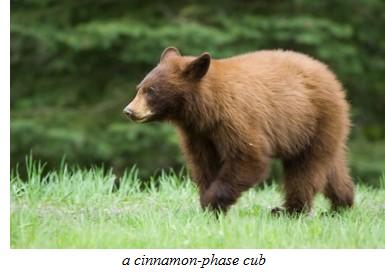 is that very few tan or brown colored bears have ever turned up in the eastern half of the continent. is that very few tan or brown colored bears have ever turned up in the eastern half of the continent.
It should be noted there are two rare black bear subspecies that are not black. The blue or glacier bear is found among numerous glaciers, in rugged mountains, along an area of coastal Alaska. Elusive and retiring, its color runs from smoky bluish-gray to dark iron-gray with a brownish muzzle. Kermode's bear lives in a very restricted range on a few islands off west-central British Columbia. Not an albino, it has a white coat, grayish-beige muzzle, claws that are often white, reddish-brown foot pads and brown eyes. Both subspecies apparently breed true.
Scientific name - Euarctos americanus
Subspecies - 18 subspecies are found in Canada, Mexico and the United States
The 8 subspecies identified below are the most recognized.
- American black bear
- Olympic black bear
- New Mexico black bear
- California black bear
- Cinnamon bear
- Florida black bear
- Newfoundland black bear
- Louisiana black bear
RANGES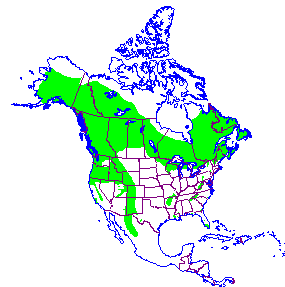
The vast range to which the animals have adapted over thousands of years takes in almost every possible mixture of terrain and climate. Climate is apparently no barrier, and nor for the most part is altitude. Blacks are common in many places in the Southeast in near-sea-level swamps, and also at 6000 and 7000 feet in mountainous terrain. They have even been seen much higher, to 9000 feet and higher, well up toward timberline.
The black bear is the most common and widespread of North America's 4 species of bears. Its range includes all wooded portions of Canada and Alaska, as well as large areas in the continental United States. They occur in a large area coincident with the Rocky Mountains, reaching southward into central Mexico. The Pacific Slope from the middle of California northward to Canada, large areas of the Northeastern States, around the Great Lakes, and an extended region of country along the Appalachians is home to this wide-ranging animal. Spot areas in the Florida Everglades, Mississippi, Louisiana, Alabama, the Carolinas, Virginia and New York hold populations of blacks as well. Of the states, Alaska has the most black bears with an estimated population of 80,000. The states of California, Maine and Washington all have black bear populations in excess of 20,000. Colorado, Idaho, Michigan, Minnesota, Montana, New Mexico, North Carolina, Oregon and Wyoming all have considerable numbers. In Canada, substantial populations are found in the Yukon and Northwest Territories. British Columbia, portions of Alberta and Saskatchewan, Manitoba, Ontario, Quebec, New Brunswick and Nova Scotia hold good numbers. Newfoundland and Labrador have some animals.
The proximity of large carnivores and the well-being of people are seldom in harmony. Consequently the black bear has suffered population and range reductions, especially in the southern regions. It has been eliminated from much of the midwestern and eastern states. The most important influence on populations was the clearing of forests, which drove the black bear from a tremendous amount of its original range. In need of roaming and foraging room, the black bear must have fairly large blocks of unbroken forest or wilderness in order to survive.
In general terms the black bear inhabits forests, swamps and shrub thickets, but occasionally wanders onto the tundra and mountain meadows, particularly if grizzlies no longer occur in the area. Except in parks, where it becomes accustomed to people, the black bear is shy and seeks out inaccessible country. It is able to sustain itself in a remarkable variety of plant communities; for example, beech, maple, spruce, fir, black spruce, jack pine, redwood, sitka spruce, western hemlock, lodgepole pine, ponderosa pine, oak, hickory, chaparral, pinyon, juniper and cypress forests are all home to this remarkable big game animal.
Home ranges of males vary from 2 square miles to 20 square miles, while those of females are much smaller at one to 2 square miles. The ranges of males seldom overlap, while females may overlap both males' and other females' ranges. Most movements of the black bear are directly related to its daily search for food; if there is an abundance, a bear may stay within as little as a square mile of range, but only as long as times of plenty last. Much of the time its wanderings will encompass at least 5 or 6 square miles - in times of scarcity at least double that or more may be necessary.
Even though black bears apparently like to travel and wander, there is no migration as such. They have no definite winter and summer forage preferences. Seasonal movement over any appreciable distance is not common.
This is a forest or woodland creature. Unlike the plains' grizzly that followed the buffalo, the black bear has never been able to adapt to completely open country. Unless there are expansive stream bottoms thick with timber and brush for it to follow, the black bear is totally out of its element..
FEEDING HABITS
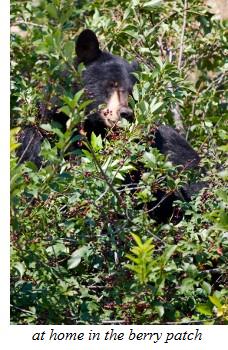
Although the black bear is classed as a carnivore, survival could not have been so successful if they had not adapted to a broad menu. A forage animal, they'll eat meat whenever they can get it and just about anything else as well. An opportunistic eater, they're not finicky.
They have developed a metabolism that can be fueled by just about any forage available. Though the black bear prefers animal food such as carrion, ants, grubs, frogs, fish and anything else it can grab, the majority of its diet is vegetation. The teeth are so designed that the large canines for seizing and tearing are complimented by flat-topped molars that serve as vegetation grinders. True predators geared to a meat diet only are extremely susceptible to decline, due to their inability to expand their range to places where its prey is meager. The black bear is a study in species survival.
Blacks leave the den in early spring. They live on a diet of clover, grass shoots and similar vegetation until their alimentary canals are again enlarged and conditioned for meat. During the summer months, black bears move widely in search of food. Seldom does a black bear go hunting for a specific kind of meal. It shuffles along, nosing here, nosing there, digging, clawing, ripping, overturning, sniffing, eating all it finds.
D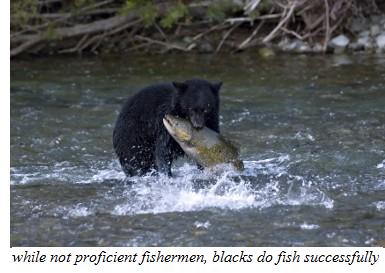 uring the spawn, black bears go after fish with a purpose. While by no means as expert fishermen as grizzlies, they are on occasion able to grab quantities near stream obstacles or where a smaller stream is brimming with them. For the most part, black bears take spawned-out salmon, dead or dying, and others trapped in shallows, where they are easier to catch. uring the spawn, black bears go after fish with a purpose. While by no means as expert fishermen as grizzlies, they are on occasion able to grab quantities near stream obstacles or where a smaller stream is brimming with them. For the most part, black bears take spawned-out salmon, dead or dying, and others trapped in shallows, where they are easier to catch.
They love sweets. Black bears raid bee trees in the wild and destroy apiaries. Fruit and berries in season are eaten with relish. Orchards are a prime target. Vegetable gardens and certain crop fields are also on a bears favored list. Grasses of endless variety, clover, sapwood, buds, sweet corn, melons, tomatoes, pumpkins and fields of barley or green wheat are sought. Wild nuts such as acorns, beech nuts and others are rich in fat and oil. Nuts help bears put on layers of fat before denning.
CHARACTERISTICS
The black bear has been able to adapt well to man's presence. As animal traits go, this bear likely has more intelligence and cunning than its larger relatives, but is clearly a shy creature, with an uncanny capacity to retain its privacy. Its ability to survive on the very edges of man's communities is in many ways like the whitetail deer. Today black bears live short distances of very large cities, where habitat is suitable and food available.
The most highly developed sense of the black bear is smell. It is important a bear pick up scents at long distance due to the cover it favors. This keen sense of smell is also important in locating a diversity of food. Hearing is also very good. Among bears, the black has the largest ears and extremely sharp hearing. Again, this sense was probably developed to a high level because the animal lives and hides in heavy cover. The black's eyesight is poor. While it sees movement readily, it cannot quickly identify motionless objects unless it can smell them. With its daily foraging, extra-sharp eyesight is not any great advantage, as in cover it cannot see far anyway.
Ordinarily a quiet animal, blacks utter vocal sounds when irritated, breeding or communicating with their young. Large bears may bawl or roar, snuffle or make grunting sounds. When suspicious, a black will rear up on its hind legs and grunt. When a black begins to cough, growl and snap its teeth together, prepare to back off. The bear is going to come at you - with purpose. A wounded black on occasion utters a hair-raising moan. Cubs may let out little bawls when scared, and whimper and whine to their mother. Black bears do not constantly make vocal sounds - you can travel through bear country for many years and never hear a snort.
The black bear is a solitary creature except when breeding, rearing young, or when attracted to an abundant source of food. Big boars are inclined to stay in the thickest, most remote cover, except for the occasional foray. Blacks are intelligent and show great interest in exploring and examining new objects, especially if they smell edible. Unpredictable, black bears also display a great capacity for destruction. They appear to take great pleasure in wrecking anything that may contain food. They'll root through garbage, rip tents, smash coolers, bite cans and break into remote cabins.
Humans, the grizzly, and wolf packs are the only predators capable of threatening adults. Cubs at times stray too far from their mother and are killed by male black bears and cougars. Generally a female black sends her offspring up a tree if danger is sensed. In territory where grizzlies occur on the same range, they do not tolerate blacks. Any black bear that sees or smells a grizzly flees. Thousands of black bears are slain yearly by hunters and trappers as they are a nuisance to agriculture and campers.
Black bears are strong swimmers as well as excellent climbers. They have short, closely curved claws that cling to bark expertly. An adult black, when pressed, can shinny up a tree at almost running speed. Coming down a tree, the bear has to move rear end first, sliding and grabbing with its claws. It is not uncommon for a descending black to let go a few feet above the ground and plop down.
The black bear has several different gaits. It rambles along flatfooted in a rolling, almost aimless manner. It also walks swiftly, head swinging, or at times breaks into a swift gallop. Going all-out for short bursts, a running bear may reach 25 or 30 miles per hour. Its slower gallop covers much ground and can be maintained for great distances.
DENNING
Foraging increases during late summer and autumn, when the animal may put on 2 pounds or more of fat per day in preparation for winter denning - an extra 100 pounds is common, and twice that in northern areas is not particularly rare. Individuals have been known to travel 100 miles to reach a new source of food. When temperatures approach freezing, the bear becomes less active. As a prelude to hibernation, it feels too dull and drowsy to eat for a few days. During that short fasting period the entire digestive system is mostly emptied to accommodate winter inactivity.
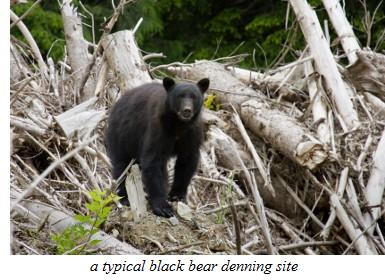
The black bear seeks out a den in late fall, usually around November. This depends upon altitude and weather severity. Black's in southern climes, undoubtedly with instincts dating back to the early evolution of the species, may go into a den for only a week or so, or intermittently, during winter. This season is a time of scarce forage.
Adults enter hibernation first, as early as mid-October in the north and as late as January in the southern United States. Dens may be a cave, burrow, thicket, blowdown, tree cavity, under a fallen log, hay stack, or simply a hollow in the snow. The animals don't eat, drink, urinate or evacuate their bowels during the winter. The intestine is blocked by a plug of digested food until spring.
In the North, black bear's show no regular arousal periods; however, in southern regions' individuals sometimes become active for short periods on warm winter days. The body temperature drops slightly and its breathing rate is slightly slowed. Strangely enough, the old callused layer of skin on the foot pads is shed while the bear sleeps through the winter. Hibernating blacks are not impossible to arouse. Jarring or pounding around the den will cause them to move. The animal emerges from mid-March in the south to early May in the north. Up to a quarter of a black's weight will be lost through fat utilization. As food is relatively scarce at this time of the year, the bear tends to roam widely. Two to four weeks after emerging from hibernation the black bear's fur is rubbed and shaggy-looking. From then until late fall, before the animal has again fattened up for hibernation, its coat is no good for a trophy. Early spring and late fall are the best times to hunt black bears for trophies.
REPRODUCTION AND GROWTH
Female bears come into heat every second year in June or July, occasionally late May or mid-August. During that period, a male may stay with the same female for several weeks. Unlike other times of the year, mating bears become quite affectionate. Embryos cease developing at an early stage, to resume again in late November or early December when the female is denned up cozy and warm.
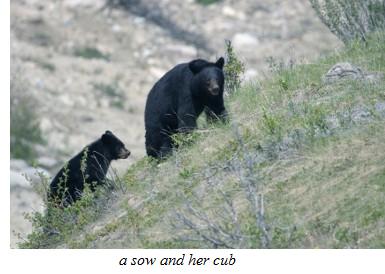
Usually 2 cubs (one to 5) are born in late January to early February, while the female is still inactive. This allows the female and her young to wait out the winter and the coming of spring forage. Twins are common and triplets not uncommon. The gestation period is 7 to 9 months, but most growth occurs in the last 6 to 8 weeks prior to birth.
The young are extremely small - only 8 inches long and 6 to 8 oz in weight and largely undeveloped at birth. Most unusual is the placing of a mothers' teats. Two are located between her hind legs and four more are on her chest. This probably is to facilitate the tiny cub's ability to find milk, as they are born to a less than alert mother. The black coat appears in several weeks but the eyes do not open until 6 weeks of age. The family emerges from the den from late March to early May. Early in their lives, cubs become agile tree climbers - scurrying up the nearest tree at the first hint of danger. A boar bear that happens by has no compunction about killing a cub, but woe to the one that tries it. The mother flies into a violent rage and will fight instantly.
The cubs need their mother's milk until mid-summer and are self-sufficient by autumn; however, most remain with the mother until the following spring or summer when the mother comes into heat and adult males appear on the scene. Full size is reached at 4 years of age. Sexual maturity of females may occur from 2 to 5 years, but usually within 3 years. Lack of food crops such as berries and acorns can delay sexual maturity or results in a smaller litter size or even postponement of breeding. Males begin to mate at an age of 5 years, but only live for an average of 3 to 5 years, females for 5 to 8 years. Few will reach 10 years, and the maximum life span is 26 years in captivity.
DAILY ACTIVITY
 There is a question as to whether black bears move mainly by day or by night. It has been shown all bears move whenever they please. Blacks are active at midday, midnight or dawn. Although the last hour of daylight is invariably the best hour of hunting, bears are also found scrounging around on a slope during late morning if they feel like it. This species is most active for several hours just after dark and before dawn, but it is not unusual for a black to be out hunting in the day or throughout the night. There is a question as to whether black bears move mainly by day or by night. It has been shown all bears move whenever they please. Blacks are active at midday, midnight or dawn. Although the last hour of daylight is invariably the best hour of hunting, bears are also found scrounging around on a slope during late morning if they feel like it. This species is most active for several hours just after dark and before dawn, but it is not unusual for a black to be out hunting in the day or throughout the night.
After its belly is full, the black bear makes a bed and will doze for several hours. The bed may be in a thicket of brush, under blowdowns or just anywhere that is comfortable and secluded. While they range in the same general area, blacks do not habitually use the same bed more than once.
2. HUNTING THE BLACK BEAR
BEWARE THE BEAR!
Your exposure to potential danger when dealing with black bears depends on whom you talk to. Even though blacks are shy and evasive and would rather run than stand and fight, statistics indicate more people have been mauled and killed by blacks than by any other member of the bear family. While this may be because there are more blacks over a much greater range, it should convey a strong message.
One of the reasons we do not generally see the black bear as a threat is the image we often see. Smoky with his friendly messages, children's teddy bears, the "tame" bears encountered in our parks give us no idea as to how strong and fast a bear can be.
Black bears are not very aggressive unless cornered or wounded - the species is not known to be especially irritable or quick-tempered. The wild card is that blacks are totally unpredictable. When aroused, a black bear displays several threatening gestures. This could include a moan, blowing sound, extension of the lips or lowering of the head and ears, usually followed by a charge.
The real danger comes when the black bear attacks. While the grizzly rears up to swing and swat with its forearms and rake its opponent with its claws, a black bear charges its antagonist on all fours like a dog. Swiping blows with the forearms and furious biting with formidable teeth causes a lot of damage. Clamping jaws onto its victim, the black bear will hang on tenaciously, biting deeper until the opponent is dead or disabled.
Understandably, sows with cubs are extremely excitable and often vicious. Placing yourself between a sow and her cubs is one situation you want to avoid. Old bears, injured bears, even very hungry bears, are irritable and ill-tempered. A bear startled at close range may launch into a protective rage. Any black bear deserves respect as potentially dangerous. They certainly have the equipment to cause you a lot of grief.
LET'S FIND BLACKS
Hunter's always get excited when they spot fresh bear sign during a hunt. Most of the time however, all it will tell you is that a bear has been in the area. Because a black bear has an uncanny ability to keep out of sight, it's not likely you'll spot the animal. Keep in mind it is not so much the specific type of habitat that keeps black bears in a region. Blacks rove over a large block of country, need a large amount of forage present and stay in the vicinity of snarled thickets.
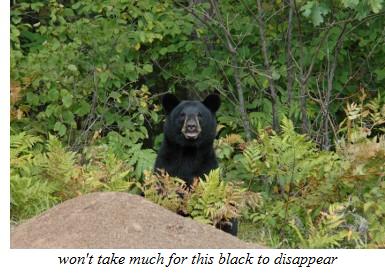 Probably 90 percent of black bears taken annually are bagged at random by hunters after other big game - bear season just happens to be open. Because deer and black's commonly use the same ranges, deer hunters collect most of them. Even though the majority of black bear hunting is not done intentionally, thousands of hunter's do score regularly. Probably 90 percent of black bears taken annually are bagged at random by hunters after other big game - bear season just happens to be open. Because deer and black's commonly use the same ranges, deer hunters collect most of them. Even though the majority of black bear hunting is not done intentionally, thousands of hunter's do score regularly.
While black bears do occasionally venture from the forest into open areas, this animal requires cover - with at least portions of it dense. This includes a broad diversity of range. Depending where you hunt for blacks, this might be swamp, mountain forests and meadows, heavy black timber or mixed woodland. Your best chance at spotting a black is to hunt the edge, where open areas meet thick cover.
Food is key to locating blacks. Choice areas to hunt black bears are berry patches, abandoned orchards, barley fields, campsites and game trails running parallel to rivers and creek bottoms. Alder and willow tangles along any water, standing or running, is invariably used heavily by bears in their home territories. In mountainous regions, river channels and the grassy slopes adjacent are favored by this animal.
The remains of game-kills often produce a bear, if you can get there before the mob of scavengers that are inevitably drawn to a kill. Often black's raid remote ranches or camps for garbage, poultry or even livestock. These bears gain a reputation as pests through such raids and tend to hang around the area. It's not easy to discourage a black from exploiting a convenient food source. As a result the bear is usually captured and relocated or killed.
In spring, bears are hunted as they emerge from hibernation. Seek out any patch that has been cleared of snow and the first blades of grass have appeared. Bears eat these tender green shoots to recondition their digestive systems after the inactivity of hibernation and are often found on these patches.
A bear marks its presence plainly as it occupies and forages over a specific territory. Tracks reveal themselves in mud, dust and snow. The only track a black bear print might be confused with is that of the grizzly. The difference is, a black has smaller claw marks and the hind foot is up to 4 inches wide and 7 inches long - a grizzly's track is much larger and the stride is longer.
Watch for sign on the trunk of trees. When a bear climbs a tree, each claw sinks into the bark. These eventually show as dark scars on a lighter colored bark. If tree scars are abundant they may indicate that this is prime bear country and a search for fresher sign could be called for. Rotten stumps or logs will be shredded where they've sought ants and grubs. Broken limbs on fruit and berry trees indicate where black bears have been foraging. Look for droppings. In the springtime, while the bears are feeding on new growth vegetation, scats are left in large piles. Once a bear is on more solid food, the droppings will be firm, 1 1/2 inches in diameter and in pieces several inches long. Again, bears are great travelers. Don't spend at lot of time working a single area unless you have bait set out. Keep moving. Boars and sows are not generally found together except during mating season. Bears are not known to be sociable animals except in special situations, such as a spawning run. They are brusque individualists and any adult bear seen is prone to be alone.
Methods of hunting black bear vary widely from state to state and province to province. In some areas no hunting is allowed using dogs. Other zones allow baiting, but not with an old horse or cow destroyed for that purpose. Stands can be productive in certain situation or even cruising back roads in remote country. Check your local game laws carefully prior to a hunt. Know what methods of hunting are within the law and make an effort to find out the most productive bear hunting tactics in the area you plan to hunt. You'll find the exercise is well worth your while.
DOGS AND THE CHASE
In some areas of the continent, black bear are hunted with dogs. The major reason for using dogs is the nature of the habitat encountered. The terrain and foliage are such that a hunter without dogs wouldn't stand a chance at bear. A pack of tough, highly specialized hounds is required for bear hunting. Hunting with dogs makes for a dramatic, demanding hunt.
In some areas there is no dog hunting allowed and where it is legal, there are not many trained packs. Because a trained pack is the heart of this method, you will normally need to book a hunt with an outfitter to experience this type of hunt. If you decide this is the type of hunt you want, be careful of shady operators. Check references. It is fairly expensive and the outcome is rather uncertain.
If you decide to try this venture on your own, keep in mind the expense of training and keeping dogs. It also takes a lot of one's time and the dogs suffer a high mortality rate when a bear is coursed. Furthermore you need a location that has a large enough bear population to make it worthwhile. Do yourself a favor if this is the type of hunt you want and book with an outfitter who specializes in running bears with dogs. As well, bear are often hunted with dogs used for other game - such as cougar.
When bear are hunted with dogs, the animal is either run past the hunters, brought to bay, or put up a tree. This is one type of hunting where almost any legally used firearm is suitable. After the thrilling chase is over, shooting the treed animal is rather anticlimactic.
HUNTING OVER BAIT
Hunting over bait is one of the most successful methods of black bear hunting. This is done almost entirely in springtime, as soon as ravenous bears have come out of their dens. Baiting, or hunting over a natural bait, is not legal everywhere, and there are spring seasons in only a few states and provinces. However, if it's legal and you have access to good bear country, you can set this hunt up on your own.
Let's look at some different ways to approach baiting. First of all, locate a bait station and your downwind stand. This can be as simple as a clump of bushes with a clear view of your bait, to a tree stand in close proximity. A tree stand is well worth the effort. When conditions are right and you have a bear sneaking up to your bait, the elevation will feel that much more secure. It also gives a better field of view in typical overgrown and tangled bear habitat.
If it's allowed in your area, the bait can be an old horse or cow destroyed for that purpose and hauled in, or maybe a pile of freshly caught trash fish or perhaps even a dead big game animal that died during the winter. Garbage dumps - from winter lumber camps for example - that are abandoned before spring thaw are good bets for a bait location. Bears hang around them after coming out of dens, eating grass that sprouts in the area and digging in the dump for discarded food.
The best method of baiting is to use a barrel. Use a steel 45 gallon drum and cut two holes in it, one near the top and one close to the bottom. Make them large enough that a bear can just get a paw in, not their head. With two chains, secure the barrel tight to a stout tree trunk. For bait, fill the barrel with old bakery goods, molasses, jam, butcher shop discards, over-ripe fruit, fish guts and just about anything else you can get. Don't be too selective; bears aren't. Once you've filled your barrel with the concoction, fasten the top securely and leave it alone for a few days. If you have the time and resources, more than one set-up will give you a better chance at the bear you want. Some barrels will be visited, some won't, but once a bear has visited a bait barrel, it's likely to be back.
The best time of day to hunt over any bait is the last two to three hours before dark. Set yourself up in the spot you've selected and be prepared for a long and lonely vigil. The secret to success is your ability to remain absolutely still. Bears take a long time coming into a bait barrel; testing the air for scent, watching for movement, alert to any danger signs. They move noiselessly and with great stealth. Usually, the bear will be at the barrel before you're even aware of its presence. When you bring your rifle around, do it slowly and with great care. The slightest detected movement will send your trophy off instantly. It may take a couple of nights to bag your bear, but it'll be worth every minute.
THE FLOAT HUNT
Along the Alaska coast, blacks are hunted the same as browns along coastal rivers. A boat is used to cruise the shoreline. The same method can be used on inland rivers in just about any black bear country. This type of hunt can be very effective, especially early in the spring when the trees are just beginning to leaf out.
Timing is important; too early and the bears won't be out - too late and the foliage will conceal them. As long as you have a boat that can safely navigate the river you've chosen, you're in business. Try to pick a river that has long, gradual slopes running up from it - with heavy cover and numerous open meadows present.
To start your hunt, run upriver for two reasons. First, once you've reached a starting point, you can cut your engine for a leisurely float back to base. This allows you to hunt silently and glass the slopes constantly. When a bear is spotted, it's a simple matter to put in to shore and begin your stalk on foot. This will likely involve some climbing, but you're after game you know is there.
The second reason you always start your hunt upriver is in case of motor trouble or even the possibility of running out of gas. If your floating with the current, eventually you'll reach your camp. Down river from your home base is a long way back.
STILL OR STAND HUNTING
Still hunting for black bears, especially in fall, is largely wishful thinking. They are simply too wary. Even in spring when bears are really on the prowl, you cannot cover enough ground to be at the right spot at precisely the right time except by chance. Hunting along old logging or wilderness roads in spring is sometimes successful. Glassing slopes or hunting along stream channels may yield a bear, but even that possibility is remote.
Very rarely, a stand beside a well-worn bear trail may bring an opportunity. Even with a number of hunters spread out on stands in prime habitat where a bear may pass within range, you're generally wasting your time. Still hunting and stand hunting for black bears is usually a fool's game; however, if you still insist on still hunting or stand hunting, do it in front of a bait barrel.
3. RIFLES, CARTRIDGES & OPTICS
REQUIREMENTS OF A RIFLE FOR BLACK BEAR
The best rifles for this game animal are those most suitable for deer hunting. Any reliable bolt-action will handle most black bear hunting situations you'll find yourself in.
CHOOSING THE RIGHT CARTRIDGE
Cartridges suitable for deer hunting are usually adequate for black bears. Our choices for availability, reliability and ability to do the job are below:
| CARTRIDGE |
BULLET WEIGHT |
CARTRIDGE |
BULLET WEIGHT |
|
|
|
|
| .25/06 Remington |
120 gr. |
.284 Winchester |
150 gr. |
| .264 Winchester Magnum |
140 gr. |
.308 Winchester |
150 gr., 180 gr. |
| .270 Winchester |
130 gr., 150 gr. |
.30/06 Springfield |
150 gr., 165 gr. |
| 7 mm Remington Magnum |
150 gr. |
.348 Winchester |
200 gr. |
| 7 mm-08 Remington |
120 gr. |
358 Winchester. |
200 gr. |
| .280 Remington |
150 gr. |
.444 Marlin |
240 gr. |
Often killed in timber and at relatively short range, large caliber, medium-powered cartridges may be included. Cartridges in the .257 Roberts, .243 Winchester, 6 mm Remington, and .30/30 Winchester class are a little light under most hunting conditions, but will perform well at close range.
OPTICS FOR BLACK BEAR HUNTING
The same applies to black bear hunting as to deer hunting. A good quality, low-powered scope from any recognized scope manufacturer will suffice. Binoculars are a must.
4. SHOT PLACEMENT
MAKE THAT FIRST SHOT COUNT
A properly hit black bear is not a hard animal to put down. They are thin-skinned and not particularly tough. Although your first priority with any of the larger bears is to anchor the animal, a well-placed lung or heart shot on a black will work just fine. Head and spine shots are difficult to make in most hunting situations and should be avoided if a better shot can present itself. As with its bigger cousins, such as the grizzly, breaking down the shoulders will quickly disable the animal. A lethal finishing shot can then be taken on an immobile bear.
WOUNDED BLACK BEARS
Other than with a solid hit in the shoulders, a wounded black that can move will move - at lightening speed into the thickest, most tangled cover available. As with any potentially dangerous animal, going in after a wounded black is not going to be high on your list of favorite things to do. This is one case where a fifteen minute break before pursuit is highly recommended. During your wait, reload your rifle, turn the scope down to its lowest setting and get your breathing back to its normal level. Adrenaline runs high at this time.
Proceed with extreme caution. Regardless of what you may believe about the danger of black's in general, this is now a wounded animal. Once hurt, blacks have only one aim and that is to stay alive - by whatever means available. Stay alert and carefully watch the ground and area ahead of you. Look for any telltale signs of a hit. Blood sprayed over ground cover, leaves, branches and fallen logs is the most obvious. Tufts of hair and overturned leaves where the animal has run are also good clues. If you lose your quarry's trail, scout out any black timber in the immediate vicinity. Often, a mortally wounded black bear will moan pitifully and give away the location of their hiding spot, usually under a tangle of windfall or behind a fallen log. Again, stay alert.
5. CONCLUSION
THE FUTURE OF BLACK BEAR HUNTING

Several factors will ensure good black bear hunting remains in the future. First, the black bear is an adaptable denizen of timbered forest lands. By nature a wanderer, lumbering operations do not disrupt its living patterns to any great degree - the bear simply leaves a disturbed area and travels until it finds a more suitable habitat. Second, the black bear is now considered a game animal in almost every state and province. Protected by game laws, black bear populations are now managed by competent wildlife agencies. Another factor is the widespread ban on killing of female bears with cubs at her side. As well, the taking of bear cubs is now largely prohibited. This all helps to increase the bear population. Black bear populations in some states and provinces have doubled since the turn of the century, with indications of future increase.
The species is certainly not in danger of disappearing from North America. However, in spite of its adaptability and furtiveness, the black bear has suffered serious population declines from large areas of its original habitat. In some cases, hunting pressure, chiefly hide hunting, destroyed bear numbers in spot areas. As civilization progressed and settlements established, all bears in close proximity were destroyed with a vengeance. Livestock of every description, from sheep to pigs to cattle to poultry had to be protected. Blacks are extremely fond of sweets. Bee keepers in many places such as Florida and northern Alberta always have had to take severe measures. A single raiding bear can put an apiary out of business in a single night.
The black bear is a superior and exciting game animal. Overall, even though black bear range is only a remnant of what it was in earlier times, this animal is not in peril. Numbers may be less, but the black bear will be with us into the foreseeable future.
|